


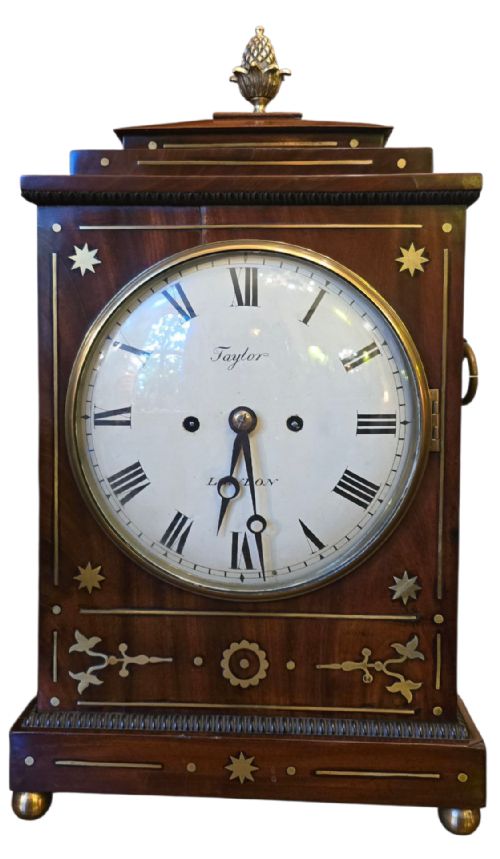


English Regency Period Clock
An English regency period clock brings precise mechanical movement and refined timber craftsmanship into a room.
English Regency Period Clock
An English regency period clock comprises mantel clocks, wall clocks, and longcase clocks produced across the Georgian and Regency eras. These timepieces display timber and metal construction from the early nineteenth century.
Bracket clocks and drop-dial wall clocks form the core of what appears on this page, housed primarily in mahogany cases. Many incorporate brass mounts, enamel dials, and wooden faces.
Makers working in London and regional towns such as Stroud produced these pieces utilising fusee movements and verge escapements.
How they were made
Cabinetmakers constructed the cases using solid mahogany, Cuban mahogany, and ebony, frequently adding brass inlay and gilt bronze mounts to the timber surfaces. Glazed bezels protected the enamel and wooden dials.
Clockmakers fitted chain fusee and verge movements powered by 8-day mechanisms to regulate time accurately.
One gilt bronze timepiece captures a cherub reaching eagerly for birds perched high in a tree.
What varies in quality
The refinement of the cabinetwork and the sophistication of the dial design separate examples. Pieces featuring intricate brass inlay, carved wooden details, or gilt bronze ornamentation stand apart from plain timber housings.
The reputation of the maker inscribed on the dial or movement influences the standing of a clock. Signed London movements by recorded makers carry distinct horological interest compared to unsigned provincial work.
L. Vick of Stroud·Taylor of London·FB Adams London·Baetens London·Fatton Eleve de Breguet London
The English Regency Period Clock Glossary
- Fusee
- A conical pulley used in spring-driven clocks to equalise the torque of the mainspring as it unwinds. This mechanism ensures consistent force is applied to the gear train.
- Verge
- An early escapement mechanism controlling the rotation of the escape wheel. It provides the regulating heartbeat of the clock.
- Bracket clock
- A portable table or mantel clock originating from the period when clocks sat on decorative wall brackets. They often feature carrying handles on top.
- Drop-dial wall clock
- A wall-mounted clock featuring a circular dial above a short vertical wooden trunk. The lower case often has a glazed door to view the pendulum.
- Lancet top
- A pointed, arched architectural case shape resembling a gothic lancet window. This silhouette appears on tallcase and bracket clocks from the era.
English Regency Period Clock: Frequently Asked Questions
Where did people place these clocks?
Bracket clocks sat on mantelpieces, tables, or specialised wall brackets in principal rooms of a house. Their portable nature allowed owners to move them between chambers.
Wall clocks hung in kitchens, hallways, or commercial spaces where employees or family members needed to check the hour quickly.
How do fusee movements work?
A chain or cord pulls from a conical drum to drive the gear train of the clock. This conical shape compensates for the weakening tension of the mainspring.
As the spring unwinds, the leverage changes across the cone to maintain steady power to the escapement.
What timber types appear most?
Mahogany serves as the primary timber for the cases, appearing in standard and Cuban varieties. Ebony and ebonised finishes also provide dark contrast.
Brass inlay and gilt bronze mounts frequently decorate these wooden surfaces.
How do I tell a wall clock from a mantel clock?
Wall clocks feature flat backs and hanging fixings designed to secure directly to vertical surfaces. Their dials often feature wooden faces rather than glass-covered bezels.
Mantel clocks stand freely on flat surfaces on bracket feet and typically house their mechanisms inside robust mahogany or gilt bronze architectural cases.