


English Pottery Dog Statues
English pottery dog statues bring the character of nineteenth-century hearths directly into modern rooms.
English Pottery Dog Statues
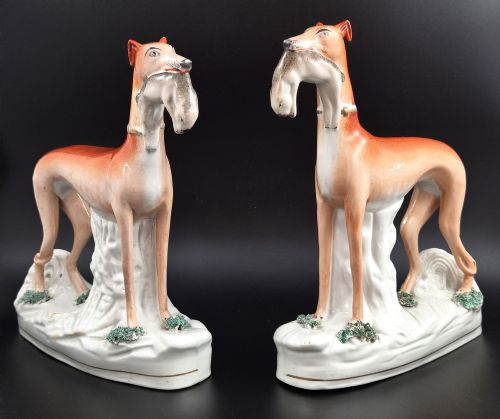
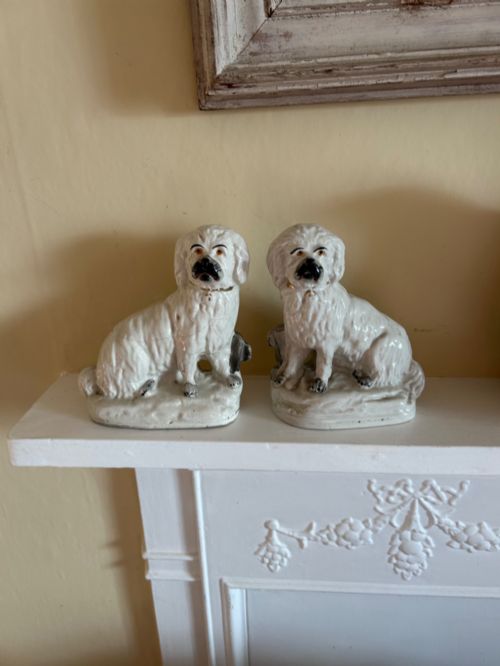
When you search for english pottery dog statues, you encounter decorative figures shaped as greyhounds, poodles, spaniels, and pugs. These ceramic pieces frequently appear in pairs designed to sit on either side of a fireplace mantel.
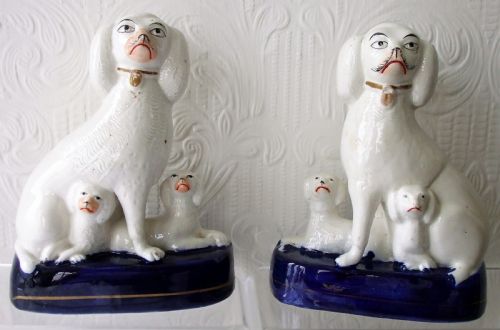
The selections on this page stem primarily from the Victorian era and the nineteenth century, including specific dates like eighteen eighty, eighteen sixty, and eighteen thirty. Figures range from simple greyhounds and spaniels to more complex groupings such as poodles with pups or children riding setters.
Originating largely from English workshops, these figures served as ornamental sculptures, though variations like greyhound quill holders also functioned as desk accessories. They capture domestic animal forms popular during the Georgian and Victorian periods.
Materials and construction methods
Makers formed the figures in ceramic moulds before firing and hand-painting the details. The resulting bodies received a transparent or coloured glaze to seal the earthenware.
Several poodles arrive complete with extra pups tucked safely beneath their ceramic paws.
Distinguishing quality in figures
The distinction between standard and superior pieces rests on the crispness of the hand-painting and the complexity of the subject matter. Single dogs generally demand less attention than matched pairs or multi-figure groups like poodles with pups.
Careful execution of facial expressions, enamel colouring, and gilding separates finer decorative figurines from basic production pieces. The inclusion of functional elements, such as inkwell or quill holder components, also alters the character of the object.
The English Pottery Dog Statues Glossary
- Earthenware
- A porous pottery body fired at a relatively low temperature and rendered watertight by a vitreous glaze. It forms the primary substrate for nineteenth-century figures.
- Enamel
- Opaque glass colours applied over the fired glaze and fixed in a second, lower-temperature kiln firing. It provides the bright coats and markings on the animals.
- Cobalt glaze
- A deep blue metallic colorant mixed into the liquid glass coating before firing. It creates rich dark tones on specific ceramic details.
- Quill holder
- A desk accessory featuring moulded channels or loops designed to hold writing feathers. Several greyhound figures incorporate this functional form.
- Figure group
- A ceramic composition depicting multiple subjects together, such as adult dogs with their pups or children alongside setters.
English Pottery Dog Statues: Frequently Asked Questions
Where were english pottery dog statues displayed?
These figures typically stood on mantelpieces in nineteenth-century homes, arranged in symmetrical pairs on either side of the fireplace opening.
Collectors today continue this traditional placement on mantels, sideboards, and living room shelves.
Which dog breeds appear most often?
Spaniels, poodles, greyhounds, and pugs dominate the available selection of nineteenth-century ceramic figures. Poodles often appear accompanied by small pups or in textured coat styles.
Greyhounds frequently occur as seated pairs or incorporated into desk accessories.
How do you date a ceramic dog?
Dating relies on stylistic markers, glazing techniques, and recorded manufacturing periods associated with nineteenth-century Staffordshire production. Victorian examples often display specific enamel palettes and moulded bases.
Earlier Georgian pieces from the early decades of the century show simpler forms and restrained coloration.
Are these figures sold as pairs?
Many listings feature matching pairs designed to mirror each other on a mantelpiece. Single figures and larger collections of four also occur.
Matched pairs remain the standard format for nineteenth-century hearth ornamentation.