




English Oak Monk Bench
These English oak monk bench pieces combine sturdy historical seating with practical storage and folding surfaces for everyday living.
English Oak Monk Bench
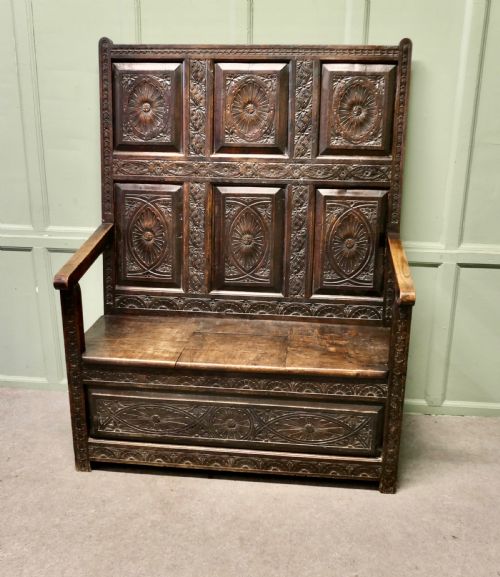
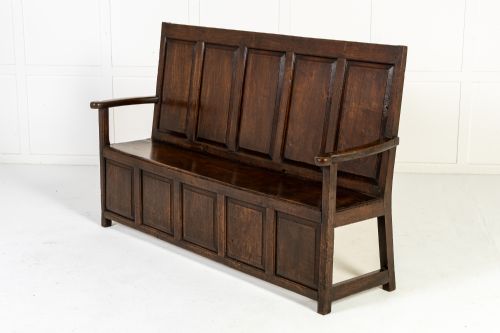
An English oak monk bench brings centuries of craftsmanship into the home, offering a solid wooden seat alongside integrated storage or a convertible table top. Buyers seeking this phrase encounter heavy timber settles, hall benches and convertible armchairs originating from the seventeenth century onward.
The pieces appearing on this page span several distinct eras, including seventeenth-century wainscot designs, eighteenth-century panelled settles and nineteenth-century Gothic revival or Jacobean revival interpretations. These heavy wooden items served generations in farmhouse kitchens, hallways and grand rooms.
Most examples rely on dense native timber and box seat construction designed to withstand heavy daily use. Whether high-backed or fitted with a metamorphic table top, each piece reflects the utilitarian needs of its period.
Factors influencing quality
Quality rests heavily on the proportion of original timber preserved through centuries of use and the integrity of the structural joints. Pieces maintaining their early patination and untouched surface textures stand apart from heavily restored or later constructed examples.
The depth and execution of carved details, from simple geometric panels to elaborate figural motifs like the Green Man, separate standard utilitarian furniture from exceptional artistic commissions. Original hardware, such as iron hinges on box settles, further distinguishes superior pieces.
Victorian carvers occasionally hid fierce Green Man faces among the traditional oak foliage.
The English Oak Monk Bench Glossary
- Settle
- A wooden bench with a high back, solid arms, and often a closed box base for storage. This form protected sitters from draughts in older English homes.
- Wainscot
- A style of wooden panelling or furniture construction using panel-and-frame techniques. Seventeenth-century examples often feature carved backrests in this manner.
- Metamorphic
- Describing furniture designed to transform into another object, such as a bench that converts into a table. These pieces utilised pivoting mechanisms.
- Box settle
- A bench featuring an enclosed storage compartment beneath the seat. The hinged lid allowed household goods to be kept safely away from damp floors.
English Oak Monk Bench: Frequently Asked Questions
What is a monk bench?
A monk bench is a traditional wooden seat that often doubles as a table by pivoting the backrest downward. They combine seating with surface space.
Most surviving examples date from the seventeenth century through to the Victorian revival period, constructed primarily from solid oak.
How do I date an oak settle?
Dating relies on examining the construction joints, tool marks, timber shrinkage, and the style of any carved panels. Seventeenth-century pieces typically show pegged mortise and tenon joints.
Later Victorian revivals often copy earlier styles but use machine-sawn timber or different assembly methods that reveal their nineteenth-century origins.
Where were these benches used?
These benches were traditionally placed in hallways, farmhouse kitchens, and great halls to provide seating near hearths. The high backs and box bases helped block cold draughts.
Today they function well in modern entryways and dining spaces where storage and compact utility are needed.
Are all monk benches old?
Many pieces date to the Victorian era when makers revived seventeenth-century styles, and some incorporate older timber combined with later additions. Examining the wear patterns helps determine age.
Checking the interior of box seats and the joining methods reveals whether a piece is entirely period or from a later revival wave.