




English Mahogany Games Table
An english mahogany games table combines timber of deep grain with folding tops designed for cards, chess, and social play.
English Mahogany Games Table
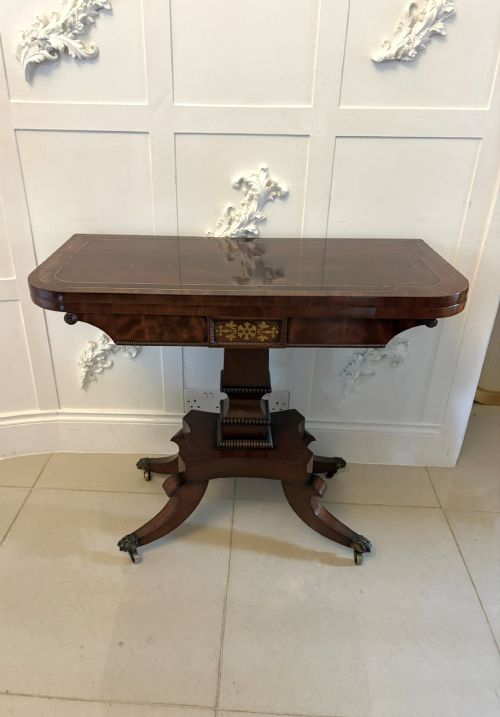
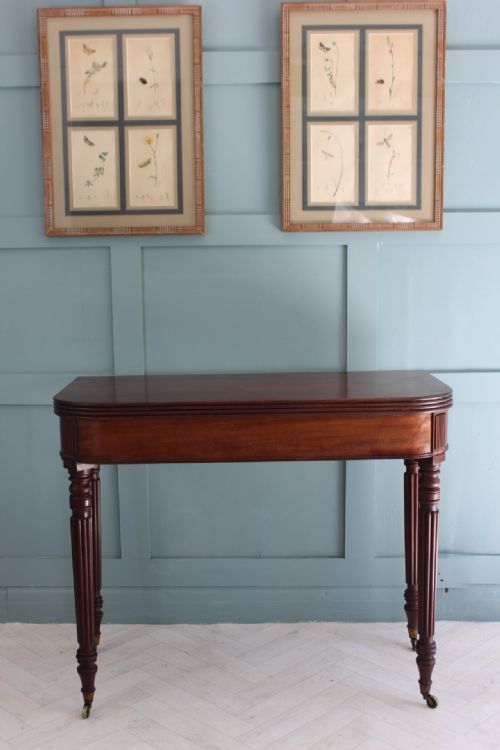
When you search for an english mahogany games table, you encounter pieces spanning the Georgian, Regency, and Victorian eras, often taking the form of fold-over card tables, tea tables, or occasional gaming surfaces. The most frequent iteration on this page is the fold-over design, which sits flat against a wall as a console or side table before opening on hinged leaves to reveal a baize-lined playing surface.
The evidence shows periods ranging from the 18th century through to the late Victorian and Edwardian phases, taking shapes from D-shape and demi-lune formats to serpentine fronts. Alongside standard card tables, the records include specialised bagatelle tables, metamorphic dining versions, and tripod chess tables incorporating auxiliary materials.
Origins remain firmly rooted in English cabinet-making traditions, moving through styles associated with George II, George III, Hepplewhite, Sheraton, and William IV. These tables served multifunctional roles in period parlours, doubling as tea tables or display surfaces when closed.
Materials and construction
Cabinet-makers utilised solid mahogany and figured veneers such as plum pudding mahogany and burr mahogany, frequently building structural carcases that support hinged folding mechanisms. Timber selection focused on rich grain patterns, particularly on the tops that remain visible when closed against a wall.
Inlay and contrasting timber details appear throughout the evidence, utilising satinwood, boxwood, and rosewood for decorative stringing, banding, and geometric motifs. Metal components include brass inlay and specific hinges or swing-leg mechanisms required to support the cantilevered leaves of fold-over tops.
Playing surfaces commonly feature inset baize, providing a soft texture for card play, while lower frames rely on sturdy pillar supports, tripod bases, or tapered legs associated with Regency and Georgian joinery.
Inlay materials recorded across the inventory include satinwood, boxwood, rosewood, and brass work integrated into D-shape and serpentine tops.
Quality and execution
Distinction across these tables rests on the quality of the timber preparation and the precision of the cabinet-making, particularly where veneers meet solid frames. Finer examples display carefully matched grain patterns across the fold-over leaves, ensuring the visual composition remains harmonious whether the table is open or closed.
The sophistication of secondary details, such as crisp boxwood and satinwood inlay, brass stringing, and well-executed pie crust or serpentine shaping, elevates standard utilitarian furniture into accomplished decorative art. Mechanism design also separates simpler pieces from superior items, with smooth action on swing legs and secure pivoting joints defining better production.
Proportion and stance dictate overall visual success, with well-balanced legs and restrained carving or inlay outperforming heavier, less disciplined Victorian revivals or later reproductions.
Edwards and Roberts
The English Mahogany Games Table Glossary
- Baize
- A coarse woollen material, typically green, used as a traditional playing surface inset into the tops of card and games tables.
- Demi-lune
- A half-moon shape characteristic of tables designed to stand flat against a wall when closed.
- Fold-over
- A hinged tabletop construction where one half folds back or rotates on a pivot to double the surface area for gaming.
- Serpentine
- A gently undulating curved furniture front featuring a convex centre flanked by concave sides.
- Stringing
- Thin inlaid lines of contrasting timber used to outline panels and table edges on Georgian and Regency pieces.
English Mahogany Games Table: Frequently Asked Questions
What is an english mahogany games table?
An english mahogany games table is a multifunctional piece of antique furniture featuring a folding or pivoting top designed to conceal a playing surface when not in use.
These tables were built primarily during the Georgian, Regency, and Victorian periods to facilitate card games, chess, and social gatherings in domestic parlours.
How were card tables used historically?
Historically, these tables stood against drawing room walls as decorative console or side tables holding lamps, tea caddies, or ornamental objects.
When guests arrived for evening entertainment, the top unfolded or rotated to reveal a baize-lined interior prepared for cards, counters, and board games.
How do I tell a Georgian table from a Victorian one?
Georgian tables typically display restrained classical proportions, elegant tapered or square legs, and refined mahogany veneers with subtle stringing.
Victorian iterations often feature heavier timber dimensions, bolder turning on the legs, and more exuberant revival styles influenced by earlier design periods.
What woods besides mahogany appear on these tables?
While mahogany forms the primary structural and visual timber, cabinet-makers incorporated contrasting woods for decorative emphasis.
Satinwood, boxwood, and rosewood appear frequently as inlay, borders, and crossbanding, alongside burr walnut or plum pudding figure variations.