
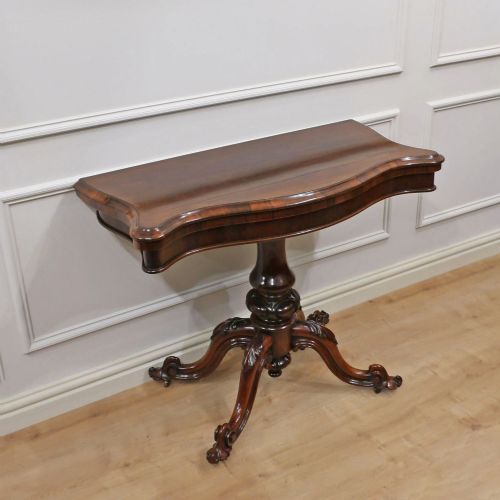
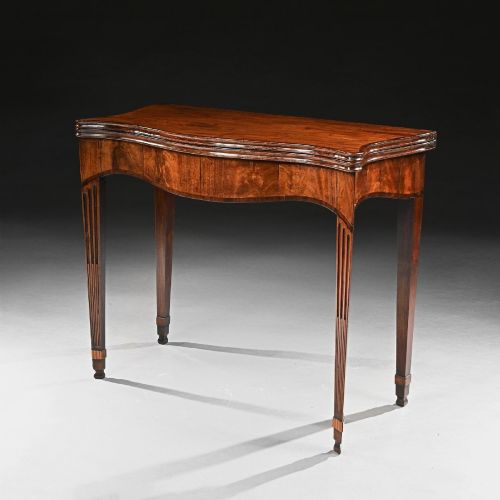
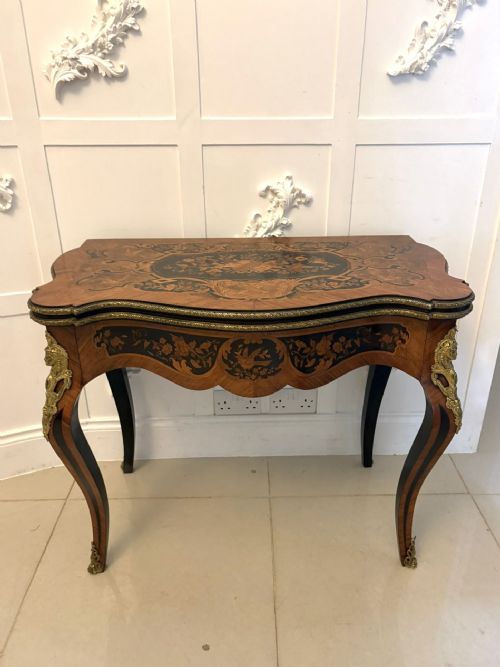
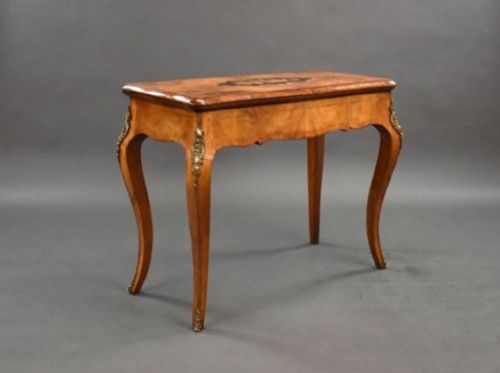

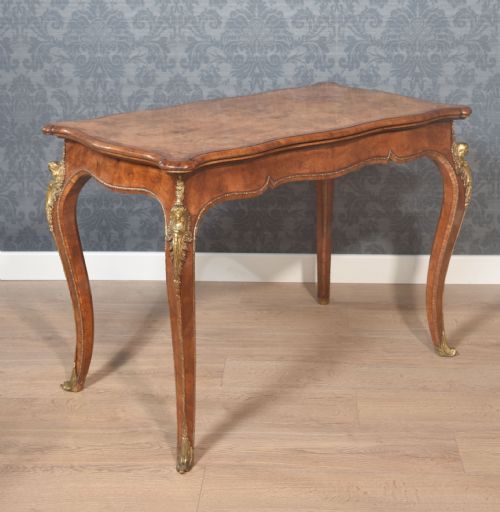


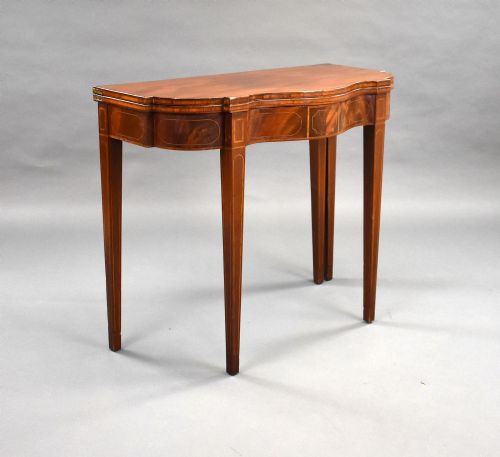


Serpentine Foldover Table
These serpentine foldover table examples combine curved mahogany, walnut, or kingwood with hinged tops for cards and tea.
Serpentine Foldover Table
When you search for a serpentine foldover table, you are looking at antique furniture designed with a sinuous, undulating front edge and a top that opens to reveal a surface for card games or tea. These pieces date across several periods, from the eighteenth century through the Victorian era and into the Edwardian period, appearing in forms such as card tables, tea tables, games tables, and console tables.
How they were made
These tables were built using solid timbers and wood veneers such as mahogany, walnut, kingwood, and rosewood, often enhanced with intricate marquetry inlay. Cabinet makers shaped the characteristic undulating front by working with timber that allowed for curved designs.
Many examples incorporate specialised mechanics, such as concertina actions to support the opened top. Ormolu mounts and brass details appear on French-influenced pieces to accentuate the Louis XV style.
Listings feature mahogany, burr walnut, rosewood, and kingwood veneers across Victorian, Edwardian, and eighteenth-century periods.
What varies in quality
Quality in these tables rests upon the selection of timber figures, such as burr walnut or rich mahogany, and the precision of the marquetry inlay. Finer pieces demonstrate exceptional colour and patination achieved through careful ageing and finishing of the wood.
The sophistication of the mechanism and the execution of the serpentine curve also distinguish finer examples. Expert construction of the concertina action or folding top separates standard production from superior cabinet making.
The Serpentine Foldover Table Glossary
- Serpentine
- A curved furniture front shaped in a convex-concave-convex wave line. This profile requires skilled woodworking to maintain symmetry and elegance across the table edge.
- Foldover table
- A table with a hinged top that doubles in surface area when opened. This design served dual functions for dining, tea, or card playing.
- Concertina action
- An expanding frame mechanism used on games tables to support the unfolded top. It extends symmetrically like a musical instrument when the table opens.
- Marquetry
- Decorative patterns created by fitting together thin slices of wood veneer. Artisans use varied coloured timbers to picture floral or geometric designs.
- Ormolu
- Gilt bronze mounts applied to furniture for decoration. This technique is frequently found on French-style revival pieces from the nineteenth century.
Serpentine Foldover Table: Frequently Asked Questions
What is a serpentine foldover table used for?
These tables served primarily as multi-functional furniture for the parlour or drawing room, functioning as side tables or console tables when closed. When the top folded open, they provided a stable surface for serving tea or hosting card games.
Their dual nature made them essential for entertaining guests in domestic interiors during the eighteenth and nineteenth centuries.
How do I identify a George III table?
George III pieces typically date from the eighteenth century and feature solid mahogany construction with refined proportions. They rely on the quality of the timber, subtle carving, and the classic serpentine outline rather than heavy veneer work.
Examining the interior construction and timber grain helps distinguish these earlier examples from later Victorian revivals.
What is the difference between card and tea tables?
Card tables often feature lined playing surfaces inside the folded top, sometimes with corner pockets for counters or coins. Tea tables were designed to hold porcelain and tea service equipment when opened.
While both share the foldover mechanism, their internal linings and slight variations in proportions reflect their specific domestic uses.
How do I care for walnut and mahogany?
Keep these timber surfaces away from direct sunlight and consistent moisture to protect the wood veneer and polish. Regular dusting with a dry, soft cloth maintains the natural patination without building up residue.
Maintaining stable room temperatures prevents the wood from warping or the marquetry inlay from lifting over time.