




English Mahogany Barometer
An english mahogany barometer brings the practical science of Georgian and Victorian weather-watching into a room with rich timber and bright dials.
English Mahogany Barometer
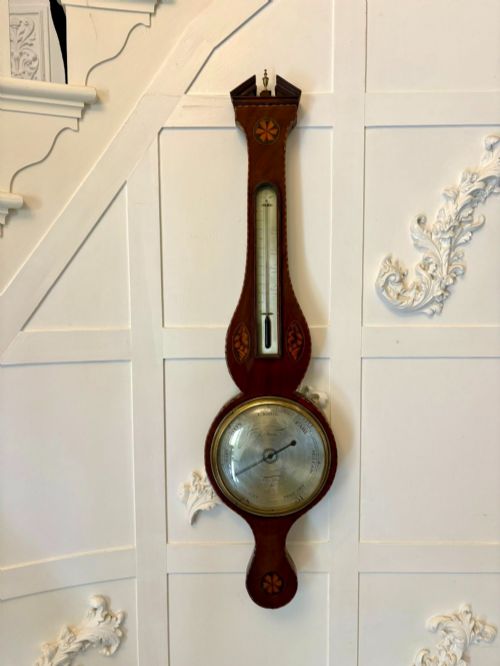
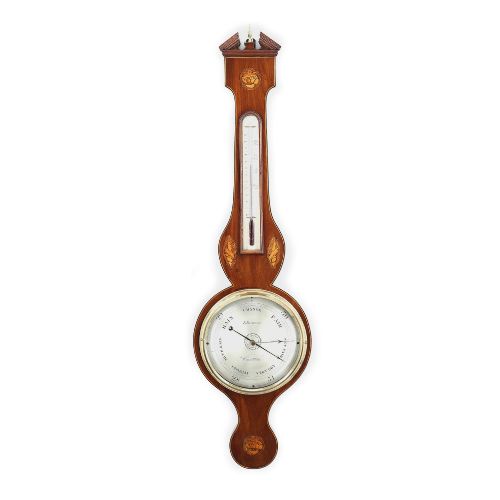
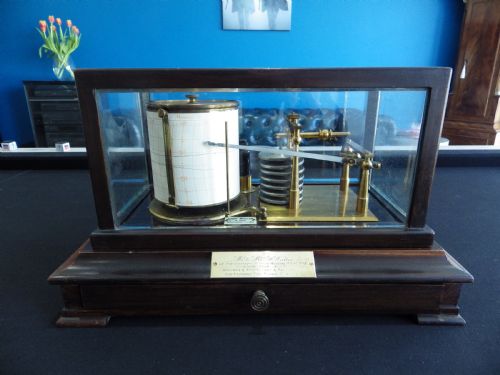
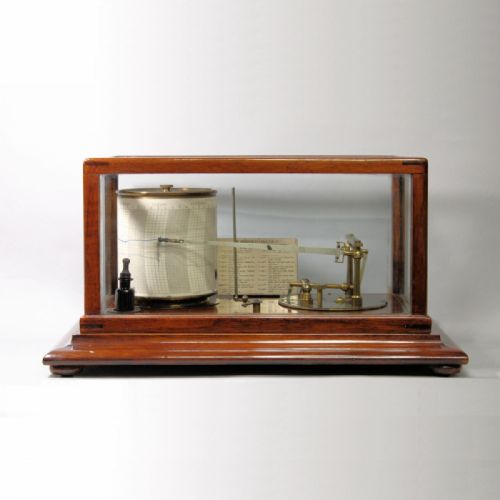
An english mahogany barometer is a domestic weather glass housed in timber, taking the form of tall stick barometers, wheel barometers with swan-neck or onion-top pediments, and compact recording barographs. The examples found here span the Georgian, Regency, and Victorian periods, alongside Edwardian and interwar pieces.
The wheel barometer is the version most frequently encountered on this page, often featuring a damp-and-dry thermometer, a hygrometer, and a circular dial at the base. Stick barometers appear in both straight and bow-fronted cases, while mechanical barographs sit within glazed mahogany boxes alongside chart drawers.
Makers working in London and provincial towns such as Norwich, Liverpool, and Cambridge signed these timber instruments on silvered brass dials or bone scale plates. The resulting objects combine cabinet-making with functional mercury tubes, aneroid capsules, and clockwork clock movements.
Evaluating Quality
Quality rests upon the crispness of the mahogany cabinet-making and the fidelity of the interior mechanics. Finely proportioned cases with subtle stringing, intact swan-neck pediments, and original bone adjustment screws sit far above plain, later-adapted housings.
The engraving on the silvered brass dial distinguishes finer workshops from standard production. Sharp, deep script bearing a recorded maker's name alongside clean graduation lines elevates an instrument beyond an anonymous provincial piece.
One recorded piece combines a mercurial barometer with a fusee drop-dial wall clock and railway interest.
B. Besozzi of Weymouth·Casella London·Molton of Norwich·Short and Mason Limited·Blake and Son·George Dollond·James Gatty·Russell of Liverpool
The English Mahogany Barometer Glossary
- Banjo barometer
- A wheel barometer named for its distinctive swollen, curved outline resembling the musical instrument. These house the mercury tube in the stem and the main dial in the base.
- Stick barometer
- A tall, narrow instrument where the mercury column remains visible against a long scale plate. They represent the earlier, more scientifically direct approach to atmospheric measurement.
- Barograph
- A self-recording meteorological instrument that traces pressure changes onto a paper chart with a pen arm. Driven by a clockwork movement, these units are housed in glazed mahogany boxes.
- Silvered brass
- A metal alloy treated with silver powder to create a bright, matte surface for engraved lettering and numbers. It provides high contrast against the dark timber cases.
- Vernier
- A small sliding scale device used to read barometric measurements down to precise fractions. It is adjusted by a small turned bone or ivory key.
English Mahogany Barometer: Frequently Asked Questions
How do I read a stick barometer?
You read the height of the mercury column against the scale plate, using the sliding vernier to measure precise fractions. Rising mercury indicates improving weather, while falling levels point to approaching rain or wind.
Changes are observed by tapping the instrument gently to settle the mercury before taking your reading.
Where should I hang a wall barometer?
These instruments need an interior wall away from direct sunlight, central heating radiators, and damp exterior stone. Stable room temperatures ensure the metal parts and timber cases do not warp or bind.
Secure mounting is essential given the weight of solid mahogany and the mercury reservoir inside.
Are these barometers still accurate?
Most antique barometers function correctly when balanced and calibrated against known local pressure readings. The mercury tubes and aneroid movements respond reliably to atmospheric shifts if the seals remain intact.
Minor calibration is often possible via the adjustment screw on the dial face.
How do I tell a Georgian barometer from a Victorian one?
Georgian examples often feature restrained mahogany cases with delicate boxwood stringing and architectural pediments. Their dials tend to be simpler and signed by provincial or London makers of the eighteenth century.
Victorian instruments frequently adopt bolder proportions, decorative carving, and heavier 'onion top' heads, occasionally incorporating aneroid movements alongside traditional mercury tubes.