




English Library Clock
An English library clock is a precision timepiece built for the study or desk, combining mechanical reliability with handsome cabinet-making.
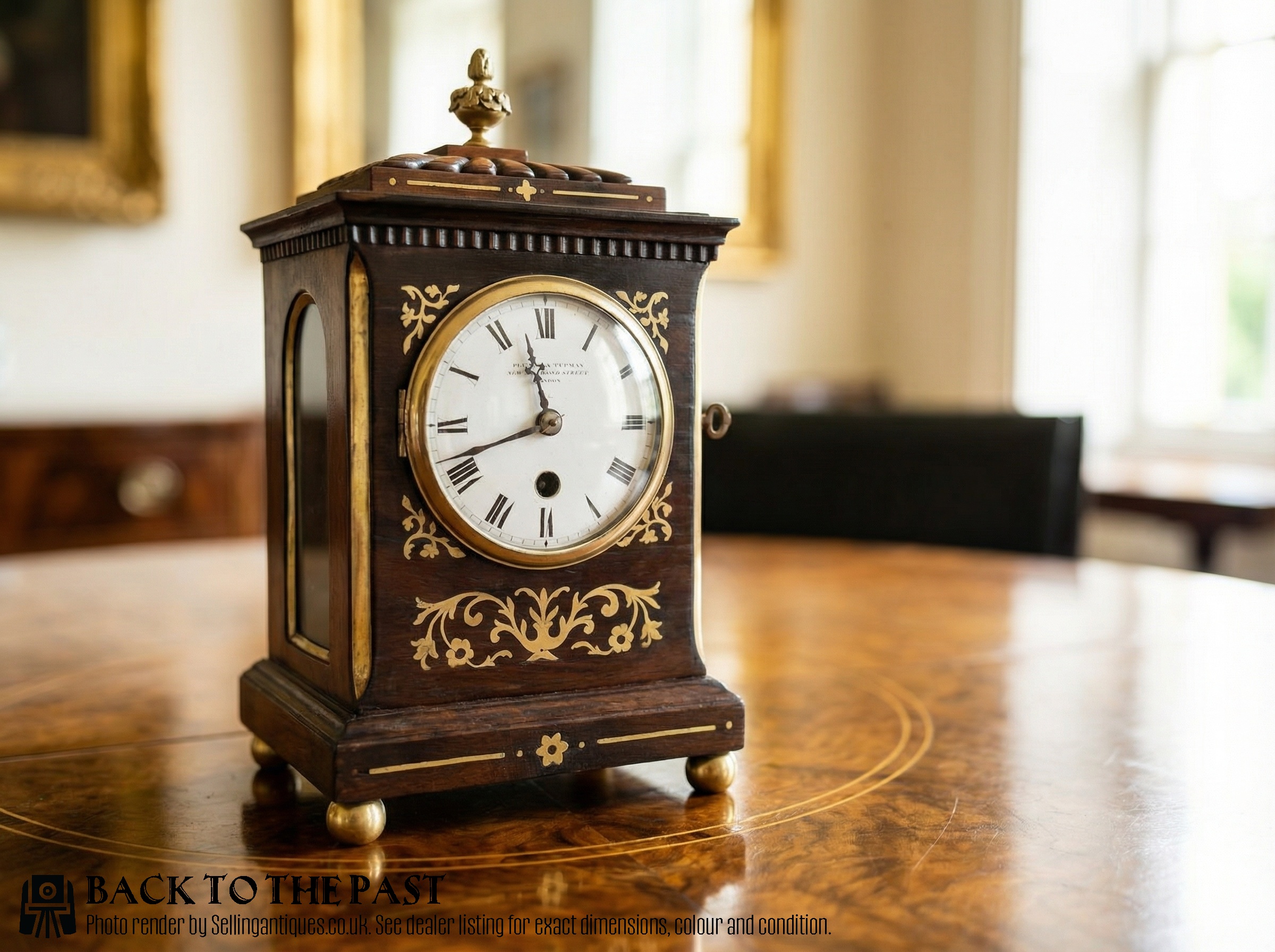
English Library Clock
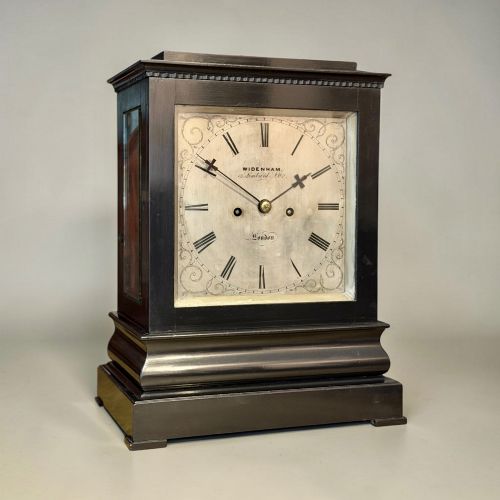
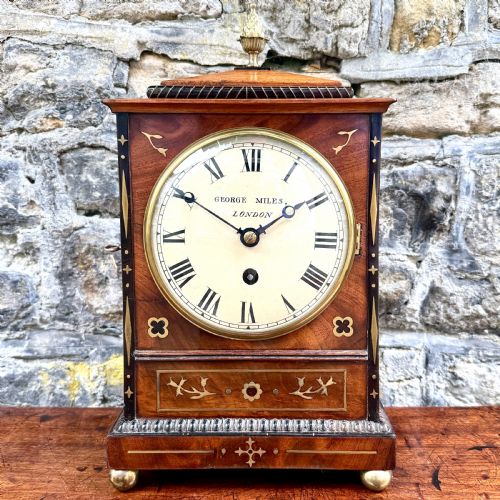
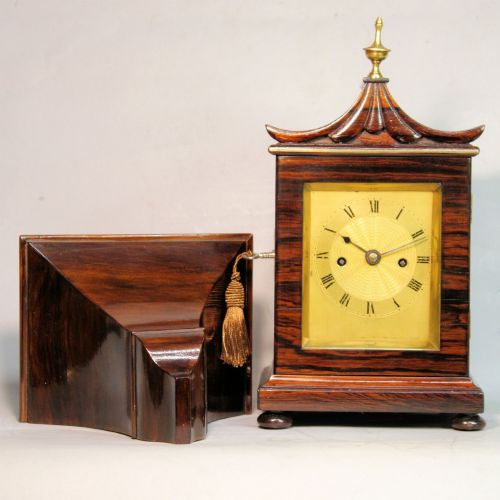
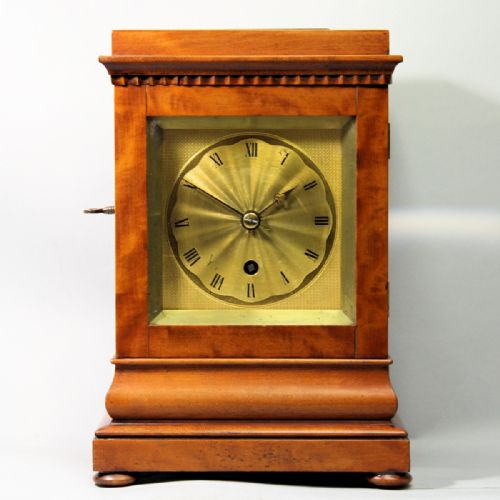
When you search for an English library clock, you look at compact mechanical timepieces designed for domestic or professional study spaces. The examples on this page span the Georgian, Regency, and Victorian periods, manifesting primarily as mantel clocks, bracket clocks, and five-glass or four-glass table clocks.
You are most likely to encounter Victorian and nineteenth-century pieces housed in mahogany or rosewood cases. These vary from miniature travelling timepieces to substantial fusee clocks signed by notable London makers.
The forms range from traditional wooden bracket cases to glass-sided designs that reveal the movement within. Wall clocks also appear among the records, reflecting the diverse ways these timepieces were deployed in municipal and domestic settings.
Materials and construction
Cabinet makers built the housings from dense hardwoods such as mahogany, rosewood, satinwood, and ebonised wood, occasionally employing burr walnut. These timbers were selected for their stability and rich grain, providing a durable enclosure for delicate internal mechanisms.
The mechanical heart relies on brass plates, steel pivots, and fusee movements driven by chains or cords to maintain even tension as the mainspring unwinds. Dials feature silvered metal or gilded brass, often with engine-turned details, protected behind bevelled glass panels.
Listings feature mahogany, rosewood, and satinwood cases housing single chain fusee movements and silvered metal dials.
Separating the ordinary from the exceptional
Quality rests upon the refinement of the movement and the precision of the case joinery. Maker signatures from established workshops in London or regional centres indicate higher standards of horological craftsmanship.
The choice of dense cabinet timbers and the crispness of brass mounts or engine-turned dials distinguish finer examples from standard production pieces. Complexity also plays a role, with striking and repeating mechanisms commanding greater attention than simple timepieces.
Widenham of London·Bush of London·Webster Cornhill London·Dent·Phillips Brothers·Arnold and Frodsham·McCabe London·Plumbly and Tupman·Barraud and Lunds·John Massey Strand London·Leith of London·Johnson of London·Francis Correll Lutterworth·Brockbanks and Atkins·John Moore and Sons·T Boxell Brighton·John Murray London·Frodsham
The English Library Clock Glossary
- Fusee
- A conical pulley used in mechanical clocks to equalise the torque of the mainspring as it runs down. This ensures consistent power delivery and better timekeeping.
- Five glass clock
- A style of mantel clock featuring glass panels on the top and all four sides, allowing light to flood the internal movement. This form became popular during the nineteenth century.
- Bracket clock
- A portable spring-driven clock originally designed to sit on a wall bracket to aid resonance and visibility. Later versions functioned primarily as table or mantel clocks.
- Escapement
- The mechanism that controls the release of wheel power to maintain the motion of the pendulum or balance wheel. Platform escapements allowed smaller clocks to keep accurate time without a swinging pendulum.
English Library Clock: Frequently Asked Questions
What is an English library clock?
It is a portable mechanical timepiece made for a study, library, or desk. These clocks use spring-driven movements rather than weights, making them compact enough for furniture placement.
They combine practical timekeeping with decorative cabinet work in woods like mahogany and rosewood.
How do fusee movements work?
A fusee is a conical pulley connected to the mainspring by a chain or cord. As the spring unwinds and loses power, the chain moves to a wider part of the cone, maintaining steady force on the gear train.
This clever mechanical device ensures the clock maintains consistent accuracy throughout its running cycle.
Where were they placed?
Owners placed them on mantelpieces, desks, bookcases, or specialised wall brackets in studies and libraries. Their portable nature allowed them to be moved between rooms as needed.
Some smaller versions included campaign handles for travel.
How do I date an English library clock?
Dating relies on stylistic clues in the wooden case, the signature of the maker, and the evolution of the internal movement. Regency and Georgian pieces display different cabinet proportions compared to Victorian examples.
Makers' records and engraved serial numbers often help narrow down the decade of production.