

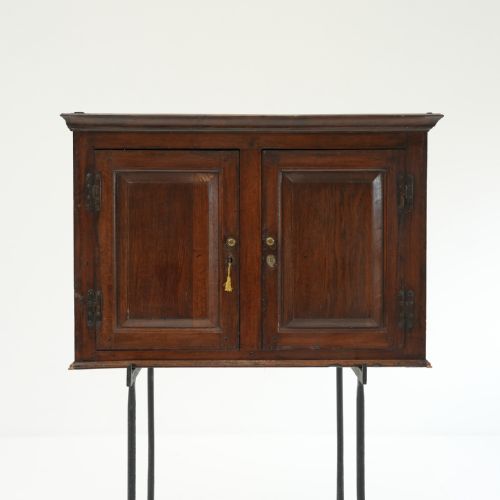


English Hanging Cupboard
An English hanging cupboard brings compact storage and period character to empty wall space.
English Hanging Cupboard
An english hanging cupboard serves as a wall-mounted storage piece designed to keep items secure while saving floor space in period rooms. These items encompass corner cabinets, wall display units, spice cupboards, and larger wall-mounted wardrobes originating from the 17th century through to the Edwardian era.
Materials and construction
Cabinet makers relied primarily on native oak and rich mahogany, often incorporating flame mahogany veneers, walnut, satinwood, and decorative satinwood inlay to add visual contrast on doors and friezes.
Joinery techniques included crossbanding and panel construction, complemented by brass H-hinges, escutcheons, and working locks with keys. Glazed doors utilised timber muntins to divide glass panes for display purposes.
Some pairs of small oak cabinets owe their existence to timber salvaged from a royal yacht.
Judging the quality
Superior examples distinguish themselves through the choice of timber figure, such as well-matched flame mahogany or richly grained oak, alongside crispness in inlaid satinwood details and crossbanding. The integration of original brass hardware and well-fitted doors dictates the overall standard.
Plain country pieces offer robust utility through simpler construction, whereas town-made urban examples demonstrate refined proportions, sophisticated stringing, and curved bow fronts that require advanced carpentry skill.
Town and Emanuel
The English Hanging Cupboard Glossary
- Crossbanding
- A strip of veneer applied to the border of a panel where the grain runs perpendicular to the main surface. This technique creates a neat framing effect common on Georgian cabinet doors.
- Bow front
- A convex curved cabinet face that projects forward from the wall. This shape softens room angles and appears frequently on Georgian examples.
- Livery cupboard
- A traditional storage piece originally used for food and drink rations. These early forms display sturdy oak construction and ventilation openings.
- Spice cupboard
- A small wall-mounted cabinet containing multiple internal drawers for culinary ingredients. These compact units date largely to the 18th century.
- Satinwood inlay
- Contrasting blonde wood inserted into dark timber surfaces to form geometric or floral patterns. It highlights the refined taste of the maker.
English Hanging Cupboard: Frequently Asked Questions
How do I hang a heavy oak corner cabinet safely?
These pieces require heavy-duty wall brackets or direct screwing into masonry or timber studs using the internal mounting points provided by the original maker. Professional installation is recommended given the substantial weight of old oak.
Distributing the load across structural wall supports ensures the antique remains secure without pulling away from the plaster.
Were these cupboards meant for kitchens or living rooms?
Georgian and Victorian households placed these units across various rooms including parlours, kitchens, bedrooms, and reception halls depending on their size and internal fittings. Spice cupboards and small glazed display units served domestic utility and display.
Larger press cupboards and wardrobes held clothing, linens, or tableware in upper floors and main living spaces.
How do I date a Georgian hanging cupboard?
Dating relies on timber selection, handle styles, secondary woods used for interior linings, and construction methods such as hand-cut dovetails. Pieces from the mid-18th century often feature solid oak, while later Georgian examples introduce mahogany and satinwood inlay.
Examining the hinge types and the style of any glazing bars provides further clues to the decade of manufacture.