




English Cottage Garden Painting
An English cottage garden painting captures the tranquil charm of rural domestic life through vibrant blooms and rustic architecture.
English Cottage Garden Painting
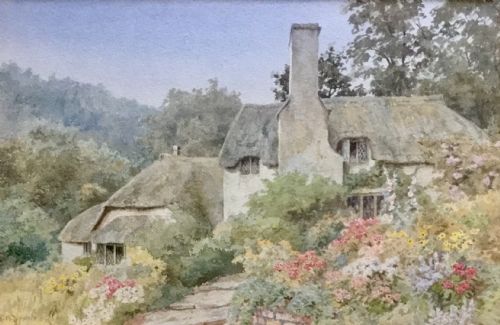
An English cottage garden painting portrays traditional rural scenes dominated by floriferous borders, stone pathways, and modest dwellings. These works capture a romanticized view of the countryside that resonated strongly with collectors during the late nineteenth and early twentieth centuries.
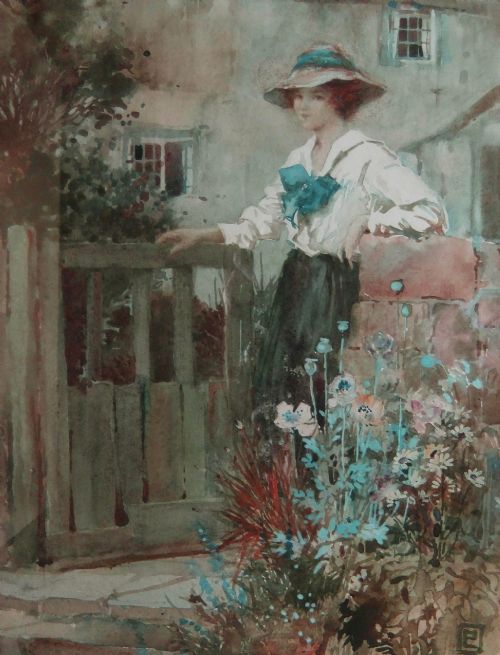
The most common examples encountered on this page date from the Edwardian era and the 1920s, executed in watercolour or oil. Artists frequently focused on domestic tranquility, depicting figures engaged in quiet rural pastimes beside thatched or stone-built houses.
Materials and methods
Artists relied primarily on watercolour pigment on paper or oil paint applied to canvas, often framing the finished works in wood and gilt wood behind glass. Canvas was frequently stretched over wooden frames or occasionally attached to board.
Techniques range from the loose, light-filled brushwork of British Impressionism to the detailed draftsmanship of Victorian rural genre painting. Pigments were handled to maximise the luminous quality of natural sunlight falling upon flowerbeds and rustic walls.
Several garden scenes prominently feature domestic pets, including pet rabbits and dogs keeping company with cottagers.
Distinguishing quality
Quality rests in the artist's handling of natural light and atmospheric perspective, distinguishing atmospheric depictions from stiff or formulaic topographical illustration. Superior works demonstrate a confident command of colour, capturing the dense, layered textures of mixed floral planting without slipping into mere botanical recording.
The strength of the composition and the vitality of the brushwork separate accomplished pieces from standard decorative output. Hand-signed works by established practitioners show a greater sensitivity to scale and rural detail.
Percy Lancaster·Owen Bowen·Ernest Higgins Rigg·Herbert Royle·Arthur Claude Strachan·Thomas Nicholson Tyndale·Jane Utley·Henry John Sylvester Stannard·Theresa Sylvester Stannard·George Frederick Nicholls·Sidney Valentine Gardner·Amy Antill·K M Attlee
The English Cottage Garden Painting Glossary
- British Impressionism
- A painting style developed around the late nineteenth and early twentieth centuries characterised by visible brushstrokes and an emphasis on natural light. Painters sought to capture the fleeting effects of weather and sunlight in domestic and rural landscapes.
- Victorian Rural Genre
- A style focusing on scenes of everyday country life, often incorporating figures engaged in domestic tasks or leisure. These works frequently sentimentalize the traditional rhythms of agricultural and village existence.
- Watercolour
- A medium consisting of finely ground pigments suspended in a water-soluble binder, applied to paper to achieve translucent washes of colour. It requires rapid decision-making and a light touch to preserve the luminosity of the underlying paper.
- Gilt Wood
- Timber frames treated with a thin layer of gold leaf or metallic gilding, commonly used to frame fine art paintings during the nineteenth and early twentieth centuries. The reflective surface enhances the visual depth of the artwork.
English Cottage Garden Painting: Frequently Asked Questions
What periods do these paintings date from?
The works span from the Victorian period through the early twentieth century, with a strong concentration from the Edwardian era and the 1920s.
Artists during these decades frequently returned to pastoral themes, recording a changing rural landscape before the onset of modern development.
How should I care for a antique watercolour?
Watercolours require careful placement away from direct sunlight to prevent the pigments and paper from fading over time. Maintaining a stable indoor environment protects both the paper support and the gilt wood frame from humidity fluctuations.
What is the difference between oil and watercolour?
Oil paintings utilise pigment suspended in a drying oil applied to canvas or board, offering rich texture and deep colour saturation. Watercolours employ water-soluble pigments on paper, resulting in a lighter, translucent effect typically displayed behind glass.
Where were these rural scenes usually set?
The compositions frequently depict vernacular architecture and gardens across English counties such as Yorkshire, Somerset, and Surrey. Artists travelled to picturesque villages to record thatched cottages and walled gardens filled with traditional perennials.