





English Collectors Cabinet
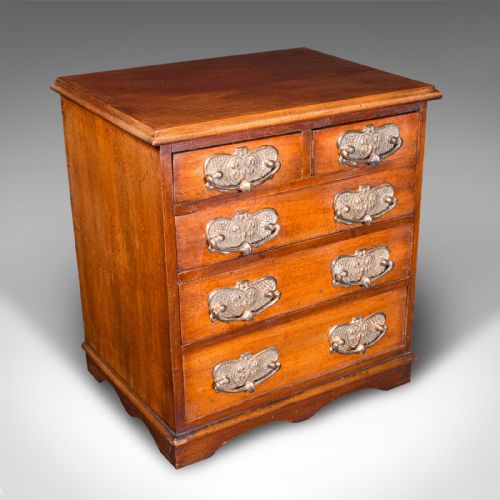
An English collectors cabinet holds the curiosities of a room, taking the form of multi-drawer chests, tabletop cases, and cabinets on stands.
English Collectors Cabinet
An english collectors cabinet serves to organise and display specialised items, ranging from butterflies and minerals to coins and documents. Buyers searching this phrase meet mostly Victorian multi-drawer chests in walnut, oak, and mahogany, alongside earlier Georgian and Regency desktop cases.
The format varies from substantial forty-drawer cabinets to compact table-top specimens and small cabinets on stands. Many examples incorporate glazed doors, folding flaps, or secure locking mechanisms designed to protect delicate contents from dust and handling.
Makers such as Watkins and Doncaster built tall multi-drawer formats specifically for natural history specimens, while others produced gentleman's folio cabinets or botanical storage chests. Each piece reflects the Victorian and Georgian obsession with classification, categorising everything from fossils to medals within tightly fitted internal tiers.
Materials and Construction
Cabinet makers utilised dense native and exotic timbers including oak, mahogany, satinwood, and burr walnut to construct the primary carcass and internal framework. Drawer linings frequently employ secondary softwoods or cedar, fitted with precise joints to withstand constant opening and closing.
Brass handles, campaign drop pulls, and escutcheons punctuate the facades, often accompanied by functioning lever locks to secure valuable contents. Surface treatments rely on polished French polish or wax finishes that accentuate the natural figure of the burl and grain.
English Collectors Cabinet Retail Price Guide 2026
Typical asking prices for english collectors cabinet among the pieces listed under this phrase on Sellingantiques today, from the lower quarter to the upper quarter. They describe what is for sale here now, not the wider market.
Some tiny Victorian drawers still hold forgotten fragments of butterfly wings and antique dust.
Assessing Quality and Execution
Quality rests in the precision of the drawer construction, where fine dovetails and dust-proof partitioning separate superior workshop output from utilitarian storage. The choice of timber figure, such as highly decorative burr walnut or figured oak matched across multiple drawer fronts, indicates the original tier of commissioning.
The presence of original glazed doors, working brass locks with matching keys, and intact internal felt or baize lining elevates an example. Structural integrity in the runners and the weight of the timber used for the drawer bases dictate how well the piece survives centuries of use.
Maple and Co·Roberson and Co·Watkins and Doncaster·Royal Worcester
The English Collectors Cabinet Glossary
- Wellington chest
- A tall, vertical chest of drawers featuring a hinged locking stile on one side that secures all drawers simultaneously. This format was frequently adapted for specimen and document storage during the nineteenth century.
- Specimen cabinet
- A piece designed with numerous shallow drawers intended for classifying natural history items like insects, shells, or minerals. These drawers often feature glazed protective frames or internal glass covers.
- Penwork
- A decorative technique utilising India ink applied to a light wood background to simulate Japanese lacquer or engraved ornament. Examples from the late eighteenth century often display intricate chinoiserie motifs.
- Cabinet on stand
- A form consisting of a main storage body elevated on a separate framework of legs or a low base table. This design lifts the viewing height and lightens the visual mass of denser timbers like walnut and oak.
- Pate-sur-pate
- A ceramic decorating method where raised white porcelain paste is built up in successive layers on a contrasting coloured body. This technique appears on decorative ceramic plates associated with nineteenth-century factory production.
English Collectors Cabinet: Frequently Asked Questions
What did they store inside?
These cabinets housed specialised collections including butterflies, fossils, coins, medals, and botanical specimens. Gentlemen and scholars used the shallow drawers to organise delicate items systematically.
Larger versions accommodated artists' materials, documents, cigars, or household napery. Each internal layout was tailored to the specific dimensions of the owner's collection.
How do I date an example?
Dating relies on timber selection, construction methods, and hardware styles across different periods. Eighteenth-century pieces often feature bracket feet and hand-cut dovetails in oak or mahogany.
Victorian iterations introduce heavier walnut veneers, machine-sawn elements, and complex locking stiles like the Wellington mechanism. Maker labels and stamps inside the drawers provide definitive origin points.
Are all drawers dustproof?
Most dedicated specimen cabinets incorporate internal dust lips between the drawer tiers to protect fragile contents. These thin wooden margins seal the gap when each drawer closes completely.
Simpler storage chests lack this feature, functioning as standard multi-drawer furniture rather than sealed entomological cases. Examining the gaps between drawer fronts reveals the presence of dust protection.
Where should I place one?
These pieces suit studies, libraries, or living spaces where their multi-drawer facades can be appreciated up close. Tabletop versions sit comfortably on desks or sideboards, while tall cabinets require stable wall placement.
Direct sunlight and dramatic changes in humidity should be avoided to protect sensitive wood veneers and historical finishes. Ensuring a level surface prevents the numerous drawers from binding in their runners.