




End Support Writing Table
These end support writing tables balance structural strength with clean lines, giving a room a distinct centrepiece for daily correspondence.
End Support Writing Table
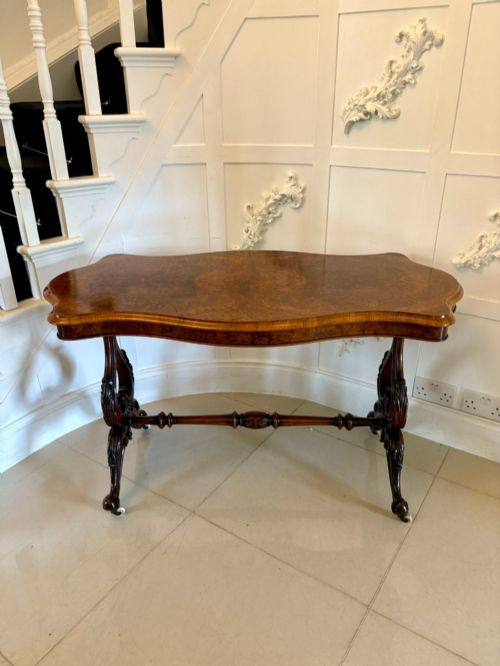
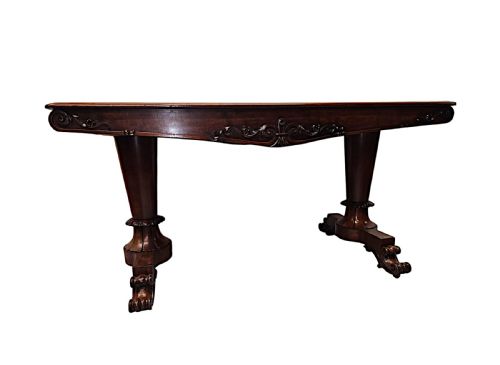
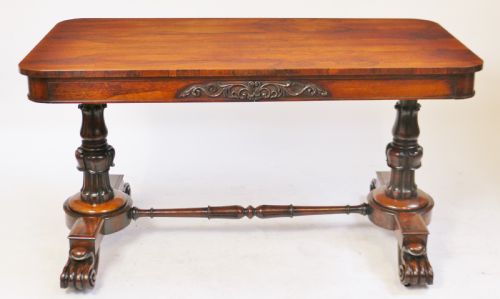
An end support writing table provides a stable surface for letters and paperwork, supported by vertical end pillars or trestles rather than traditional corner legs. When searching for an end support writing table, buyers encounter pieces primarily from the Regency, William IV, and Victorian periods, alongside earlier 19th-century examples.
The form often includes useful drawers fitted into the frieze for storing writing materials, whilst some examples function as dual-purpose partners desks or card tables. Timbers such as mahogany, rosewood, and burr walnut dominate the selection, showing the rich grain patterns favoured by makers of these eras.
How they were made
Cabinet makers utilised dense hardwoods like mahogany and rosewood, often applying decorative veneers such as burr walnut and burr oak to the main surfaces. These timbers were selected for their ability to take a deep, polished finish while providing the structural rigidity required for end support construction.
Joinery techniques relied on sturdy framing methods to connect the top to the vertical end supports and central stretchers, ensuring the table remained stable under use. Brass fittings, including casters and drawer pulls, were integrated into the design to add both mobility and refined detail.
Materials across the selection range from dense mahogany and rosewood to figured burr walnut, oak, and ceramic elements.
What varies in quality
The quality of an end support writing table rests on the selection of timber and the precision of its veneer work, with finely figured burr walnut or rich rosewood marking out superior examples. Makers who took greater care matched grain patterns symmetrically across the top and drawer fronts to create a cohesive visual impact.
Construction details also separate standard production from exceptional cabinet work, particularly in the carving of the end supports and the smooth operation of the drawers. Stamped signatures from notable workshops indicate a higher tier of craftsmanship and design pedigree.
Williams and Gibton·Gillows
The End Support Writing Table Glossary
- End support
- A structural configuration where the weight of the table rests on two vertical pillars or trestles at either end rather than four corner legs. This design provides unobstructed legroom and a distinct architectural silhouette.
- Frieze
- The horizontal band situated directly beneath the tabletop, frequently housing one or more integrated drawers. In better pieces, this section displays continuous veneer matching.
- Partners table
- A large desk designed to be used from both sides simultaneously, typically featuring opposing banks of drawers. These pieces often incorporate finished backs to allow placement in the middle of a room.
End Support Writing Table: Frequently Asked Questions
What is an end support writing table?
An end support writing table is a desk design that uses vertical pillars or trestles at each end for support rather than standard corner legs.
This construction leaves the sides open and provides a distinct architectural silhouette suited for placement in the middle of a room.
How were these tables used originally?
These tables served as dedicated surfaces for writing letters, managing household accounts, and reading in libraries or withdrawing rooms.
Fitted drawers allowed owners to keep stationery and documents close at hand while maintaining a tidy top surface.
How do I identify a Regency period table?
Regency tables typically display classical proportions, crisp architectural lines, and dark timbers such as rosewood or mahogany.
They often incorporate decorative elements like brass inlay, lyre-shaped end supports, or reeded pillar details.
Where should I place an end support table?
Because the finished grain and construction extend to all sides, these tables sit comfortably in the centre of a room rather than pushed against a wall.
They also function effectively behind a sofa or as a freestanding desk facing into the space.