





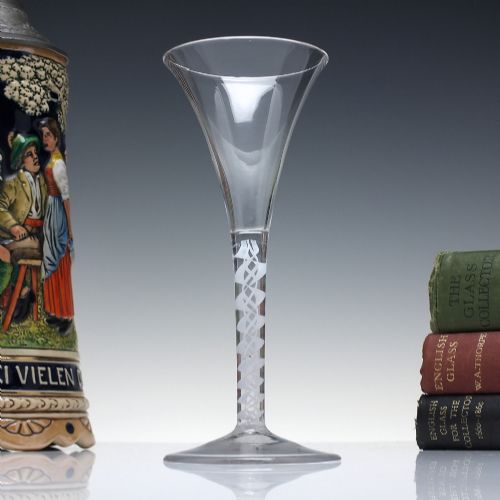



Enamel Twist Wine Glass
An enamel twist wine glass is a Georgian drinking vessel shaped by 18th Century glassmakers, prized for its opaque white and coloured glass threads.
Enamel Twist Wine Glass
An enamel twist wine glass belongs to the Georgian period of the 18th Century, specifically the decades around the mid to late seventeen-sixties. When collectors search for an enamel twist wine glass, they encounter drinking glasses and goblets formed from clear lead glass or lead crystal glass.
The most common form on this page is the wine glass with an opaque twist stem, alongside variants like the ale glass. These pieces feature distinct bowl shapes, including rounded funnel, wrythened ogee, ovoid, flute-moulded ogee, and trumpet profiles.
How they were made
English glassmakers of the 18th Century utilised lead glass and lead crystal glass to form these drinking vessels. The defining decorative stem feature relies on glass canes enclosing white enamel or red colour twist threads.
Craftsmen drew and twisted these enamel rods within the clear metal of the stem, creating single series, double series, and multi-spiral patterns beneath bowls shaped by blowing and moulding.
Enamel Twist Wine Glass Retail Price Guide 2026
Typical asking prices for enamel twist wine glass among the pieces listed under this phrase on Sellingantiques today, from the lower quarter to the upper quarter. They describe what is for sale here now, not the wider market.
What varies in quality
The distinction between standard examples and superior pieces rests on the complexity of the stem formation and the crispness of the bowl moulding. Multi-spiral and red colour twist varieties demonstrate advanced glasshouse dexterity compared to straightforward single series opaque stems.
Proportion, weight of the lead crystal glass, and the precision of the enamel twist threads determine the refinement of the drinking glass. Engraved decoration upon the bowl further elevates specific examples within the Georgian range.
The Enamel Twist Wine Glass Glossary
- Opaque twist
- A stem formation enclosing white enamel threads rather than clear air bubbles. This technique became popular in English glasshouses during the 18th Century.
- Ogee bowl
- A cup shape curving inward at the rim and outward below, resembling an asymmetrical 'S' profile. It appears frequently on Georgian drinking glasses.
- Double series
- A stem containing two distinct sets of twist elements, often an outer spiral enclosing an inner core of enamel threads. It requires greater skill to execute than a single series.
- Wrythened
- A decorative spiral moulding applied to the bowl or body of the glass. This creates a subtle optical swirl in the clear metal.
Enamel Twist Wine Glass: Frequently Asked Questions
How do I date an enamel twist wine glass?
Most examples date from the mid to late 18th Century during the Georgian era. Makers utilised specific bowl forms and stem twists characteristic of that period.
Examination of the metal weight, pontil mark on the underside, and bowl styling helps confirm the Georgian origin of the drinking glass.
What is the difference between single and double series twists?
A single series stem contains one set of enamel threads, often wrapped in a simple spiral down the glass. A double series incorporates an inner and outer set of twists.
Glassmakers achieved the double series by combining multiple enamel rods within the clear lead crystal stem during manufacture.
Were these glasses used for wine only?
Georgian drinking vessels served various beverages depending on their size and bowl capacity. While termed wine glasses, certain forms functioned as goblets or ale glasses.
Taller or narrower vessels accommodated specific drinks in 18th Century households, though all shared the characteristic enamel twist stem.
How should I display an 18th Century glass?
Display these pieces in a stable cabinet away from direct sunlight and heavy vibrations. Lead crystal glass benefits from secure shelving that protects the delicate stem and foot.
Keep the environment at a steady temperature to preserve the historical integrity of the lead glass and enamel components.