





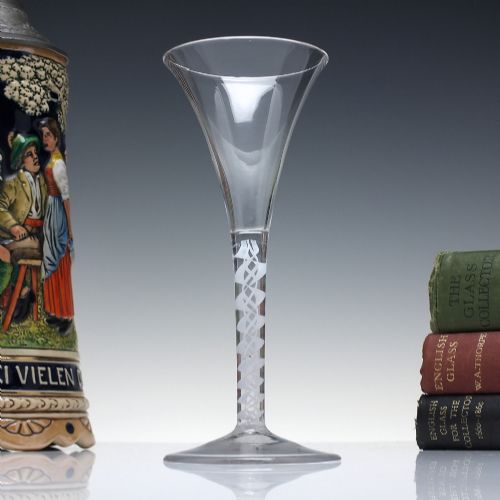



Enamel Twist Stem
These enamel twist stem pieces are Georgian drinking vessels defined by their milky white and coloured internal threads.
Enamel Twist Stem
When you search for enamel twist stem, you are looking at eighteenth-century glassware designed for wine and ale. The pieces found here date from the Georgian period and primarily take the form of wine glasses with distinct stem formations.
You will encounter rounded funnel bowls, ogee bowls, and ovoid bowls supported by slender stems containing opaque white or red enamel threads. These stems range from single series to multi-spiral configurations enclosed within clear lead glass.
English production dominates the selection, featuring pieces formed around seventeen-sixty and seventeen-seventy. Alongside standard wine glasses, larger goblets and flute-moulded variants appear within the listings.
How they were made
Maker workshops produced these vessels using lead glass and lead crystal formed into specific bowl shapes while incorporating opaque white enamel and red colour twist elements inside the stem. The manufacturing process required skilled manipulation of molten glass to trap the intricate internal threads without distorting the outer profile.
Techniques such as wrythening and flute-moulding shaped the bowls of these eighteenth-century glasses, adding texture and visual depth above the twist stems. Master glassmakers sealed the enamel rods within clear metal, drawing and twisting the heated cane to achieve the desired spiral patterns.
Enamel Twist Stem Retail Price Guide 2026
Typical asking prices for enamel twist stem among the pieces listed under this phrase on Sellingantiques today, from the lower quarter to the upper quarter. They describe what is for sale here now, not the wider market.
Listings feature eighteenth-century Georgian glassware, encompassing lead crystal wine glasses and ale glasses with opaque white and red enamel twist stems.
What varies in quality
Quality in these drinking glasses rests upon the complexity and crispness of the internal twist formation. Multi-spiral designs and precise enamel alignment demonstrate superior technical execution compared to simpler single series arrangements.
The proportional balance between the bowl, stem, and foot dictates the visual success of each piece. Refined bowl configurations, such as flute-moulded ogee shapes or finely engraved surfaces, elevate certain examples above standard tavern or household forms.
The Enamel Twist Stem Glossary
- Opaque twist
- A stem formation utilising milky white enamel rods drawn into a spiral pattern inside clear lead glass. This technique became popular during the mid-eighteenth century.
- Ogee bowl
- A bell-shaped drinking vessel bowl with a curving contour that turns outward at the rim. It provides an elegant silhouette characteristic of Georgian glassware.
- Wrythen
- A decorative spiral moulding applied to the body of a glass bowl. This technique creates a gentle swirling effect in the glass surface.
- Single series
- A stem construction featuring one distinct set of twisted elements enclosed within the glass rod. It represents a foundational style of eighteenth-century twist stems.
- Lead crystal
- A heavy, clear glass composition containing lead oxide that increases brilliance and weight. This material served as the primary medium for Georgian drinking vessels.
Enamel Twist Stem: Frequently Asked Questions
What is an enamel twist stem glass?
These pieces are eighteenth-century drinking vessels featuring slender stems filled with opaque white or red enamel threads. They reflect the refined glassmaking techniques of the Georgian era.
Collectors prize them for their intricate internal patterns and diverse bowl forms, which include rounded funnel, ogee, and trumpet profiles.
How do I date these glasses?
Most examples originate from the mid-to-late eighteenth century, specifically between seventeen-fifty-five and seventeen-seventy. Stylistic indicators like double series twists and flute-moulded bowls help narrow the timeframe.
Examination of the lead glass body and pontil mark on the underside further assists in confirming period manufacture.
What bowl shapes are common?
The listings show a variety of bowl forms designed for wine and ale consumption. Ogee, rounded funnel, and ovoid shapes dominate the selection.
Some bowls feature flute-moulding or wrythen twists, while others include engraved decoration across the surface.
Were these used for wine?
Georgian society utilised these vessels primarily for consuming wine and ale during social gatherings. Their delicate proportions suited formal dining and tavern settings alike.
Today, they function mainly as display pieces for collectors of antique British glassware.