





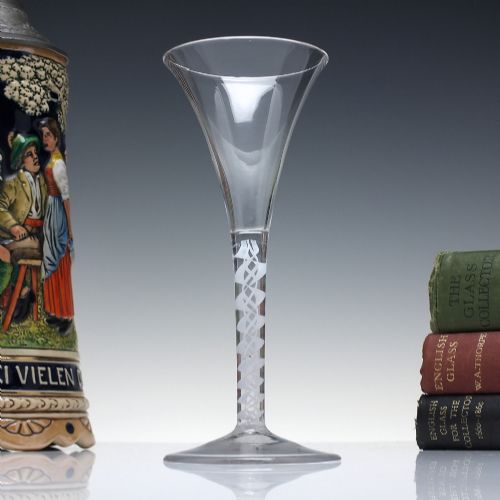



Enamel Twist Glass
These enamel twist glass pieces are eighteenth-century drinking vessels and later lighting that collectors prize for their intricate internal stems.
Enamel Twist Glass
Enamel twist glass encompasses drinking vessels and decorative lighting formed with opaque white or coloured glass elements sealed inside the stem. The pieces most commonly met on this page date from the eighteenth century, specifically the Georgian period, alongside occasional Art Deco lighting.
The glassware takes the form of wine glasses, ale glasses, and larger goblets featuring various bowl shapes such as ogee, rounded funnel, and trumpet. Makers shaped these drinking vessels with single, double, or multi-spiral twist configurations within the transparent metal.
Beyond drinking vessels, the category includes functional items like table lamps that combine enamelled glass with wrought iron supports. These diverse objects share a reliance on vitreous enamels to create distinctive linear patterns within the composition.
How they were made
Glassmakers utilised lead glass and clear lead crystal to form the main body of the drinking vessels, ensuring clarity and weight. They incorporated white enamel and coloured enamel elements within the stem by drawing and twisting canes of glass before enclosing them in a clear outer layer.
The bowls were shaped by hand, occasionally featuring flute-moulded or wrythened surface textures created while the material remained hot. Metalwork elements in later pieces, such as the wrought iron used in the nineteen-twenty lamps, were forged and combined with enamelled glass components.
Enamel Twist Glass Retail Price Guide 2026
Typical asking prices for enamel twist glass among the pieces listed under this phrase on Sellingantiques today, from the lower quarter to the upper quarter. They describe what is for sale here now, not the wider market.
The listings span from the eighteenth century into the nineteen-twenties, uniting Georgian drinking vessels with Art Deco lighting.
What varies in quality
Quality in these glass pieces lies in the precision and complexity of the internal twist formation, ranging from simple single strands to dense multi-spiral arrays. The clarity of the lead crystal and the crispness of bowl profiles, such as ogee and trumpet forms, also distinguish finer examples.
Proportion and balance dictate the desirability of each piece, with well-drawn stems and evenly distributed internal threads showing superior craftsmanship. Surface engraving on the bowl further elevates an example, particularly when executed with fine detail.
The Enamel Twist Glass Glossary
- Opaque twist
- A glass stem containing opaque white or coloured enamel threads rather than air bubbles. This technique became popular in English drinking vessels during the eighteenth century.
- Ogee bowl
- An S-curve bowl shape featuring a concave upper section and a convex lower section. This profile frequently appears on Georgian drinking glasses.
- Wrythen
- A decorative spiral pattern moulded into the surface of a glass bowl. It creates a subtle optical movement when light passes through the metal.
- Double series
- A stem construction involving two distinct sets of twists, such as a pair of opaque enamel spirals enclosed by a outer cable of finer threads.
- Lead crystal
- A high-clarity glass containing lead oxide that provides weight and brilliance. It serves as the primary material for the vessels found in these listings.
Enamel Twist Glass: Frequently Asked Questions
What is an enamel twist glass?
An enamel twist glass is a drinking vessel featuring opaque white or coloured enamel threads drawn into spiral patterns inside the clear stem.
Most surviving examples date from the Georgian period and take the form of wine glasses or ale glasses.
How do I date an enamel twist glass?
Dating relies on examining the bowl form, the complexity of the internal stem twists, and the characteristics of the lead glass metal.
Eighteenth-century pieces typically display hand-blown bowls and specific twist configurations associated with the Georgian era.
Were these glasses used for wine?
These vessels served primarily for consuming wine, ale, and other alcoholic beverages during formal dining and social gatherings in the seventeen-hundreds.
The smaller bowls suited fortified wines, while taller goblets and ale glasses accommodated different drinks.
How should I display enamel twist glass?
Display these pieces in well-lit cabinets where light can pass through the clear lead crystal and highlight the internal enamel threads.
Stable shelving away from direct heat sources ensures the safety of the fragile glass structures.
What is the difference between single and double series twists?
A single series twist contains one set of enamel spirals within the stem, whereas a double series incorporates two distinct layers or types of twist.
Double series stems often feature a central pair of opaque enamel strands surrounded by an outer cable of fine threads.