





Empire Style Timepiece
An empire style timepiece brings classical architectural dignity and gilt metal brilliance to a mantelpiece.
Empire Style Timepiece
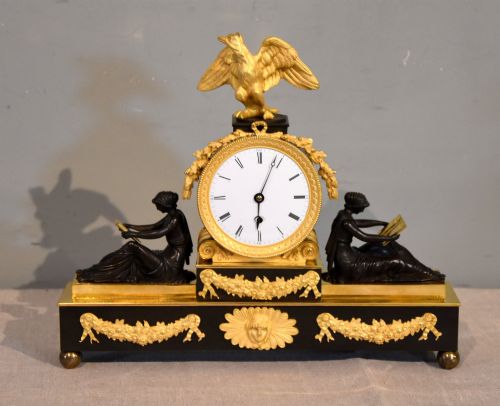
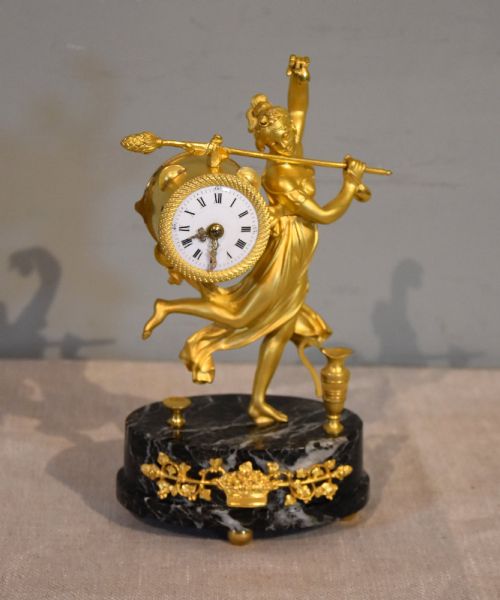
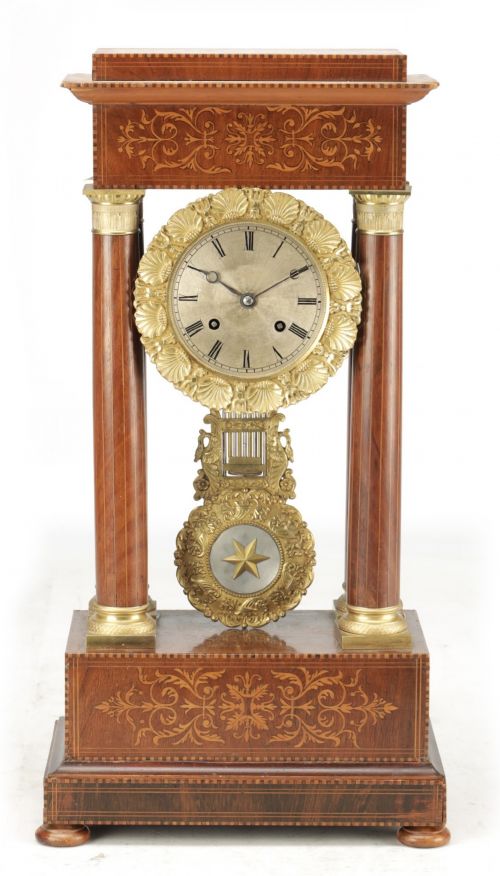
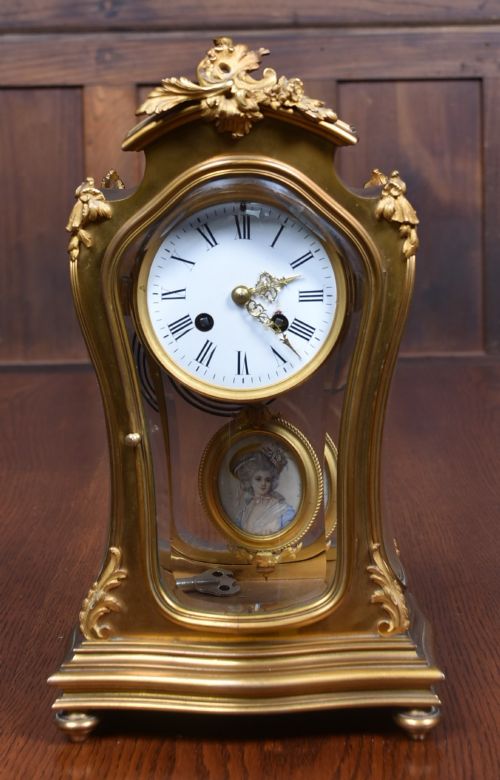
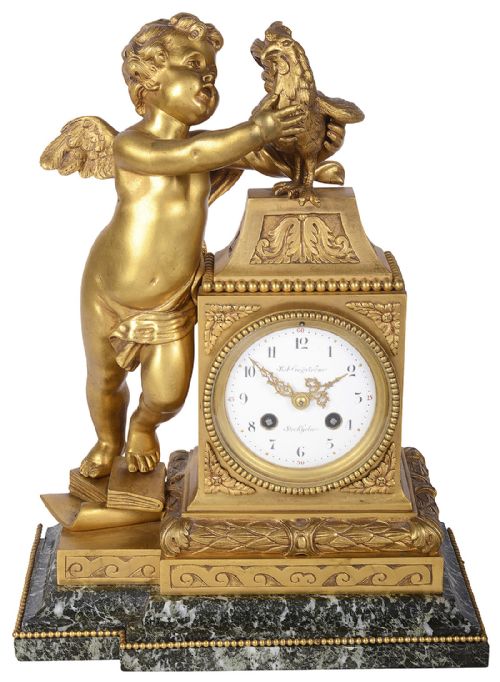
An empire style timepiece sits within a long tradition of decorative horology, drawing heavily on classical motifs, military triumphs, and ancient architectural forms. When you search for an empire style timepiece, you encounter mantel clocks, portico clocks, and clock garnitures originating predominantly from nineteenth-century France alongside English Regency interpretations. These pieces often take the form of architectural structures, porticos, or figurative sculptures incorporating deities, explorers, and animals.
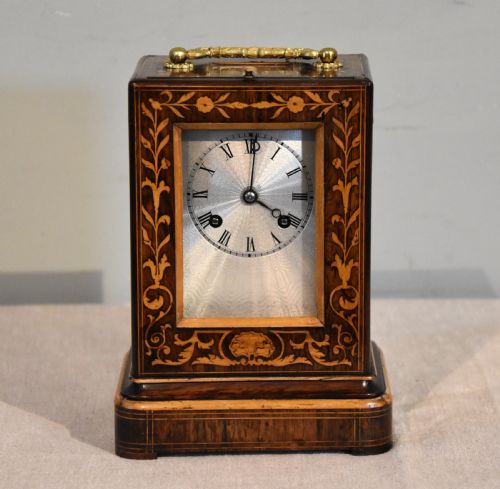
The objects listed here span several decades of the nineteenth century, ranging from crisp Regency brass and gilt designs to elaborate Victorian marble and ormolu housings. You will find distinct regional variations, including London fusee movements housed in rich woods or gilt bronze, alongside Parisian works featuring white or green marble bases. The dial work varies from simple enamel faces to signed miniatures and intricate chapter rings.
Materials and construction
Makers constructed these clocks using a combination of cast metals and dense natural stones. Ormolu and gilt bronze provide the bright, reflective surface characteristic of the style, frequently contrasted against patinated bronze, white marble, green marble, or ebonised wood. Enamel serves for the dial faces, where delicate hand-painted numerals indicate the hours.
Internal mechanics rely on traditional brass clockwork movements, including eight-day bell-striking mechanisms and chain fusee systems. Cases require precise metal casting and fire-gilding techniques, while stone bases involve careful sawing, polishing, and mounting of bronze feet and bezels.
Empire Style Timepiece Retail Price Guide 2026
Typical asking prices for empire style timepiece among the pieces listed under this phrase on Sellingantiques today, from the lower quarter to the upper quarter. They describe what is for sale here now, not the wider market.
Judging quality and execution
Quality reveals itself in the crispness of the bronze chasing and the depth of the fire gilding. Superior examples display sharp relief work on figurative elements and architectural cornices, whereas lesser pieces show soft edges from worn moulds and flat, unvarnished metal surfaces.
The integration of materials dictates distinction. In better specimens, the marble is flawless and heavy, the movement bears the signature of a known maker or retailer on the enamel dial or backplate, and the cast ornaments fit flush against the stone without visible gaps.
Baetens London·Rodier·Baltazart·Henry Berkeley Square London·FB Adams London·James Ritchie Son Edinburgh
The Empire Style Timepiece Glossary
- Ormolu
- Gilded bronze produced through a mercury gilding process. This technique yields a deep, lasting golden lustre unique to period pieces.
- Portico clock
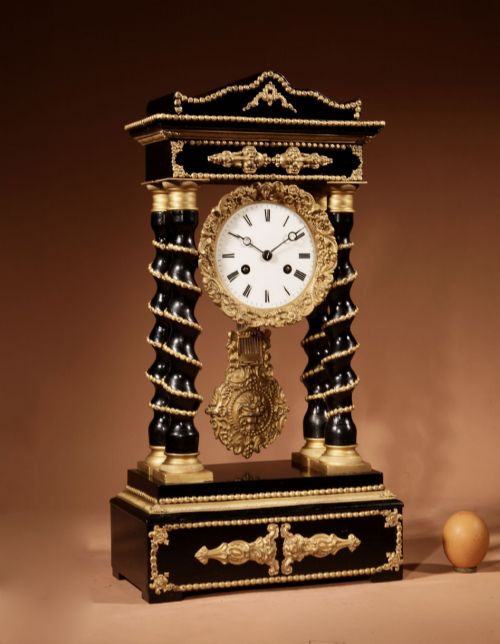
- A mantel clock built in the form of a classical architectural portico with four supporting columns. The pendulum often hangs visibly within the central opening.
- Fusee
- A conical pulley used in mechanical clocks to maintain even drive force as the mainspring unwinds. It ensures consistent timekeeping across the winding cycle.
- Garniture
- A set comprising a central clock flanked by matching decorative objects such as vases or candelabra. These sets create a balanced display on a mantelpiece.
- Silk suspension
- A method of hanging a clock pendulum by a thin strand of silk. This delicate arrangement appears in earlier nineteenth-century French movements.
Empire Style Timepiece: Frequently Asked Questions
What is a clock garniture?
A clock garniture is a matched decorative set containing a central timepiece accompanied by side ornaments such as urns or candelabras. These sets were designed to sit together on a mantelpiece.
They unified the decorative scheme of a nineteenth-century interior by repeating the materials and motifs of the main clock case.
How do I tell an English Regency clock from a French Empire piece?
English Regency clocks often utilise robust fusee movements housed in dark woods like rosewood or ebonised frames with restrained brass mounts. They reflect a sober architectural geometry.
French Empire pieces tend to feature bright ormolu, figurative bronzes, and white marble bases with eight-day striking movements. Their visual focus centres on classical sculpture and mythological storytelling.
How do I care for gilt bronze and marble?
Dust bronze and ormolu surfaces regularly with a soft, dry brush to prevent dirt accumulation in the crevices. Avoid all chemical polishes, which strip the historic gilding.
Clean marble bases using a slightly damp cloth followed by immediate drying. Keep the clock away from direct sunlight and heat sources to protect the stone and internal oils.