


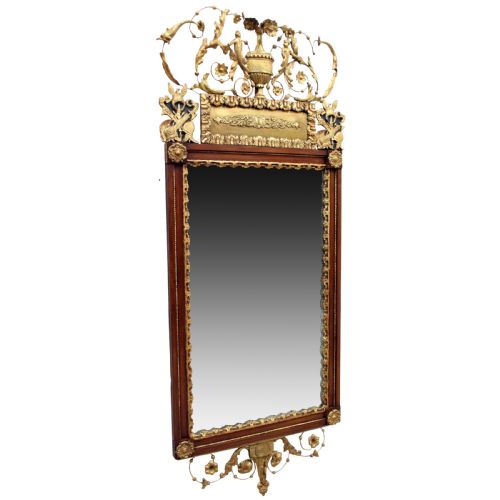
Empire Style Pier Glass
An empire style pier glass brings architectural symmetry and rich wood tones to a room, reflecting light with classic proportion.
Empire Style Pier Glass
An empire style pier glass is a tall, vertical mirror designed to hang in the wall space between windows, anchoring the room's decorative scheme. The pieces encountered here span the nineteenth century, taking forms such as French Empire style wall mirrors, grand Regency examples, and substantial Victorian interpretations.
Makers and workshops across Britain, France, Italy, Sweden, and Central Europe produced these mirrors during the nineteenth century. The selection ranges from Biedermeier mahogany framed pier glass to tall Italian walnut pieces adorned with marble details and French Empire revivals from eighteen ninety.
Wall mirrors and pier mirrors dominate the selection, though related forms such as ebonised and gilt wood mirrors also appear. Buyers will find both restrained neoclassical designs and more ornate gilded pieces that reflect the broad reach of the empire style.
Materials and Construction
Cabinetmakers built the foundational frames of these mirrors using dense hardwoods such as mahogany and walnut, frequently selecting figured veneers for visual depth. Ebonised wood provides dark, sharp contrasts against gilded highlights.
Giltwood and gesso elements add reflective brightness to the frames, applying gold leaf over prepared plaster layers upon wood bases. Ormolu mounts and gilt bronze details punctuate the designs with cast metallic ornamentation.
Some tall mirrors stretch up to eight feet high, demanding tall ceilings and generous room proportions to stand comfortably.
Assessing Quality and Execution
Quality rests in the harmony of proportion and the crispness of the carving or gilding upon the frame. Superior examples demonstrate careful selection of mahogany or walnut veneers that wrap symmetrically around the vertical format.
The integration of decorative elements like ormolu mounts, marble accents, and ebonised details separates standard production from finer workshop output. Original mirror plates with authentic foxing and depth contribute significantly to the character of a piece.
The Empire Style Pier Glass Glossary
- Pier glass
- A tall mirror designed specifically for the wall space between two windows. These mirrors visually expand the room and reflect natural light.
- Giltwood
- Timber that has been coated with a thin layer of gold leaf. This technique brightens architectural woodwork.
- Gesso
- A plaster mixture applied to wood frames as a base for gilding or painting. It provides a smooth surface for detailed carving work.
- Ebonised wood
- Timber treated to imitate ebony, usually through staining and polishing. It creates a stark, dark contrast against gilded details.
- Ormolu
- Finely chased and gilt bronze mounts applied to furniture and frames. The technique adds metallic lustre to timber surfaces.
Empire Style Pier Glass: Frequently Asked Questions
Where should I hang a pier glass?
These tall mirrors are traditionally placed on the narrow wall space between two windows, known as the pier. This placement maximises the reflection of natural light deep into the room.
They also function effectively above low console tables or mantels where their vertical proportions balance horizontal furniture arrangements.
How do I identify nineteenth-century mirrors?
Nineteenth-century mirrors often display distinct construction methods, such as hand-cut timber framing and traditional joinery behind the glass. Examination of the mirror plate can reveal slight imperfections or ageing characteristic of older manufacturing.
Stylistic cues like French Empire, Biedermeier, and Regency motifs also help anchor the piece within the eighteen hundreds.
Are these mirrors heavy to hang?
Solid timber frames combined with glass and sometimes marble or bronze mounts make these mirrors substantial objects. Proper wall anchors and weight-bearing fixings are essential for secure installation.
Professional hanging is recommended to support the vertical load safely against the wall.
What woods were used in these frames?
Mahogany and walnut form the primary structural timbers for the majority of these pieces, often utilised for their rich grain patterns. Secondary woods or ebonised treatments also appear to create contrasting visual borders.
Gilded wood and gesso frequently overlay these timber foundations to provide decorative brilliance.