
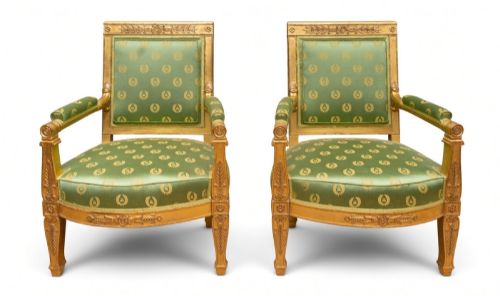
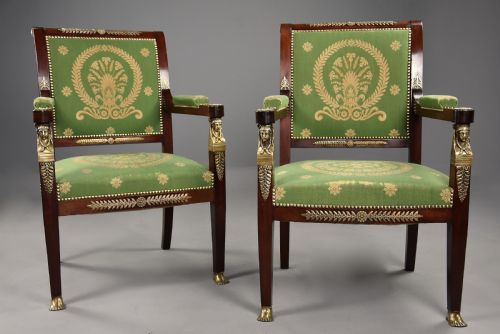
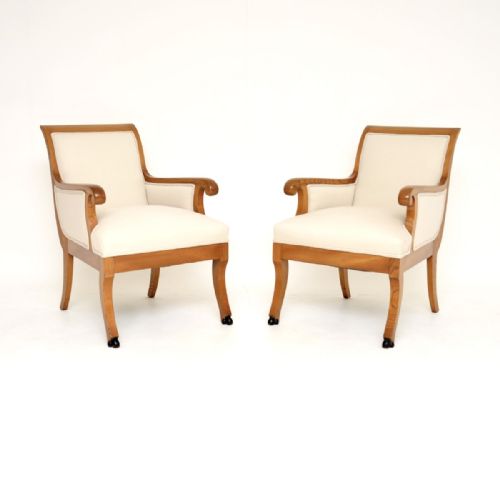


Empire Style Open Armchair
An empire style open armchair brings monumental neoclassical presence to a room, offering grand proportions and architectural dignity.
Empire Style Open Armchair
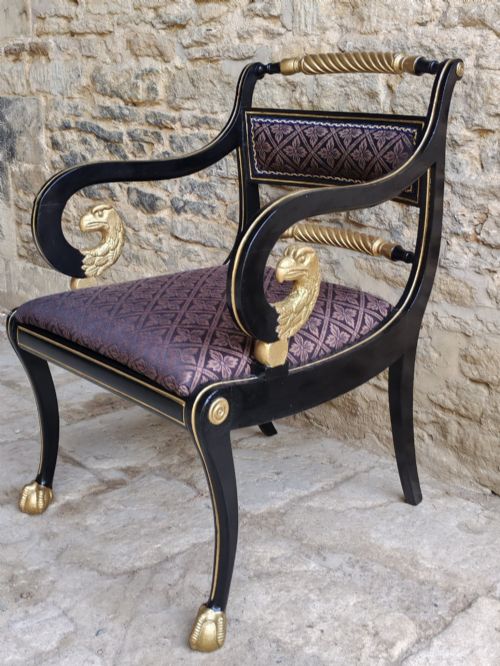
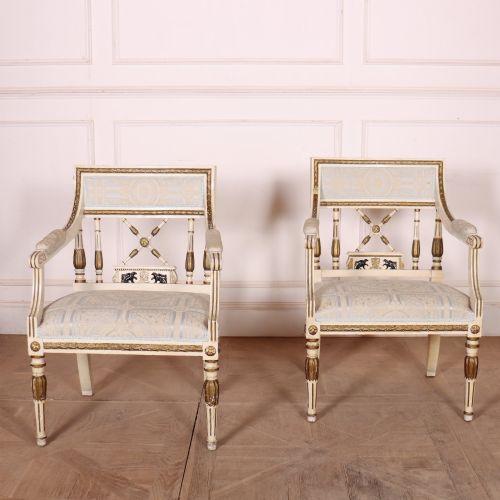
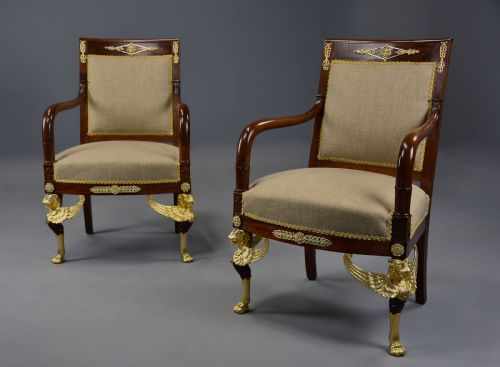
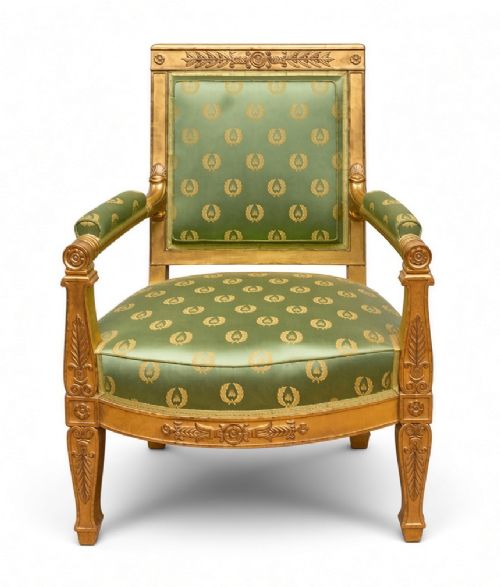
An empire style open armchair draws on classical antiquity through bold structural lines, upright backs, and scrolling arm supports. When you search for an empire style open armchair, you encounter distinct variations spanning the nineteenth century through later revivals.
The pieces listed on this page include French Empire, Swedish Empire, Italian Neoclassical, and Regency forms. Mahogany frames and giltwood finishes dominate the selection, often upholstered in silk or patterned fabric.
You are most likely to meet nineteenth-century examples alongside later revival pieces from the late nineteenth and early twentieth centuries. These chairs function equally well as library seating or decorative salon accents.
Materials and construction
Cabinetmakers utilised solid mahogany and elm for the primary structural frames, often applying gesso to prepare surfaces for gilding. Ormolu mounts and brass details accent the timber components, adding metallic contrast to the woodwork.
Giltwood finishes require meticulous application of gold leaf over layered gesso grounds on carved frames. Upholstery techniques employ traditional textiles, silks, and modern fabrics secured to support the open arm design.
Listings feature mahogany, giltwood, and solid elm frames upholstered in silk and fabric across nineteenth-century and revival periods.
Distinctions in quality
The refinement of carved detail and the crispness of gilded gesso separate superior examples from standard production. Timbers selected for rich grain patterns and deep patination indicate higher workshop standards.
Original mounts, integrated brass ornamentation, and structural integrity dictate the standing of an individual piece. Attribution to known makers or documented royal provenance elevates historical importance considerably.
Jacob-Desmalter·Henry Thomas Peters
The Empire Style Open Armchair Glossary
- Fauteuil
- An open-framed armchair with upholstered seat, back, and arm pads, originating in France. This form defines many pieces catalogued under the empire style.
- Ormolu
- Gilt bronze mounted onto furniture surfaces as decorative ornamentation. The technique involves applying a mercury and gold amalgam to bronze.
- Gesso
- A plaster mixture applied to wood surfaces to provide a smooth base for gilding or painting. It allows intricate carved details to remain sharp under gold leaf.
- Restauration
- A transitional French design period bridging Empire and Louis Philippe styles, spanning the early nineteenth century. Pieces from this era retain classical severity with softer decorative elements.
- Regency Revival
- A twentieth-century movement recreating early nineteenth-century English and continental furniture forms. These later interpretations often utilise traditional joinery and classic silhouettes.
Empire Style Open Armchair: Frequently Asked Questions
What defines an empire style open armchair?
An empire style open armchair is characterised by neoclassical architectural lines, straight or slightly curved legs, and prominent arm supports. These seating pieces draw inspiration from ancient Roman, Greek, and Egyptian forms.
They frequently incorporate rich timbers like mahogany alongside giltwood finishes, brass mounts, and upholstered panels in silk or decorative textile.
How were these chairs used historically?
Historically, these chairs served as formal seating in reception rooms, libraries, and grand salons. Their imposing silhouettes were designed to project authority, taste, and alignment with classical ideals.
While functional as seating, their primary role in elite interiors was decorative, signalling the owner's cultural sophistication.
How do I distinguish original period pieces from revivals?
Distinguishing period pieces relies on examining timber ageing, joinery methods, and the wear patterns on giltwood and brass mounts. Nineteenth-century examples display construction methods consistent with workshop practices of the era.
Revival pieces from the late nineteenth or twentieth centuries often utilise cleaner interior joinery and exhibit different surface patination compared to genuine antique equivalents.
How do I live with an antique armchair?
Living with an antique armchair involves balancing daily use with the preservation of fragile materials like silk upholstery and giltwood. Placing the chair away from direct sunlight protects delicate textiles and prevents the timber from drying.
Regular, gentle dusting maintains the gesso and ormolu mounts without compromising the historic surface finishes.