
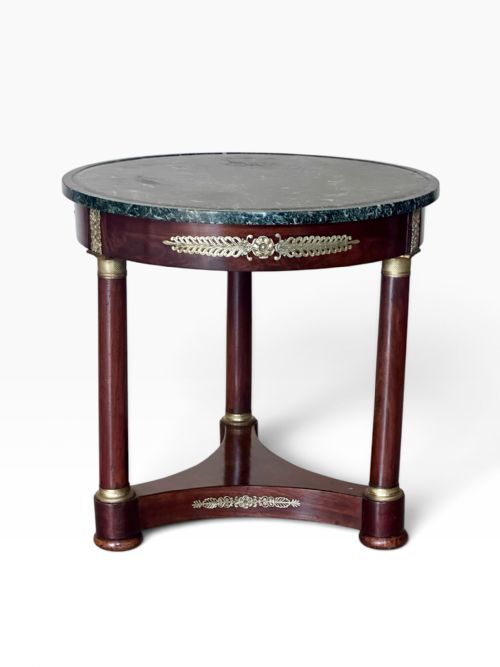
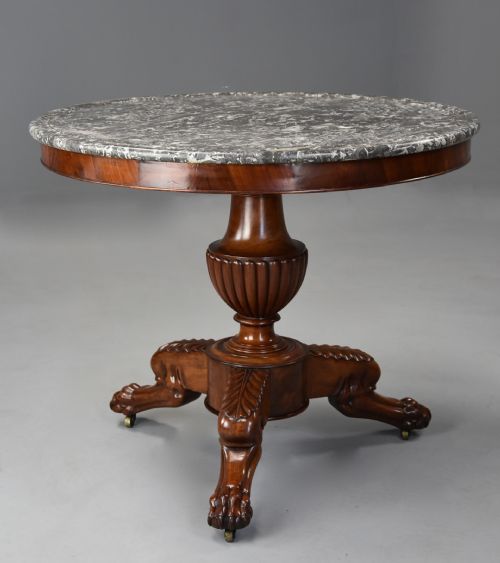
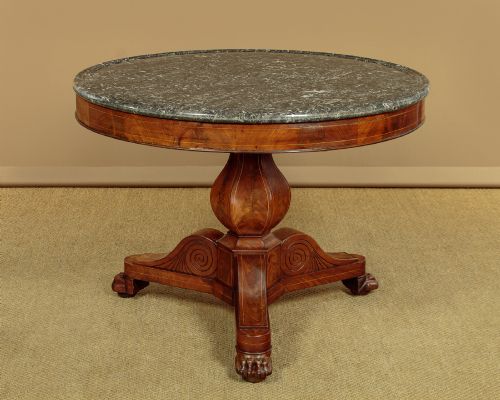
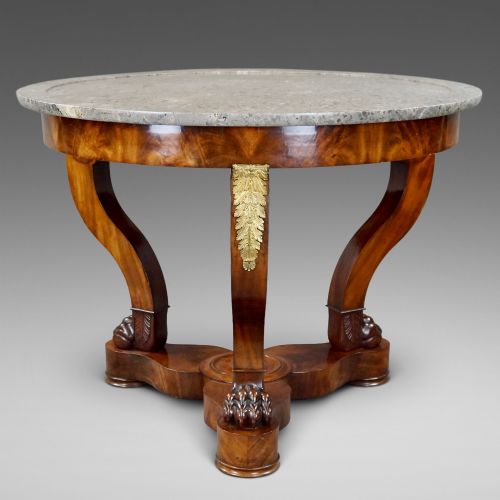




Empire Foyer Table
An empire foyer table anchors an entrance hall with monumental presence, bringing classical nineteenth-century proportion and rich mahogany or birch surfaces to domestic interiors.
Empire Foyer Table
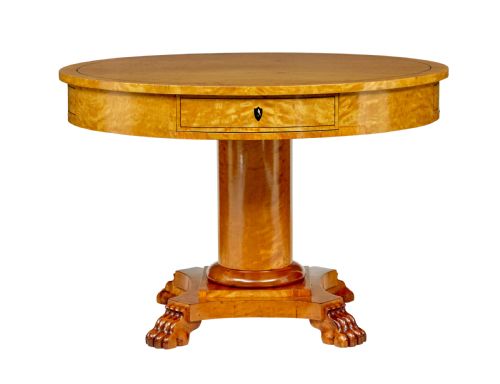
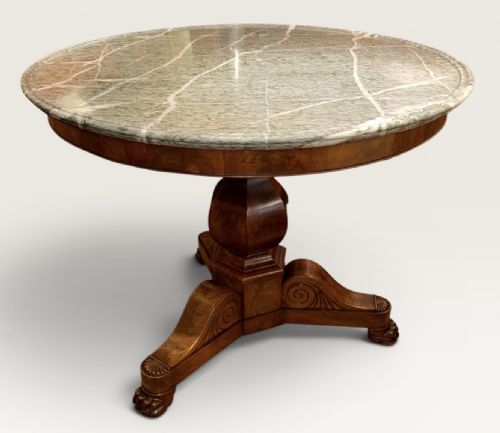
When searching for an empire foyer table, collectors encounter nineteenth-century centre tables, console tables, and gueridons originating from French and Swedish workshops. The most frequent form on this page is the round gueridon, designed to stand centrally in a room or an entrance hall.
These pieces draw on classical vocabulary, emerging from periods such as the French Empire, Charles X, and Swedish Biedermeier. Makers utilised substantial timber frames, often circular or oval in plan, intended to display heavy stone tops.
Console tables also appear within this selection, suited to placement against a hallway wall rather than standing free in the centre of the space. Their proportions reflect the architectural demands of nineteenth-century domestic design.
How they were made
Cabinetmakers constructed the foundational carcasses from timbers such as mahogany, birch, walnut, and burr elm, frequently applying fine wood veneers over structural woods. These wooden frames supported heavy inset slabs of white or veined marble.
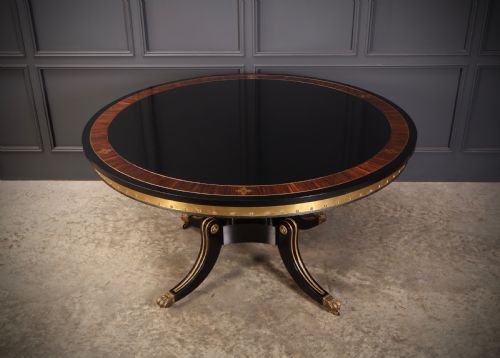
Decoration relied heavily on cast or chased ormolu and brass mounts applied to pedestals and friezes, alongside figurative elements like swans and rams' heads. Ebonised finishes and parcel silvering also appear, offering contrasting visual textures against polished timber.
What varies in quality
Quality rests in the crispness of the bronze or brass cast mounts and the fidelity of figurative details such as carved swans or rams' heads. Superior examples demonstrate confident execution in these metal and wooden ornaments.
The choice of timber grain and the quality of the inset marble top further divide standard items from exceptional ones. Select pieces employ striking burr elm, figured mahogany, or unusual porphyry marble slabs.
The Empire Foyer Table Glossary
- Gueridon
- A round occasional or centre table, typically supported by a central column above a tripod or platform base. This form dominates nineteenth-century French seating and entrance halls.
- Ormolu
- Gilded bronze applied as decorative mounts to furniture frames. It provides metallic contrast to dark mahogany and walnut timbers.
- Console table
- A table designed to stand against a wall, frequently secured with brackets or resting on front legs. These pieces suit narrow hallways and entrance spaces.
- Biedermeier
- A Central European style spanning the nineteenth century, known for domestic comfort and clean architectural lines. Swedish interpretations frequently utilise pale birch timber.
- Porphyry
- A hard igneous rock with crystal inclusions, imitated or utilised for luxury table tops. It grants an ancient imperial appearance to classical furniture.
Empire Foyer Table: Frequently Asked Questions
Where should an empire foyer table go?
These pieces suit entrance halls and spacious reception rooms where their circular or console forms can be viewed from multiple angles. Freestanding gueridons require adequate floor space to allow movement around them.
Console variations sit flush against a wall, making them practical for narrow corridors while maintaining classical architectural dignity.
How do I identify a nineteenth-century gueridon?
Look for timber construction methods consistent with the period, such as solid mahogany or birch framing supporting inset marble slabs. Characteristic decorative elements include classical brass mounts, ebonised details, and pedestal bases.
Proportions are typically heavier and more monumental than later twentieth-century reproductions, reflecting the neoclassical taste of the era.
Are marble tops original to these tables?
Many tables retain their original veined marble or porphyry tops, fitted precisely into the timber rim of the gueridon or console. The thickness and edge profile of the stone typically correspond to nineteenth-century stonemasonry standards.
Inspection of the underside reveals how the wooden frame supports the substantial weight of the stone slab.
What is the difference between French and Swedish pieces?
French examples from the Empire and Charles X periods often employ dark mahogany timbers paired with gilt bronze ormolu mounts and figurative carvings like swans. They present a bold, theatrical aesthetic.
Swedish interpretations frequently utilise blonde birch veneers, favouring clean geometric surfaces and restrained ornament characteristic of Biedermeier design.