
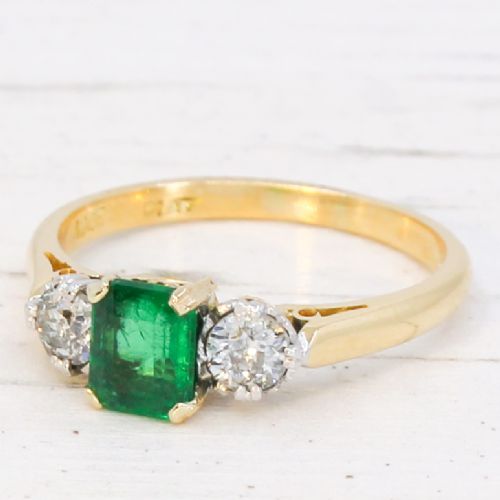
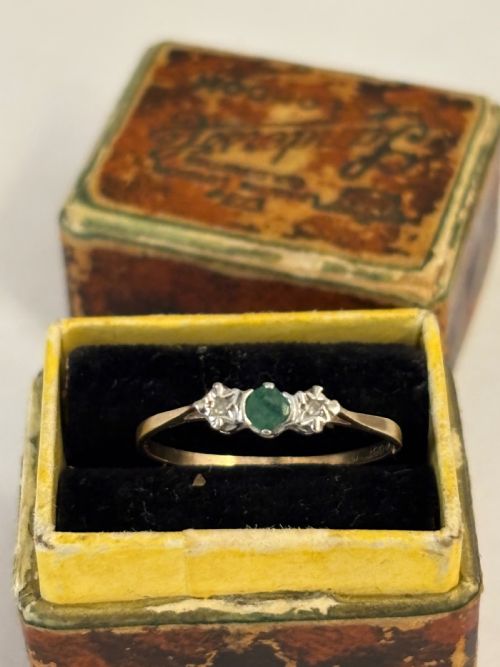


Emerald Trilogy Ring
An emerald trilogy ring brings together three stones to represent past, present, and future in a balanced finger-length setting.
Emerald Trilogy Ring
The layout typically places either a prominent emerald at the centre flanked by diamonds, or a central diamond accompanied by smaller emerald side stones. Surviving examples demonstrate how jewellers balanced these contrasting green and clear gems across decades of changing fashion.
Materials and construction
The metalwork relies heavily on platinum and various purities of gold, including yellow gold, white gold, and nine-carat or eighteen-carat compositions. Platinum gained particular favour during the Edwardian and Art Deco periods for its strength in holding delicate settings.
Gemstones are shaped into traditional cuts such as step cuts, emerald cuts, old cut diamonds, and baguette diamonds. These stones are secured in claw settings, bezels, or flush mountings designed to maximise light passage through the emerald and diamond facets.
Emerald Trilogy Ring Retail Price Guide 2026
Typical asking prices for emerald trilogy ring among the pieces listed under this phrase on Sellingantiques today, from the lower quarter to the upper quarter. They describe what is for sale here now, not the wider market.
Several rings show evidence of past lives attending jazz age parties, enduring through decades of fashion changes without losing their sparkle.
Judging quality in multi-stone rings
Quality rests on the visual harmony and individual merit of the three principal stones. A superior piece displays matching proportions where the side stones complement the central gem rather than overwhelming it.
The clarity and saturation of the emerald dictate much of the value, alongside the cut and brilliance of the accompanying diamonds. Settings executed with fine, even claw work or crisp geometric platinum framing indicate superior craftsmanship.
The Emerald Trilogy Ring Glossary
- Trilogy ring
- A jewellery piece featuring three distinct stones set in a row on the band. This configuration traditionally symbolises a couple's past, present, and future.
- Old cut diamond
- A diamond cut by hand before modern symmetrical standards were established in the early twentieth century. These stones exhibit smaller tables and broader facets that catch candlelight effectively.
- Step cut
- A gemstone cutting style featuring parallel facets that create a hall-of-mirrors effect. This cut is frequently applied to emeralds to emphasise their depth of colour.
- Baguette cut
- A rectangular stone cut with straight or tapered sides and step facets. Jewellers utilise these as slim side stones in Art Deco and mid-century rings.
Emerald Trilogy Ring: Frequently Asked Questions
What does a trilogy ring symbolise?
A trilogy ring carries a well-known romantic meaning, with the three stones representing the past, present, and future of a relationship. This symbolism makes the configuration a popular choice for engagement and anniversary jewellery.
The design dates back through multiple historical eras, allowing buyers to select a piece laden with both personal sentiment and period charm.
Are emerald trilogy rings suitable for daily wear?
Emeralds possess a distinct hardness that requires a measure of care during everyday tasks. While diamonds are exceptionally durable, emeralds benefit from protective settings like bezels or careful positioning.
Owners often remove these rings during manual work or heavy activity to protect the central green stone from impact and scratching.
How do I identify an Art Deco emerald ring?
Art Deco pieces typically display geometric symmetry, sharp lines, and extensive use of platinum alongside white or yellow gold. The mounting often incorporates baguette or old cut diamonds arranged in strict architectural patterns.
These rings contrast sharply with the softer, flowing floral motifs of the preceding Edwardian era.
What is a Colombian emerald?
Colombian emeralds originate from the famous mines of South America and are widely regarded for their rich, saturated green colour. Historical specimens from the early twentieth century frequently carry this regional origin.
Gemological certificates often accompany these specific stones to detail their geographic source and any oil treatments used to enhance clarity.