
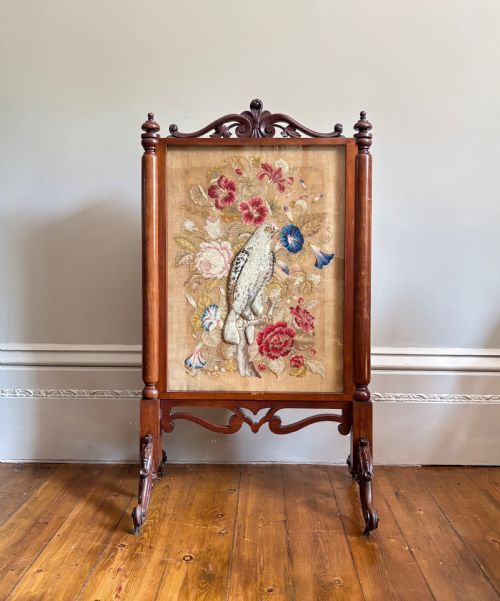


Embroidered Wooden Fire Screen
These embroidered wooden fire screen pieces block hearth heat while displaying needlework artistry.
Embroidered Wooden Fire Screen
An embroidered wooden fire screen combines a timber frame with a textile panel designed to shield a person's face from the intense heat of an open hearth. When you search for this phrase, you find examples originating from the Georgian, Regency, and Victorian periods, alongside occasional twentieth-century metamorphic designs.
The most common formats on this page are carved walnut or mahogany frames holding needlepoint, woolwork, tapestry, or Berlin work panels. You also encounter adjustable pole screens and dual-purpose occasional tables that transform to serve the fireside.
Origins span English workshops to nineteenth-century Anglo-Indian production, incorporating silver and gold thread alongside traditional wool and silk textiles. The variety ranges from simple sampler panels to elaborate architectural motifs like the Taj Mahal.
Materials and construction
Cabinetmakers constructed the supportive frames using dense timbers such as mahogany and walnut, frequently incorporating carved details into the woodwork. These wooden structures provide the rigid support necessary to tension and display the textile inserts.
Needlework panels utilise wool, silk, and canvas worked in techniques including needlepoint, Berlin work, and tapestry stitching. Some panels incorporate metal threads of silver and gold to create luminous decorative effects within the design.
Adjustable mechanisms rely on brass components and pole mounts that allow the textile shield to slide vertically to the desired height. Protective glass occasionally covers the delicate embroidery to shield the threads from soot and handling.
Listings span periods from the Georgian era through the Regency and Victorian epochs, alongside twentieth-century items.
Distinctions in quality
Quality rests upon the crispness of the timber carving and the density of the wood used for the frame. Solid walnut and mahogany structures with deeply carved ornament indicate a higher grade of production than plain or softwood carcasses.
The complexity and execution of the needlework panel dictate the standard of the piece. Finely worked Berlin work, tapestry, or metal thread embroidery demonstrate greater artisanal investment than simple or sparse needlework samplers.
Integration between the textile panel and the wooden frame reveals the maker's intent. Secure housing that protects the edges of the embroidery and smooth mechanical action in adjustable pole screens or metamorphic tables separate superior examples from basic domestic items.
The Embroidered Wooden Fire Screen Glossary
- Berlin work
- A style of needlepoint popular in the nineteenth century that used brightly coloured wools worked over printed paper charts. This technique allowed makers to produce elaborate pictorial and floral designs with ease.
- Pole screen
- A type of fire screen featuring a vertical wooden shaft on a weighted base, carrying a sliding panel that can be adjusted for height. It allowed people to position the textile shield precisely between their face and the hearth.
- Needlepoint
- A form of canvas work embroidery stitched by hand using wool, silk, or metallic threads over an open-weave mesh. It forms a durable and decorative surface suitable for domestic furnishings.
- Metamorphic
- Describing furniture designed to transform into another functional object, such as a fire screen that converts into an occasional table. This ingenuity suited compact Victorian and twentieth-century interiors.
- Tapestry
- A heavy textile woven or worked by hand to depict figurative scenes, foliage, or heraldic motifs. In fireside accessories, the term frequently describes dense needlework panels mimicking historical woven hangings.
Embroidered Wooden Fire Screen: Frequently Asked Questions
What is an embroidered wooden fire screen?
An embroidered wooden fire screen is a decorative accessory designed to shield people from the radiant heat of an open coal or wood fire. It consists of a timber frame holding a textile panel worked in wool, silk, or needlepoint.
These pieces served a practical purpose in period parlours before central heating existed, while also displaying the needlework skills of the household or professional embroiderers.
How do you use a pole screen?
A pole screen operates by sliding the framed textile panel vertically along a central wooden shaft. You adjust the height to block the heat coming directly from the fireplace toward a chair.
The weighted base keeps the entire stand stable while the panel is repositioned to suit different seating heights.
How do I date a fire screen?
Dating relies on identifying the timber used in the frame and the style of the carving alongside the textile technique. Georgian and Regency examples often feature mahogany frames and simpler needlework, while Victorian pieces lean towards walnut, heavy carving, and Berlin work.
Twentieth-century variations introduce metamorphic functions that combine the screen with an occasional table.
Were these screens made in England?
Many examples originate from English workshops utilising native and imported timbers like mahogany and walnut. The listings also include pieces from Anglo-Indian production featuring regional materials and metallic embroidery.
Domestic makers often worked the needlepoint panels themselves, inserting them into professionally built frames.