
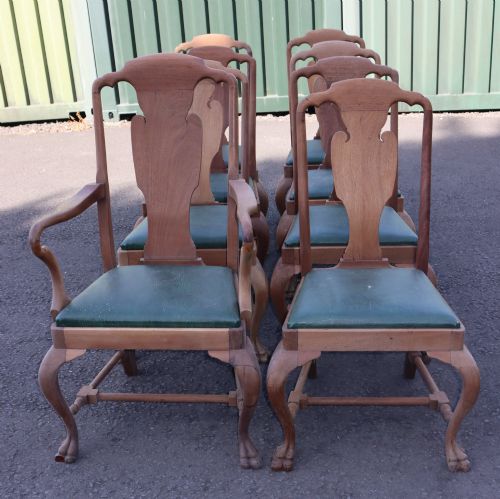


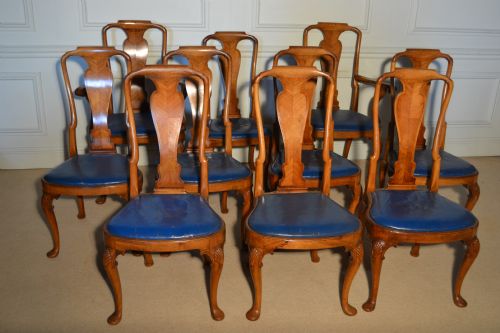
Eight Queen Anne Chairs
Eight queen anne chairs bring scale and rhythm to a dining room, offering matched sets from the eighteenth century to the twentieth.
Eight Queen Anne Chairs
Eight queen anne chairs comprise matched sets of dining chairs spanning the eighteenth century to the twentieth century. The version you are most likely to meet on this page is the walnut or mahogany set from the Edwardian period or the nineteen-twenties, built in revival styles.
These pieces function primarily as dining chairs, often appearing alongside tables in matching timber. The form brings uniformity to large dining spaces through consistent shaping of backs and legs.
The evidence shows groupings that include oak, mahogany, and burr walnut. Revival periods produced many of these large sets, alongside original eighteenth-century examples.
What varies in quality
The choice of timber creates distinct visual tiers, ranging from plain oak and mahogany to highly figured burr walnut. Figured veneers and carved details elevate the presence of a set across multiple chairs.
Makers and workshops of different standing produced these sets, from large cabinet makers to local workshops. The consistency of the carving across all eight pieces distinguishes the work.
Listings feature walnut, burr walnut, mahogany, and oak across Edwardian, nineteenth-century, and twentieth-century periods.
Spillman And Co·Epstein·Waring And Gillows·Charles Walker Of Harrogate·Maple And Co
The Eight Queen Anne Chairs Glossary
- Queen Anne style
- A design movement characterised by curved lines, spooned backs, and cabriole legs. It draws inspiration from the early eighteenth century and saw major revivals in the Victorian and Edwardian eras.
- Burr walnut
- A wood sliced from walnut tree growths, producing swirling and intricate grain patterns. It was used on high-end revival furniture.
- Cabriole leg
- A furniture leg that curves out and then in, resembling an animal's leg in motion. It typically terminates in a pad or hoof foot.
- Drop-in seat
- A removable seat frame upholstered in fabric, leather, or textile that drops into a rebate in the chair rail.
- High back
- A tall chair back designed to support the head and shoulders, frequently seen in earlier forms.
Eight Queen Anne Chairs: Frequently Asked Questions
How do I care for leather seats?
Keep leather conditioned with appropriate balms to prevent drying and cracking over time. Avoid placing the chairs in direct sunlight or near direct heat sources.
Dust regularly with a soft cloth to protect the surface from abrasive particles. Professional cleaning helps maintain older upholstered panels without damaging the material.
Are these chairs suitable for daily use?
Solid construction in walnut, mahogany, and oak provides sturdy support for regular dining. Checking the joints periodically ensures stability across larger sets.
Replacement upholstery or recovered pads can refresh the seating for daily comfort. Older frames benefit from gentle handling rather than heavy impacts.
What timber types should I expect?
Walnut and mahogany dominate the available pieces, often featuring burr walnut veneers on decorative surfaces. Oak and beech also appear in Edwardian and revival iterations.
Timber choice often reflects the period of manufacture, with earlier pieces using solid native woods and later revival sets employing veneered panels.
How do I distinguish revival periods?
Edwardian and twentieth-century revival pieces often display machine-assisted joinery alongside hand-carving. The crispness of the carving and the finish help indicate the era of production.
Eighteenth-century originals show construction methods and wear patterns consistent with earlier hand tools. Comparing wood patination aids in identifying the true age of a set.