


Eight Drawer Mahogany Tallboy
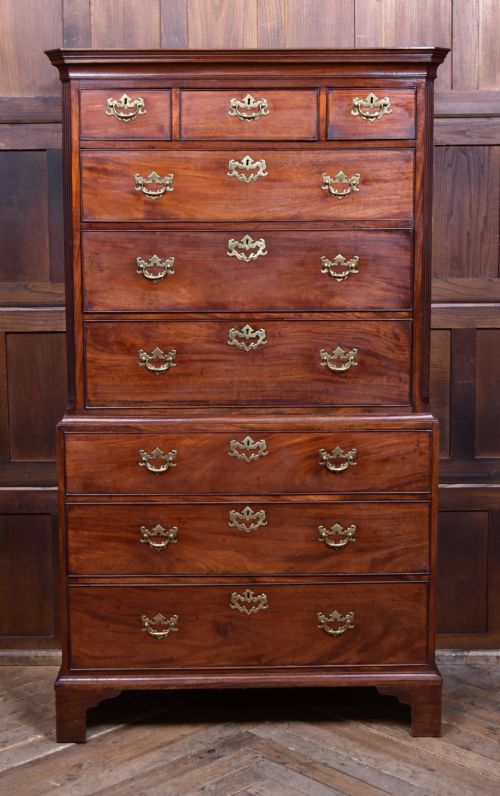
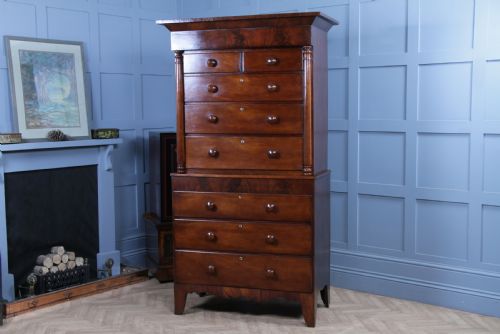
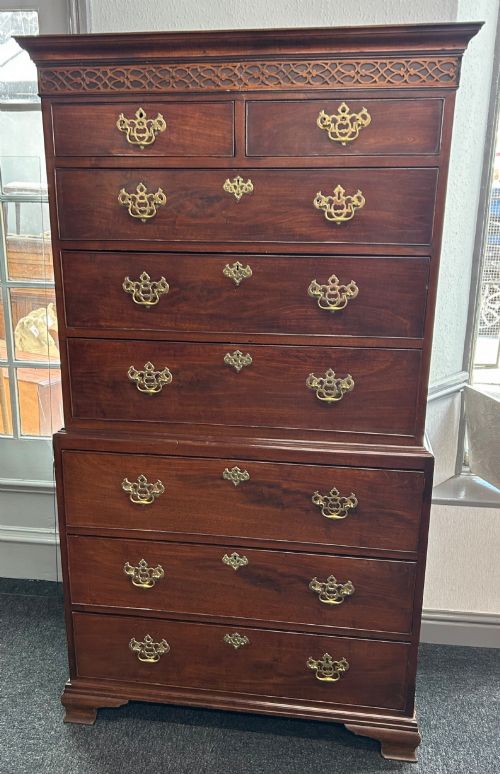
An eight drawer mahogany tallboy offers towering storage with classical proportion, uniting upper and lower chest sections in rich timber.
Eight Drawer Mahogany Tallboy
When you search for an eight drawer mahogany tallboy, you encounter vertical storage furniture built in two stacked sections, predominantly originating from the Georgian and 18th Century periods. These imposing pieces combine a smaller set of drawers above a larger base chest, creating a grand silhouette suited to high-ceilinged rooms.
The versions most commonly met on this page include George III chest on chest designs and late 18th Century tallboys rendered in solid mahogany or flame mahogany veneer. Variations range from bow-fronted carcases to Scottish regional pieces and specialised forms such as Wellington chests and collectors cabinets.
How they were made
Cabinet makers constructed these tall forms using dense mahogany timber, frequently applying figured flame mahogany veneer to the drawer fronts for visual depth. Carcases were assembled with traditional joinery, housing multiple graduating drawers that required careful fitting within the upper and lower frames.
Hardware played a functional and decorative role, with original brass swing handles and escutcheons secured to the drawer faces. Timber inlay and subtle mouldings occasionally defined the cornices and bracket feet, marking the stylistic touch of the period.
Listings span the Georgian, Edwardian, and 19th Century periods, featuring mahogany, brass, and wood inlay.
What varies in quality
Quality rests primarily in the choice of timber and the handling of the veneer, where dramatic flame figuring elevates the visual impact of the piece. The crispness of the cornice mouldings and the proportions between the upper and lower chests also distinguish finer examples from simpler workshops.
Internal construction, including the timber used for drawer linings and the smoothness of the drawer action within the stacked carcase, separates standard cabinet work from superior Georgian craftsmanship. Preservation of original brass hardware and untouched surface patination further define the hierarchy among surviving pieces.
The Eight Drawer Mahogany Tallboy Glossary
- Chest on chest
- A tall storage unit formed of two distinct sections, where a smaller chest sits directly upon a larger base chest. This stacked configuration maximises vertical capacity.
- Tallboy
- A traditional term for a high chest of drawers, often encompassing both single-carcase tall chests and two-part chest on chest designs. It provides substantial storage within a compact floor footprint.
- Flame mahogany veneer
- A thin slice of mahogany timber cut from the fork of the tree where branches meet, creating a distinctive flickering flame pattern. Cabinet makers applied this to prominent surfaces like drawer fronts.
- Wellington chest
- A narrow vertical chest of drawers secured by a hinged side locking bar that fastens with a key. This form emerged in the 19th Century for discreet storage.
- Bow-fronted
- A furniture front curved outward in a convex sweep. This styling softens the imposing rectilinearity of taller case pieces.
Eight Drawer Mahogany Tallboy: Frequently Asked Questions
Where should I place a tallboy?
A tallboy requires a room with sufficient ceiling height to accommodate its towering proportions without overwhelming the space. Bedrooms and dressing rooms provide traditional placement, offering deep vertical storage while occupying minimal floor area.
Because these pieces combine two heavy sections, positioning them against a stable wall away from direct heat sources protects the mahogany timber and veneered surfaces over time.
How do I care for mahogany furniture?
Maintenance involves keeping the timber away from direct sunlight and sudden temperature shifts to prevent the mahogany and its veneers from drying out or splitting. Gentle dusting with a dry, soft cloth preserves the polish without introducing moisture.
Occasional application of traditional beeswax nourishes the grain and enhances the natural lustre of the wood. Avoid silicone-based polishes that can build up and dull the historic finish.
What is the difference between a tallboy and a chest on chest?
While the terms are often used interchangeably, a chest on chest specifically denotes a two-part furniture form where a smaller upper chest sits squarely upon a larger lower base. A tallboy can encompass this stacked design as well as single tall chests of drawers.
Both forms share the primary purpose of providing extensive vertical storage, but the chest on chest construction allows the two halves to separate for easier transport and placement.
How can I identify Georgian period furniture?
Georgian pieces are typically characterised by solid proportions, classical architectural moulding details, and the use of dense mahogany timber. Craftsmanship from this era often incorporates hand-cut dovetail joints on the drawer construction and period-appropriate brass hardware.
Examining the secondary timbers inside the drawers and the overall patination of the wood helps confirm the age and authenticity of 18th Century examples.