
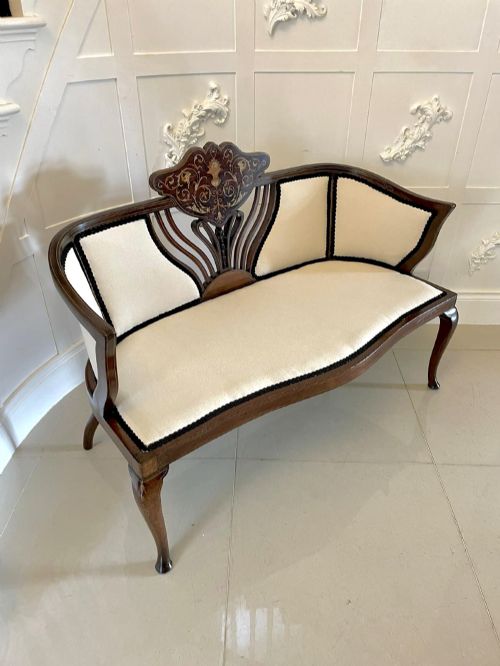
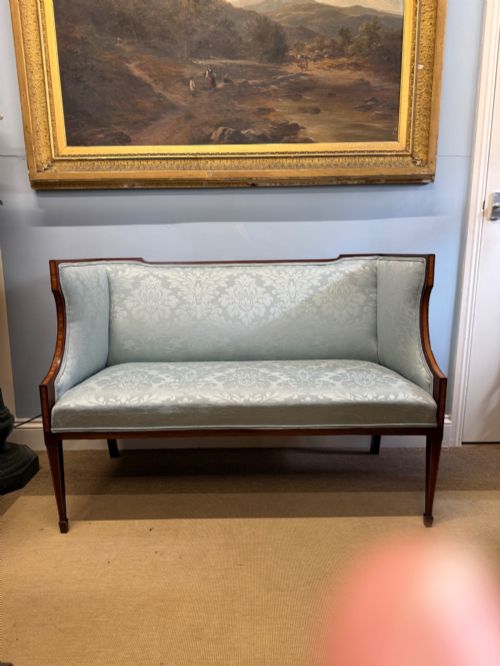


Edwardian Two Seater Bench
An edwardian two seater bench offers compact seating scaled for parlours and bedrooms, bringing period character and inlaid woodwork into modern rooms.
Edwardian Two Seater Bench
When you search for an edwardian two seater bench, you encounter a variety of compact upholstered seats designed for domestic parlours, salons and bedrooms. These pieces appear under several historical designations, including settees, small sofas, window seats and conversation seats.
The selection on this page spans the Edwardian period alongside late Victorian and early twentieth-century examples, with stylistic influences ranging from Queen Anne Revival and Louis XVI design to Edwardian Art Nouveau and Viennese Bentwood.
Materials and Construction
The frameworks rely predominantly on solid hardwoods such as mahogany and walnut, frequently accented with contrasting satinwood inlay, bone details or painted finishes. Beech appears in bentwood production, while specialised items incorporate canework for structural panels.
Upholstery relies on traditional textile coverings including fabric, velvet, damask and patterned upholstery. These textiles are fixed over sprung or padded seat foundations designed for domestic seating.
Conversation seats allow two people to sit facing opposite directions while sharing a single shared frame.
Craftsmanship and Detail
Quality separates through the precision of the cabinetwork, visible in the sharpness of satinwood inlay, carved woodwork, and fluted legs. Superior examples maintain structural integrity across joints and delicate arm supports.
The handling of secondary materials also distinguishes pieces, such as the intricacy of bone embellishments or the execution of painted surfaces on beech and walnut frames.
The Edwardian Two Seater Bench Glossary
- Settee
- A long upholstered seat for more than one person. This term frequently overlaps with small sofas and salon seats in period listings.
- Satinwood Inlay
- Decorative wood veneers inserted into contrasting timber surfaces. Craftsmen utilise this technique to create geometric or floral patterns.
- Canework
- Woven cane material utilised for seat panels or backrests. It provides a lightweight, textured alternative to solid wood or upholstery.
- Bentwood
- Wood softened through steaming and bent into curved structural forms. This technique defines specific twentieth-century seating designs.
Edwardian Two Seater Bench: Frequently Asked Questions
What is an edwardian two seater bench?
An edwardian two seater bench is a compact upholstered seating form produced around the turn of the twentieth century. These pieces were made for domestic spaces including bedrooms, halls and drawing rooms.
They combine timber frames of mahogany or walnut with decorative inlays and upholstered seats scaled for two occupants.
Where were these benches placed?
Period seating of this scale served versatile functions within domestic interiors. They frequently sat beneath windows as window seats or at the foot of beds in larger chambers.
Smaller salon settees also furnished reception rooms and parlours where space required more compact seating arrangements than a full-size sofa.
How do I identify the period?
Dating relies upon stylistic markers, timber choices, and construction techniques characteristic of the early twentieth century and late nineteenth century. Edwardian pieces often display satinwood inlay and lighter mahogany frames.
Earlier Victorian examples tend to feature heavier proportions and darker woods, while later designs incorporate bentwood or specific revival styles.
Are these seats comfortable?
Original period seating was constructed with traditional padding and sprung foundations intended for formal domestic use. Comfort levels depend upon the condition of the internal upholstery and webbing.
Many examples retain their original padding, while others are acquired for re-upholstery to suit modern seating preferences.