
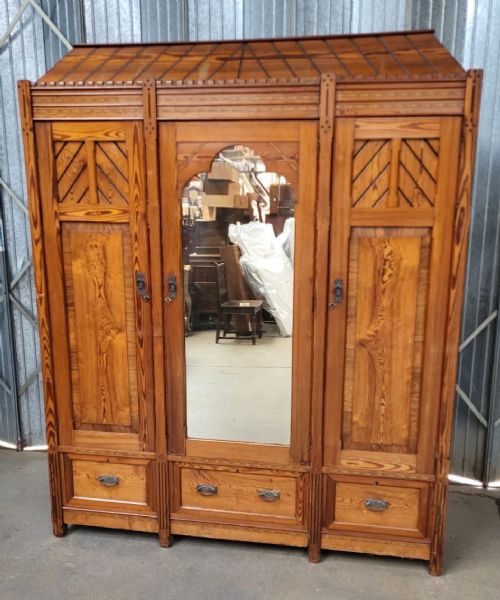


Edwardian Triple Armoire
An Edwardian triple armoire offers substantial scale and fitted storage, combining period craftsmanship with impressive presence for the bedroom.
Edwardian Triple Armoire
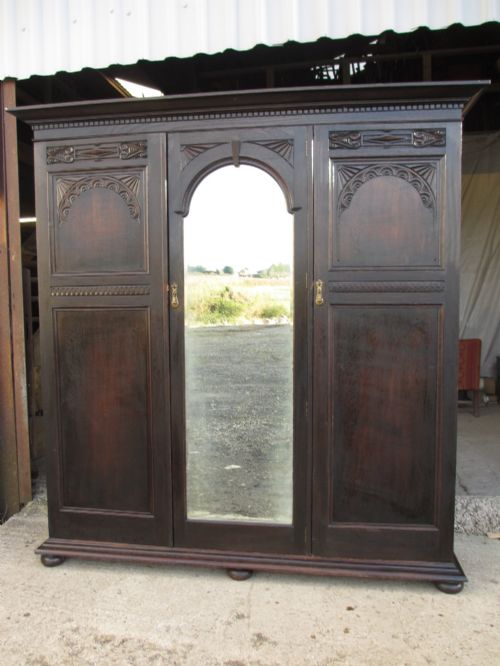
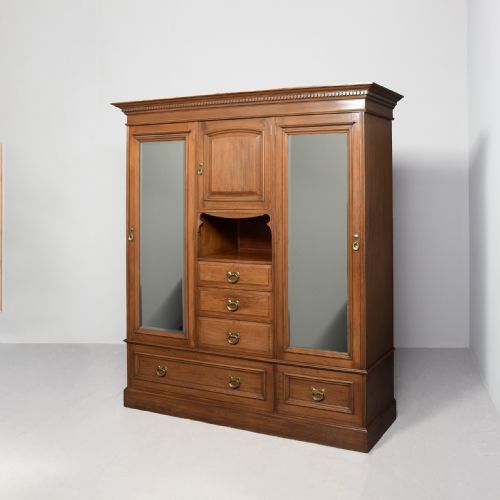
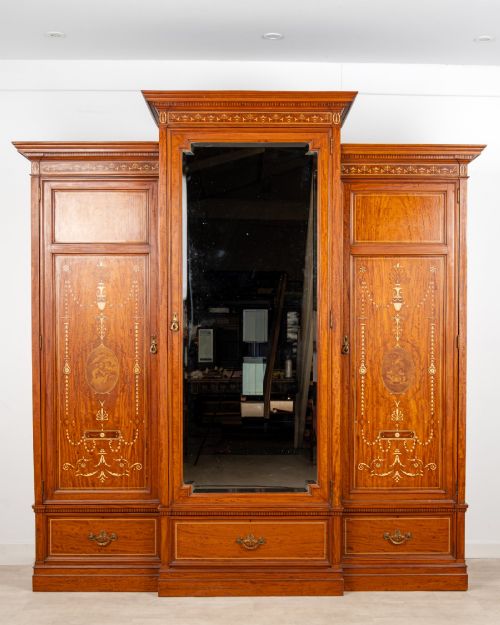
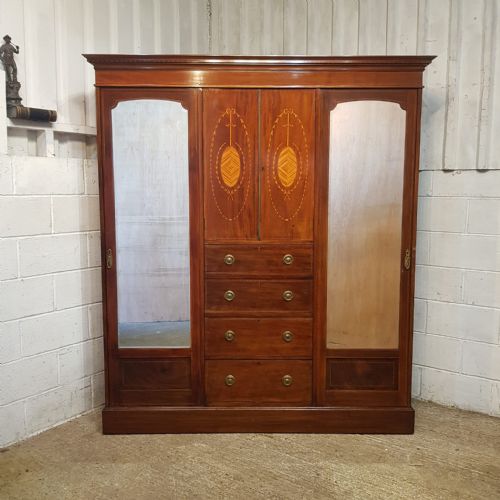
When searching for an edwardian triple armoire, buyers encounter large three-section wardrobes originating primarily from the Edwardian era, alongside related Victorian and early twentieth-century examples. These pieces typically feature a central section flanked by two matching outer compartments, often incorporating mirrored doors and compactum configurations with internal drawers.
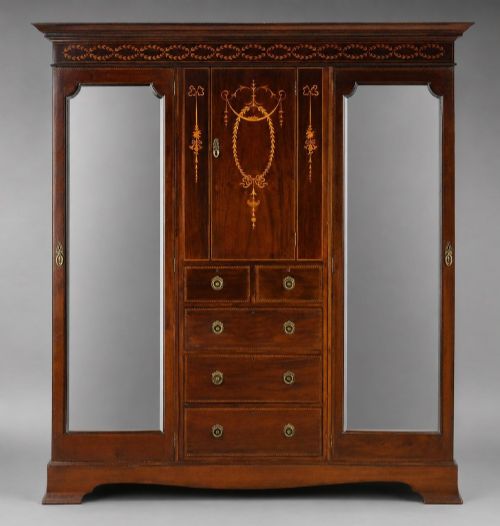
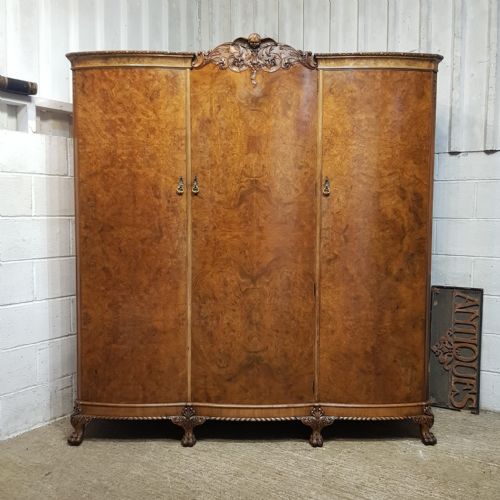
Mahogany dominates the selection, frequently enhanced with decorative inlay, alongside oak, satinwood, walnut, and burr walnut. The forms span straightforward rectilinear designs to serpentine and bow-fronted shapes, reflecting styles from Arts and Crafts and Art Nouveau to Chinoiserie Revival and classical revivals.
Materials and construction
Cabinet makers utilised solid timbers and veneers such as mahogany, satinwood, oak, and walnut, often applying elaborate inlay work to the exterior surfaces. Brass hardware secures the doors and internal fittings, while bevelled glass is set into full-length mirror doors.
Construction techniques include panelled door assembly, internal shelving and hanging space organisation, and modular multi-section carcases designed for transportation and reassembly within the home.
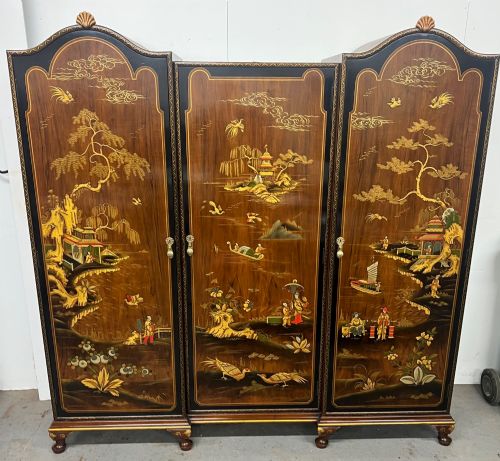
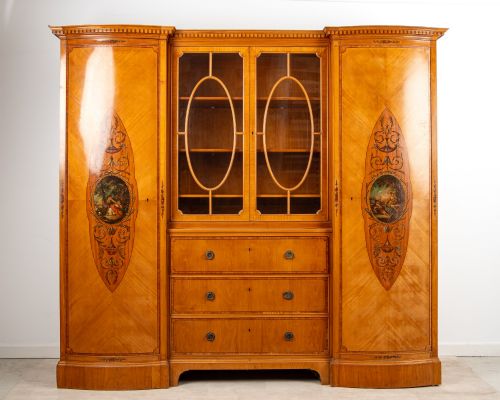
Hand-painted panels on satinwood wardrobes bring whimsical Chinoiserie scenes into the bedroom.
Distinctions in quality
Quality reveals itself in the selection of figured timber veneers, such as flamed mahogany and burr walnut, and the precision of the contrasting inlay work. Finer examples display meticulous hand-painted panels, intricate carving, and superior brass mounts rather than plain or utilitarian surfaces.
The integrity of the structural joinery, the weight and clarity of the bevelled mirror glass, and the smooth operation of multi-section compactum drawers separate standard workshop production from works by notable makers.
Maples and Co
The Edwardian Triple Armoire Glossary
- Armoire
- A large wardrobe or cupboard, typically with doors enclosing hanging space and shelves. In period furniture, the term often describes grander wardrobe forms.
- Compactum
- A multi-section wardrobe combining hanging space with internal banks of drawers, trays, and smaller compartments. This efficient design maximises storage within a single footprint.
- Inlay
- A technique where pieces of contrasting wood, shell, or metal are inserted into depressions in the carcase wood to form decorative patterns. It defines much of the surface ornamentation on Edwardian cabinetry.
- Serpentine
- A front profile characterised by a gentle convex curve flanked by two concave curves. This shaping requires advanced woodworking skill to execute across large wardrobe doors.
- Arts and Crafts
- A design movement valuing hand craftsmanship, honest construction, and simple material expression. Pieces in this style often utilise solid oak or pitch pine with understated hardware.
Edwardian Triple Armoire: Frequently Asked Questions
How do I dismantle an edwardian triple armoire?
These large wardrobes are typically constructed in three main sections - the central tower and two flanking wings - secured with internal bolts or screws. Dismantling requires numbering the disassembled panels and removing the heavy mirror doors first to ensure safe transport.
Professional removal and reassembly are recommended to protect the historic timber joints, cornices, and decorative mouldings from accidental damage.
How do I organise the interior of a compactum?
A compactum layout typically provides a combination of central hanging rails, hooks, and sliding linen trays or deep drawers behind the outer doors. This arrangement allows for versatile storage of garments, bed linen, and accessories within one cabinet.
Utilising cedar blocks or breathable cotton covers helps protect garments stored inside enclosed timber compartments over long periods.
What is the difference between an armoire and a compactum?
An armoire generally focuses on full-length hanging space behind large doors, occasionally featuring a drawer in the base. A compactum integrates dedicated banks of internal drawers and shelving alongside the hanging compartments.
Both forms belong to the broader category of large wardrobes, but the compactum offers a more compartmentalised internal storage system.