
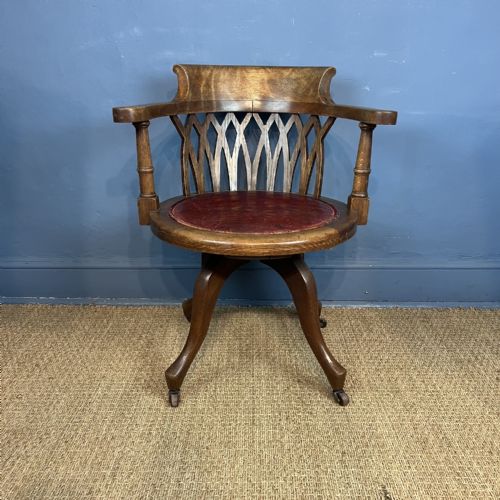
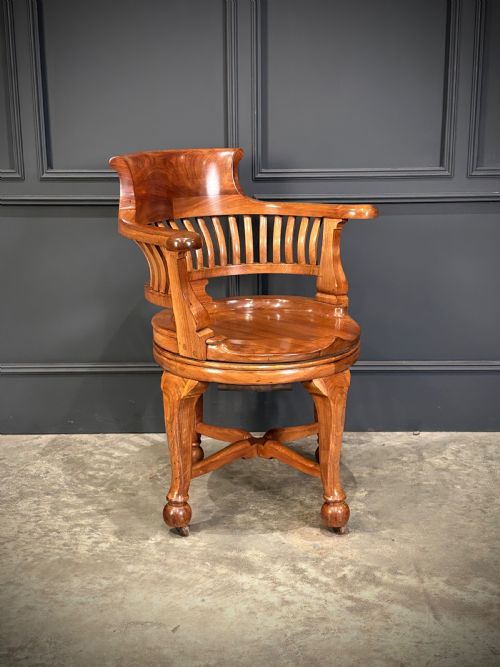
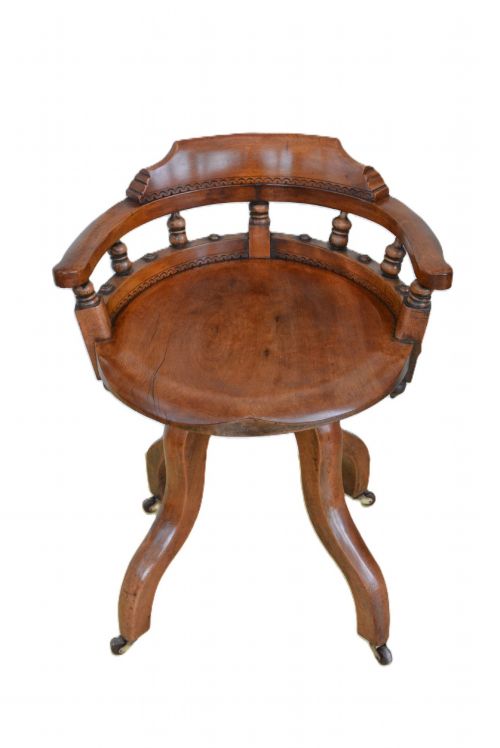


Edwardian Swivel Armchair
An edwardian swivel armchair brings practical desk utility and heavy timber character to a study.
Edwardian Swivel Armchair
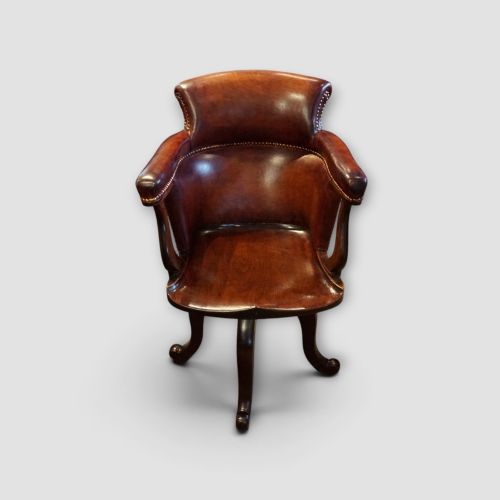
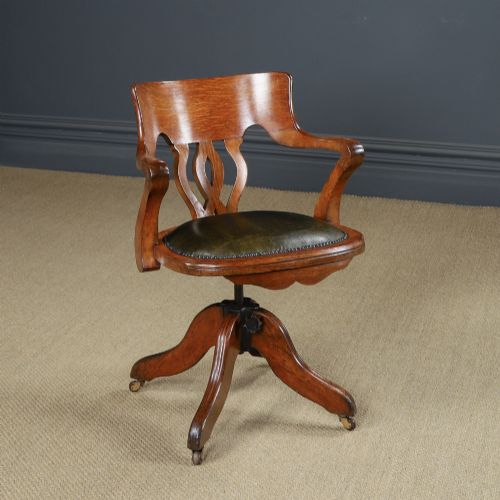
An edwardian swivel armchair is primarily found in sturdy oak or rich mahogany, built to function as a dependable office or desk seat. These pieces frequently feature revolving mechanisms and adjustable heights suited for working at a partner desk or library table.
The versions most common on this page date from the Edwardian era and the early twentieth century, though examples stretch back into the Victorian period and forward to the nineteen-twenties. They span straightforward utilitarian office chairs to more decorative desk armchairs influenced by Arts and Crafts design.
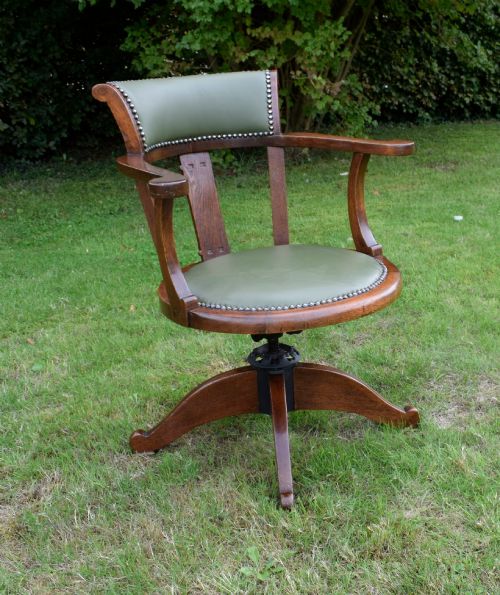
Makers utilised various secondary woods alongside the primary timbers, combining oak, beech, ash, and birch to construct the internal frames and spindle backs. Buyers encounter both plain wooden seats and versions upholstered in green or tan leather.
Construction and materials
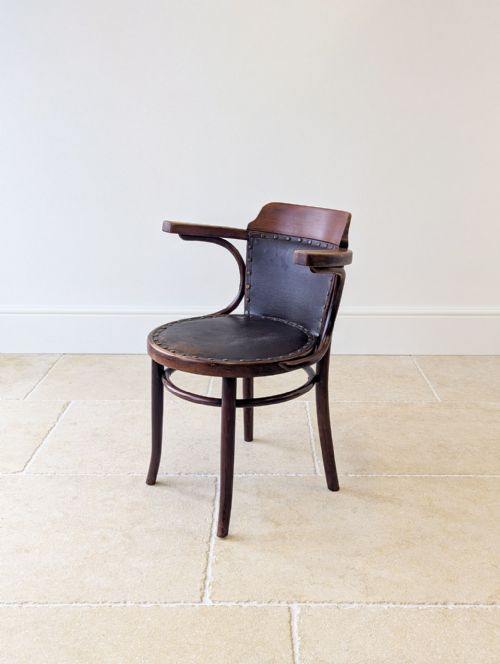
Makers constructed these chairs using dense hardwoods like oak and mahogany for the main frames, often pairing them with bentwood or carved elements. Iron and brass mechanisms provide the swivel and tilt functions beneath the seat.
Upholstered variants rely on supple leather hides attached with brass tacks over padded seats, whilst other examples showcase plain moulded wooden seats or woven cane panels.
Listings span multiple decades, incorporating Victorian and Edwardian periods alongside nineteen-twenties production.
Judging the build and mechanics
The standard of a revolving desk chair depends largely on the complexity of its undercarriage and the sturdiness of the timber frame. Heavier carved mouldings and inlaid satinwood details separate standard office seating from finer library armchairs.
The integrity of the iron and brass swivel mechanism determines the operational smoothness, whilst the quality of the hide and depth of the wood polishing dictate the overall finish.
Kendrick & Jefferson·Edward William Godwin·Shoolbred
The Edwardian Swivel Armchair Glossary
- Swivel
- A rotating mechanism beneath the seat that allows the occupant to turn freely in multiple directions. This permits easy movement between a desk and surrounding shelving.
- Revolving
- An alternative term for a chair that rotates on a central spindle base. It is commonly found on heavy office and library seating from the nineteenth and twentieth centuries.
- Bentwood
- Wood softened by steam and bent into curved shapes, notably utilised by makers like Thonet. This technique creates graceful, continuous framing without heavy joints.
- Bergere
- A type of upholstered armchair featuring enclosed cane work on the sides or back. It introduces lighter textural elements to heavy timber office furniture.
- Tilt
- A mechanical function allowing the upper portion of the chair to lean backward against spring tension. It provides added comfort during long hours at a desk.
Edwardian Swivel Armchair: Frequently Asked Questions
How do I identify an Edwardian swivel armchair?
Look for combination woods like oak and mahogany paired with early iron or brass swivel mechanisms underneath. The proportions typically match the domestic and office interiors popular during the early twentieth century.
Check for characteristic joinery and simpler aesthetic lines that distinguish these pieces from heavily carved mid-Victorian seating or later twentieth-century office furniture.
Are these chairs suitable for daily computer desk use?
Many buyers successfully utilise these revolving chairs at modern desks, provided the adjustable height mechanism aligns properly with the desktop. The sturdy hardwood frames offer reliable daily support.
One should verify the mechanics and seat height before purchase to ensure the piece accommodates a modern working posture.
What is the difference between an office chair and a captain's chair?
Captain's chairs typically feature a low, rounded enclosing backrest supported by vertical spindles above a wooden or leather seat. Office chairs frequently incorporate more complex swivel and tilt mechanics.
Both forms served administrative and library roles, but office variants prioritise movement and mechanical adjustment.
How should I care for the leather seat?
Maintain the leather by applying appropriate conditioning balms periodically to prevent the hide from drying out or cracking. Keep the chair away from direct heat sources and strong sunlight.
Regular dusting with a dry cloth keeps the polished timber and brass hardware in good condition.