


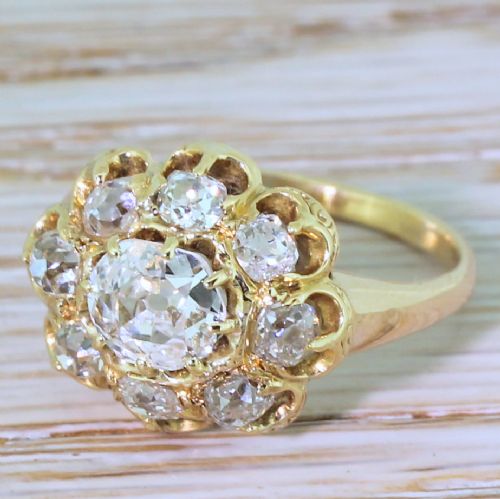
Edwardian Solitaire Cluster Ring
An edwardian solitaire cluster ring brings together central brilliance and surrounding stones in a timeless floral motif.
Edwardian Solitaire Cluster Ring
When you search for an edwardian solitaire cluster ring, you are looking at rings defined by a central stone framed by a cluster of smaller gems. The pieces on this page span several eras, including Victorian, Edwardian, Art Deco and subsequent decades, alongside the specific Edwardian examples.
The forms range from floral daisy motifs to twist designs, bombe shapes and diamond engagement rings. You will encounter various object configurations, from pure solitaire types to elaborate diamond and sapphire clusters.
Materials represented across the selection include platinum, 18ct yellow gold, gold, silver, sapphire, emerald and amethyst, alongside the dominant diamond centrepieces. The stylistic influences move fluidly between early Victorian, Victorian, Edwardian and Art Deco aesthetics.
How these rings were made
The construction relies heavily on the combination of platinum and yellow gold, often paired together within a single mounting to secure the gemstones whilst providing contrasting warm and cool metal tones. Goldsmiths utilised durable precious metals to form intricate settings such as twist bands and floral cluster heads.
Gemstones are shaped using historical cutting techniques, including rose cuts, old European cuts, old transitional cuts and standard brilliant facets. These cuts were executed by hand to maximise light return within the constraints of the rough material available at the time.
Floral daisy motifs ensure your hand forever channels a perpetually blooming Edwardian garden.
What varies in quality
Quality differences lie in the weight and proportion of the central stone relative to the surrounding cluster, with larger carat weights commanding greater presence. The precision of the antique stone cutting, whether old European or transitional, dictates how light interacts with the facet structure.
The choice of metalwork also distinguishes pieces, particularly where platinum and 18ct yellow gold are combined to create refined gallery work and secure prong or bezel settings. The integrity of the original motif, such as a floral daisy arrangement or twist band, preserves the intended aesthetic balance.
The Edwardian Solitaire Cluster Ring Glossary
- Cluster ring
- A ring featuring a prominent central gemstone surrounded by a cluster of smaller surrounding stones. This layout maximises visual impact and creates floral or geometric patterns.
- Old European cut
- An early form of brilliant cut diamond characterised by a small table, heavy crown and open culet. It produces distinctive broad flash patterns under candlelight.
- Rose cut
- A vintage diamond cut featuring a flat base and a domed crown faceted with triangular shapes. It resembles an unopened rosebud.
- Transition cut
- A diamond cut utilised during the shift from old cuts to modern brilliants, combining deep proportions with modern facet arrangements.
- Bombe ring
- A ring style featuring a domed, rounded profile that swells outwards from the finger. It offers substantial volume and prominent gemstone display.
Edwardian Solitaire Cluster Ring: Frequently Asked Questions
What is an edwardian solitaire cluster ring?
An edwardian solitaire cluster ring is a finger ornament featuring a central focal stone framed by smaller accent gems, originating from the early twentieth century.
Such pieces often incorporate platinum settings paired with yellow gold bands to highlight the central diamond or coloured gemstone.
How do I care for antique diamond rings?
Antique diamond rings require gentle cleaning with warm soapy water and a soft brush to remove everyday debris from beneath the settings.
Store them individually in lined boxes to prevent the hard gemstones from scratching softer metals or adjacent jewellery pieces.
How can I tell an Edwardian ring apart from a Victorian one?
Edwardian rings frequently utilise platinum for delicate, lace-like metalwork, whereas Victorian pieces often rely heavier on yellow gold and silver settings.
Motifs in the Edwardian era lean towards light floral patterns, whilst Victorian designs often display bolder, more robust gold structures.
What makes old cut diamonds different?
Old cut diamonds are shaped by hand rather than modern laser machinery, resulting in unique facet proportions and larger culets at the base.
These historical stones produce a softer, warmer glow compared to the precise brilliance of contemporary round brilliant diamonds.
Can I wear these rings every day?
These rings can be worn daily provided you remove them during heavy manual tasks, gardening or contact sports to protect the antique settings.
Regular inspection by a jeweller ensures that the prongs holding the cluster stones remain secure over time.