
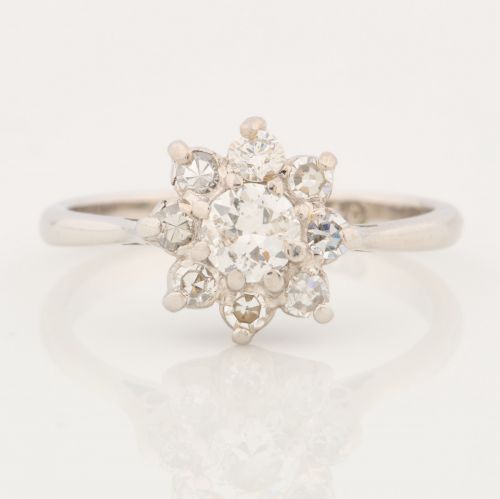
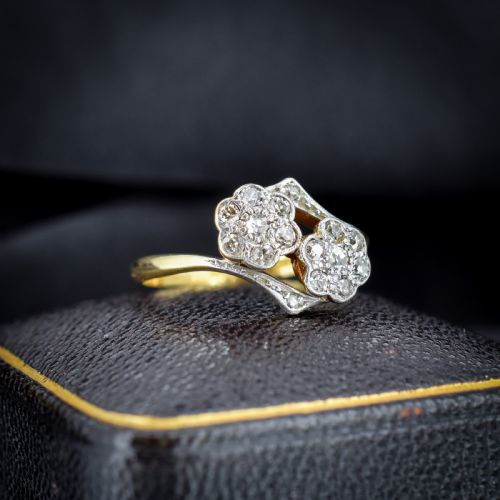


Vintage Flower Head Ring
A vintage flower head ring captures a floral cluster in precious metal and gemstones, offering timeless character.
Vintage Flower Head Ring
A vintage flower head ring centres on a cluster formation resembling a bloom, utilising central stones surrounded by smaller gems to create a floral silhouette. These pieces appear across multiple periods including Victorian, Edwardian, Art Deco, and mid-century decades.
Most examples on this page take the form of diamond daisy clusters and multi-stone arrangements set in various gold purities or platinum. Buyers frequently encounter Edwardian and 1950s interpretations featuring round cluster designs and double twist bands.
Makers and jewellers historically utilised floral motifs for engagement and dress rings, resulting in varied scale from delicate Edwardian configurations to bolder mid-century statements. The overarching aesthetic remains rooted in natural forms rendered through traditional cluster techniques.
Materials and construction
Construction relies heavily on 18ct gold, 9ct gold, and platinum to secure the central stones and surrounding petalled borders. Platinum settings frequently appear alongside yellow or white gold shanks, particularly in Edwardian and Art Deco examples.
Gems such as diamonds, garnets, rubies, emeralds, and opals are arranged in close cluster formations. Metalwork techniques involve claw settings, bezel mounts, and double twist bands that elevate the central floral head.
A double twist band gently cradles a diamond cluster, proving that jewellers liked their daisies with a little extra spin.
Factors determining quality
Quality separates through the precision of the stone setting and the proportional harmony of the floral cluster. Finer pieces demonstrate careful symmetry in the arrangement of surrounding petals and secure integration of the mount to the shank.
The choice of materials also divides the range, with platinum-topped mountings and higher carat gold bases representing finer manufacturing standards. Furthermore, the cut and matching of the central and peripheral gems influence the overall visual cohesion of the piece.
The Vintage Flower Head Ring Glossary
- Cluster ring
- A ring featuring a central stone encircled by a group of smaller gems. This configuration forms the basis of the flower head style.
- Toi et Moi
- A ring design featuring two main stones positioned side by side, translating to you and me in French. This style appears among the listed items alongside traditional clusters.
- Old cut
- A diamond cutting style prevalent in antique and Victorian jewellery characterised by a smaller table and higher crown. These stones exhibit distinct facet patterns compared to modern brilliant cuts.
- Platinum
- A dense, durable white metal utilised in antique and vintage settings for its strength in holding small stones securely. It frequently combines with yellow gold shanks in early twentieth-century rings.
Vintage Flower Head Ring: Frequently Asked Questions
What is a flower head ring?
A flower head ring is a cluster ring designed to mimic the appearance of a blossom. A central gemstone represents the flower centre, surrounded by smaller stones forming the petals.
These pieces span the Victorian, Edwardian, Art Deco, and mid-century eras, utilising various gold alloys and platinum settings.
How do I date a vintage ring?
Dating a ring involves examining the metal hallmarks, setting styles, and gem-cutting techniques. Edwardian and Victorian pieces often show distinct platinum-topped yellow gold work or old-cut stones.
Later mid-century pieces from the 1950s and 1960s display different manufacturing marks and stone arrangements characteristic of their decade.
Are these rings suitable for daily wear?
Many vintage flower head rings serve successfully as engagement or daily dress rings, provided the settings remain secure. Regular checks by a jeweller help maintain the integrity of the claws holding the cluster.
Care habits should account for softer stones or historical mountings that require gentle treatment during rigorous activities.
What metals are common in these rings?
The listings show a prevalence of 18ct gold, 9ct gold, and platinum. White gold and yellow gold both appear across different periods and styles.
Many Edwardian and Art Deco pieces combine platinum with gold to showcase white metal around the diamonds while retaining a warm gold shank.