
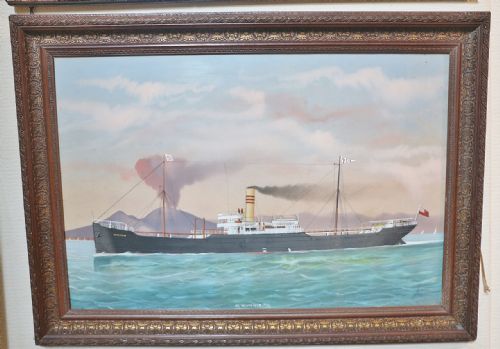


Edwardian Shipping Canvas Painting
These edwardian shipping canvas painting works capture historic vessels upon the water through period oil pigment and canvas, offering tangible links to early twentieth-century maritime heritage.
Edwardian Shipping Canvas Painting
An edwardian shipping canvas painting depicts maritime subjects, encompassing named vessels, naval cruisers, and bustling river traffic along the Thames during the early decades of the twentieth century. These works frequently record specific historic ships, such as the SS Westfield or the cruiser HMS Blenheim, rendered in oil paint on canvas.
The selection includes maritime realism alongside depictions grounded in Edwardian and Victorian marine art traditions. Buyers encounter compositions ranging from coastal scenes off Gibraltar to crowded dockland views in the Pool of London.
Alongside flat canvases, related maritime items such as pond yachts and model boats appear within the grouping, reflecting the broader material culture of early marine artistry. Most pictorial examples deploy oil on canvas housed within wood or gilded wood frames.
How they were made
Makers applied oil paint onto stretched canvas surfaces using traditional brushwork to build up coastal light, water movement, and detailed ship rigging. The primary medium of oil on canvas was frequently supplemented by wood frames, sometimes finished with gilt or gilded wood moulding.
Support structures rely on wood stretcher frames behind the canvas, while three-dimensional items like pond yachts utilise carved timber and metal components. Pigments were manipulated to capture atmospheric effects across open seas and urban riverscapes alike.
Beyond flat canvases, the selection includes a wooden pond yacht for navigating early twentieth-century waters.
What varies in quality
The standard of an edwardian shipping canvas painting rests upon the precision of the maritime draughtsmanship and the artist's ability to render nautical architecture convincingly. Works executed by named painters with established exhibition records demonstrate superior handling of light, water texture, and vessel proportions.
Framing and material preservation further distinguish individual works, as period wooden and gilded surrounds contribute to the integrity of the piece. Superior examples maintain stable paint layers on original canvas supports without extensive overpainting.
Daniel Sherrin·E Tucker·Charles Dixon·Edward Fletcher·Arthur David Mccormick·Bertram Priestman
The Edwardian Shipping Canvas Painting Glossary
- Oil on Canvas
- A painting medium where pigment suspended in drying oil is applied to a woven fabric support. This combination forms the principal surface for the majority of these maritime artworks.
- Maritime Art
- Artistic representation of ships, shipping, and the sea. This overarching genre includes both documentary records of specific vessels and broader coastal scenes.
- Gilded Wood
- Wood treated with a thin layer of gold leaf or metallic gilt powder. Frames utilising this technique frequently accompany period paintings.
- Edwardian
- Pertaining to the reign of King Edward VII and the broader stylistic period up to the First World War. Many listed canvases originate from this specific era.
Edwardian Shipping Canvas Painting: Frequently Asked Questions
Are these paintings contemporary to the ships they show?
Many works depict vessels contemporary to the artist's working period, such as early twentieth-century naval cruisers and steamships captured around nineteen hundred to nineteen ten. Other canvases revisit earlier maritime subjects through historical genre painting.
Purchasers find both eyewitness records of Edwardian shipping and retrospective views produced by artists documenting maritime history.
What subjects appear most often in these paintings?
The works predominantly feature named steamships, tall ships, Royal Navy cruisers, and trading vessels navigating coastal waters or urban rivers. Scenes set on the Thames near Tower Bridge and industrial shipping off foreign coasts recur frequently.
Such compositions offer direct visual documentation of early twentieth-century maritime commerce and naval power.
How should I display an oil painting on canvas?
Display these canvases away from direct sunlight and excessive moisture to protect the oil pigment and the underlying fabric support. Stable indoor environments prevent warping in both the canvas stretcher and the accompanying wood or gilt frame.
Proper wall placement ensures the historic materials remain preserved for future decades.
How do I identify an Edwardian marine painting?
Examination of the canvas, framing materials, and stylistic conventions helps determine the period of execution. Signatures, dates, and inscriptions detailing specific vessels like the SS Westfield provide direct chronological markers.
Many pieces also feature framing styles characteristic of the early nineteen hundreds.