
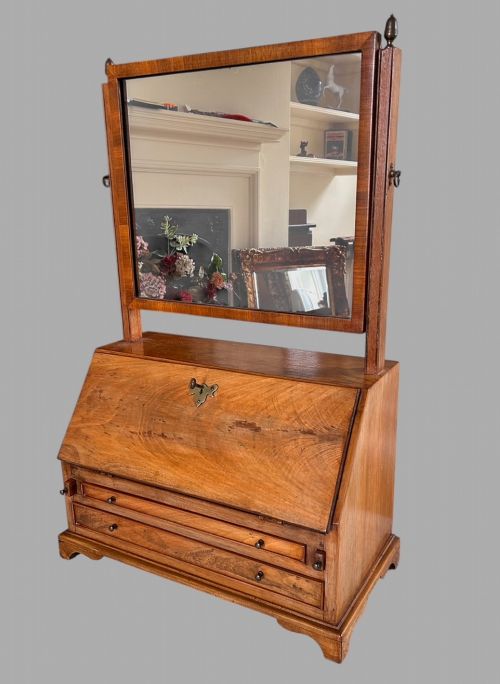


Edwardian Satinwood Vanity Mirror
An Edwardian satinwood vanity mirror brings a bright, figured timber and a tilting glass to a dressing table.
Edwardian Satinwood Vanity Mirror
An edwardian satinwood vanity mirror offers a compact glass plate mounted within a wooden frame, designed to sit upon a chest of drawers or a dedicated dressing table. Buyers seeking this phrase encounter tabletop mirrors alongside larger dressing table mirrors, small writing tables with mirrored superstructures, and freestanding dressing chests.
The pieces on this page span the late nineteenth century through to the early decades of the twentieth century, drawing on Victorian, Edwardian, and Sheraton Revival styles. While some examples are standalone tabletop items built specifically for grooming, others form the upper portion of a larger bureau or ladies writing desk.
Most items rely on satinwood as the primary timber, occasionally paired with mahogany, satin walnut, or brass fittings. Their forms range from simple oval swinging plates to elaborate inlaid structures featuring small drawers and hand-painted decoration.
How they were made
Cabinetmakers constructed these pieces primarily from satinwood and mahogany, often applying fine stringing and decorative inlay to the timber surfaces. Glass plates were cut, bevelled where desired, and secured into pivoting frames supported by upright arms.
Makers utilised brass for pivot screws, adjustment knobs, and small handles on accompanying accessory drawers. Structural stability relied on traditional joinery techniques, ensuring the upright standards securely held the weight of the tilting mirror frame.
Several pieces include secret compartments hidden behind tiny drawers, offering a clever place to stow letters.
What varies in quality
Quality reveals itself in the selection of the timber, particularly the grain figure and chatoyancy of the satinwood veneer. Finer examples display crisp, precise wood inlay and well-balanced proportions in the support arms and base drawers.
The execution of hand-painted details and the weight of the brass hardware distinguish standard production pieces from finer workshop outputs. Superior mirrors maintain smooth movement in their pivots without looseness in the supporting frame.
Gillows·John Taylor of Edinburgh
The Edwardian Satinwood Vanity Mirror Glossary
- Satinwood
- A pale, hard timber with a natural sheen that takes a high polish. It was favoured by cabinetmakers for fine veneer work and decorative banding during the Sheraton Revival period.
- Superstructure
- A set of small drawers, pigeonholes, or a mirror added to the top surface of a desk or table. This arrangement increases storage and provides a dedicated glass for writing or grooming.
- Sheraton Revival
- A late nineteenth and early twentieth-century design movement inspired by the neoclassical furniture of George Sheraton. It is characterised by slender proportions, satinwood veneers, and delicate floral inlay.
- Toilet Mirror
- A traditional term for a small mirror designed to sit on a dressing chest or table. These pieces often incorporate one or more small drawers in the base plinth.
- Bonheur du jour
- A small, light ladies writing desk featuring a raised back with drawers, shelves, or a mirror. The phrase translates from French as happiness of the day.
Edwardian Satinwood Vanity Mirror: Frequently Asked Questions
Are these mirrors attached to tables?
Many examples on this page are standalone tabletop items designed to rest upon an existing surface without permanent fixings. Others form an integrated part of a larger dressing table or writing desk superstructure.
Buyers should examine whether the mirror sits on its own base plinth or connects directly to a specific piece of case furniture.
How do I care for satinwood?
Satinwood benefits from regular dusting with a soft, dry cloth to prevent the accumulation of abrasive particles. Avoid placing the wood in direct sunlight or near heat sources to protect the polished finish.
Applying a traditional beeswax polish occasionally helps nourish the timber and maintain its characteristic sheen.
What is satin walnut?
Satin walnut is a common trade name for the heartwood of the American sweetgum tree. It possesses a warm tone and distinctive grain that resembles walnut while remaining distinct from true satinwood.
Cabinetmakers utilised this timber during the late nineteenth and early twentieth centuries for bedroom furniture and dressing chests.
Can the mirror glass be replaced?
Original mirror glass often exhibits light foxing or spotting due to the ageing of the backing silver over time. While replacement is possible, many collectors prefer retaining the original glass for authenticity.
Checking the edge silvering helps determine whether the glass dates to the original manufacture of the frame.