

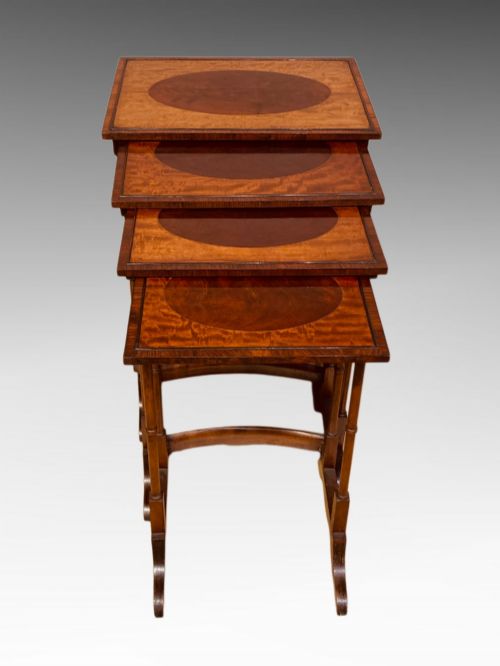
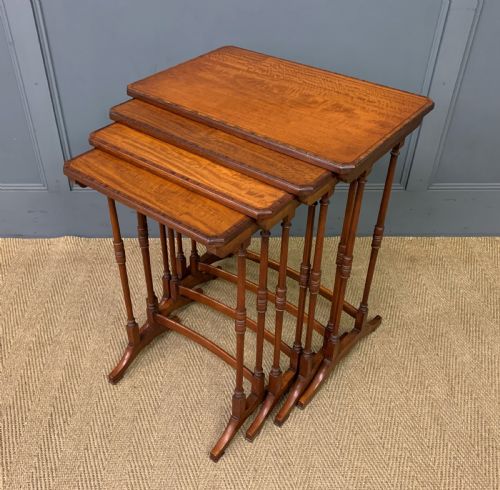


Edwardian Satinwood Quartetto Tables
Edwardian satinwood quartetto tables are interlocking sets of four nesting surfaces designed for versatility, and you want one for its space-saving elegance and refined proportions.
Edwardian Satinwood Quartetto Tables
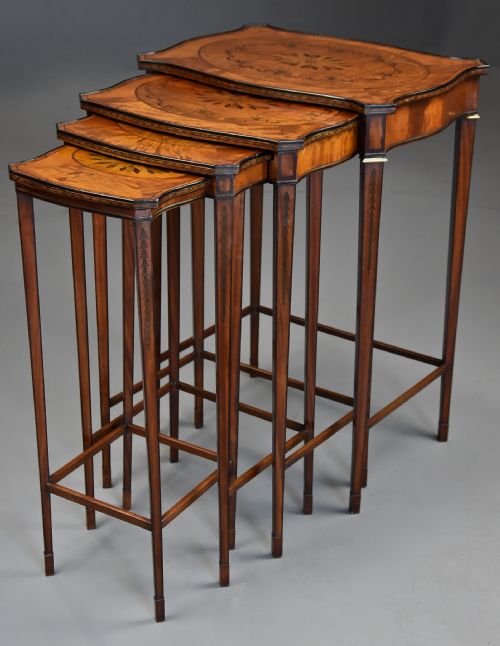
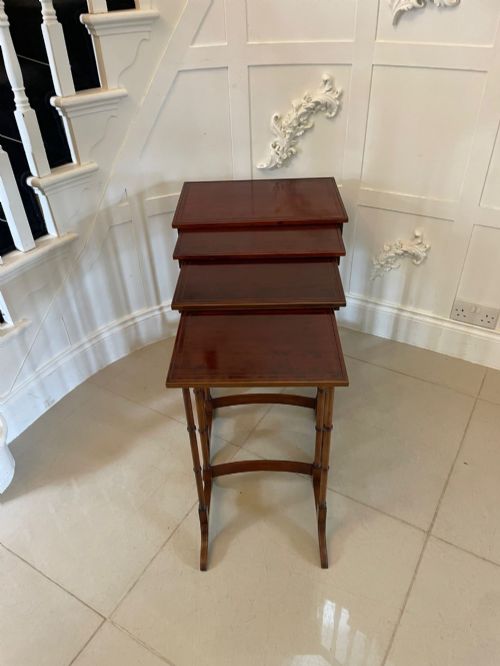
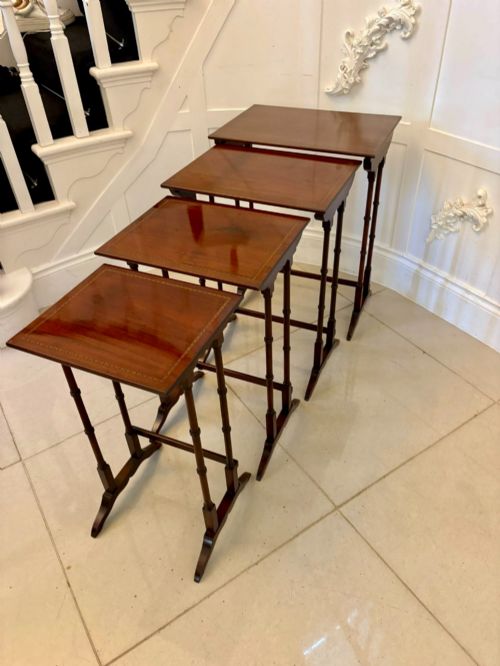
Edwardian satinwood quartetto tables take the form of nested sets containing four individual tables that graduate in size to slide neatly beneath one another. When you search for Edwardian satinwood quartetto tables, you are looking at graceful occasional furniture designed for drawing rooms and parlours where space requires clever economy.
The versions you are most likely to meet on this page date from the Edwardian period, stretching from around nineteen hundred to nineteen ten, alongside late Victorian examples. These pieces typically present rectangular or serpentine tops supported by slender legs.
Makers of this era drew heavily on Sheraton Revival aesthetics, applying delicate stringing and contrasting timbers to light woods. The resulting nests serve easily as tea tables, coffee tables, or lamp tables as needed.
How they were made
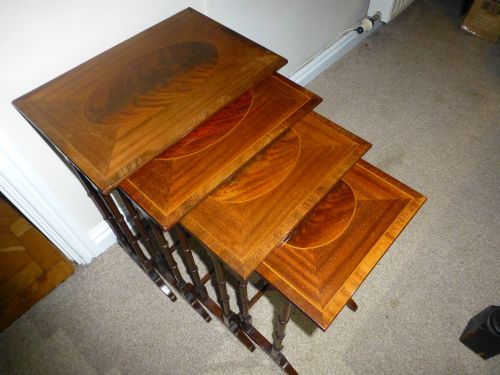
Cabinet makers constructed these nests using solid timber frames overlaid with figured satinwood or mahogany veneers, ensuring a stable yet decorative surface. They integrated contrasting lighter woods such as boxwood for fine stringing and geometric inlay work.
Joinery focused on lightweight grace, using slender turned or tapered legs that could support stacking without adding clumsy bulk. Craftspeople shaped tabletops into rectangular or serpentine forms that required precise hand-fitting so each of the four tiers nested flush.
Edwardian Satinwood Quartetto Tables Retail Price Guide 2026
Typical asking prices for edwardian satinwood quartetto tables among the pieces listed under this phrase on Sellingantiques today, from the lower quarter to the upper quarter. They describe what is for sale here now, not the wider market.
Listings on this site span the late nineteenth century through the Edwardian decade, featuring mahogany and satinwood timbers.
What varies in quality
Quality in these nests rests upon the choice of timber and the crispness of the inlay rather than mere age. Finer examples display highly figured satinwood veneers and intricate boxwood stringing executed with precision, whereas simpler models rely on plain mahogany with basic borders.
The structural integrity of the smallest, lowest table dictates the standard of the set, as thinner legs often suffer from warping or loose joints through decades of sliding. Superior pieces maintain tight tolerances between all four tiers, allowing them to glide smoothly into position without scraping.
The Edwardian Satinwood Quartetto Tables Glossary
- Quartetto tables
- A nested set of four tables designed to slide one beneath another. This term appears frequently in Edwardian furniture catalogues.
- Satinwood
- A durable, lustrous timber native to tropical regions, prized for its golden sheen. Cabinet makers used it as a primary veneer on high-end Edwardian pieces.
- Stringing
- Thin inlay lines of contrasting wood set flush into the surface of a tabletop. Boxwood stringing is common on Sheraton Revival furniture.
- Serpentine form
- A tabletop featuring a gently undulating curved edge with a convex centre flanked by concave curves. This shape adds movement and refinement to smaller occasional tables.
- Sheraton Revival
- A late nineteenth and early twentieth-century design style emulating the neoclassical furniture of Thomas Sheraton. It relies on satinwood, painted decoration, and delicate inlay.
Edwardian Satinwood Quartetto Tables: Frequently Asked Questions
What are quartetto tables?
Quartetto tables are nests of four stacking tables designed to slide neatly beneath one another to save floor space.
Cabinet makers of the Edwardian period favoured this format for entertaining, allowing hosts to deploy extra surfaces for tea or drinks quickly.
How were these tables used?
These tables served primarily in drawing rooms as versatile occasional surfaces for holding cups, lamps, or needlework.
Plyers of the set could separate the four tiers around a room when guests visited and stack them compactly away afterward.
How do I identify an Edwardian piece?
Edwardian furniture relies on lighter timbers, refined proportions, and revivals of earlier eighteenth-century neoclassical styles.
Look for bright satinwood veneers, delicate boxwood stringing, and slender tapering legs that distinguish them from heavier Victorian designs.
What is satinwood inlay?
Satinwood inlay involves contrasting sections of golden satinwood fitted into a primary wood ground like mahogany.
Craftspeople utilised this technique to create geometric borders, centre medallions, and fine decorative framing on tabletops.