


Edwardian Satinwood Press
An edwardian satinwood press offers large-scale bedroom storage finished in pale, figured timbers, combining practicality with refined period cabinetmaking.
Edwardian Satinwood Press
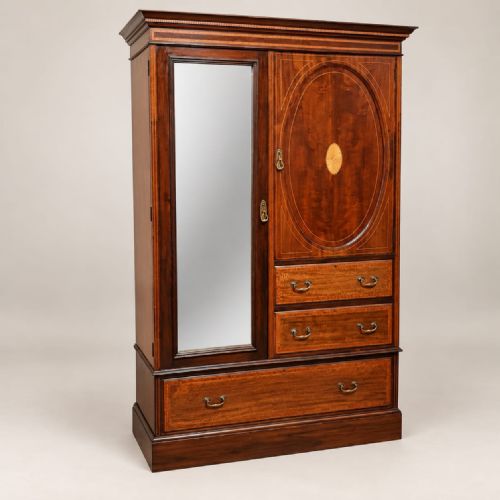
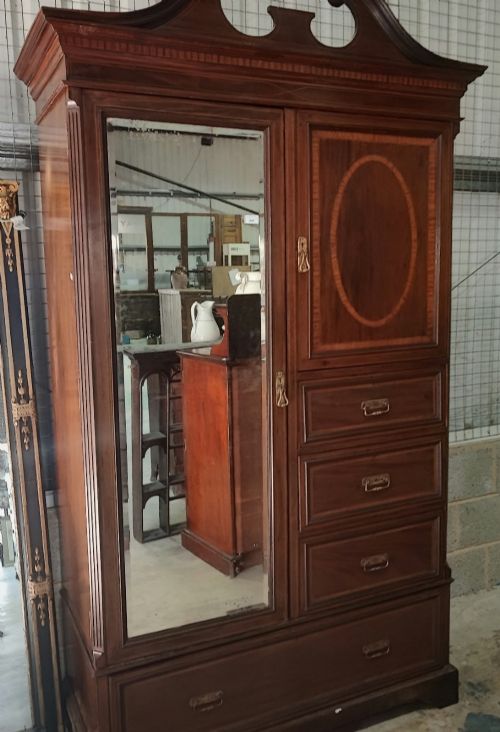
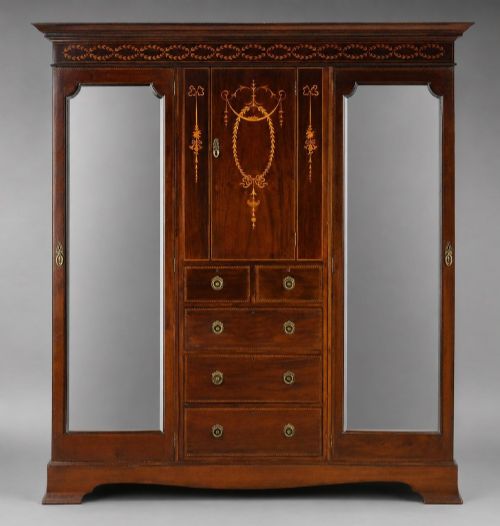
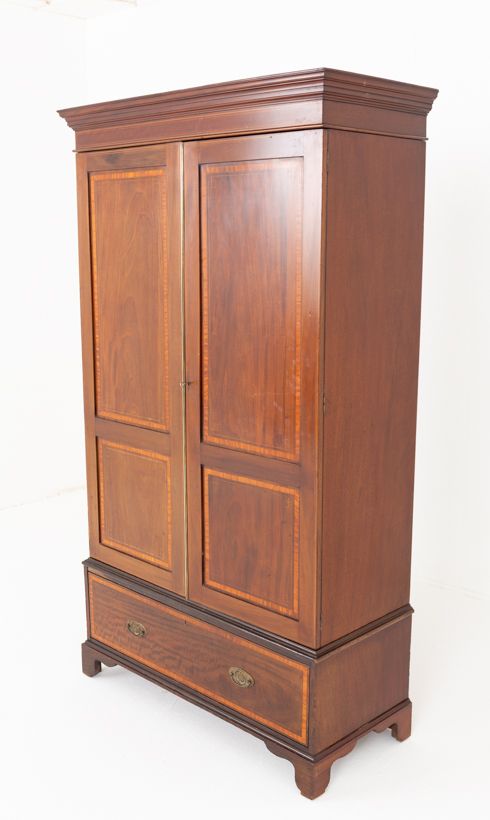
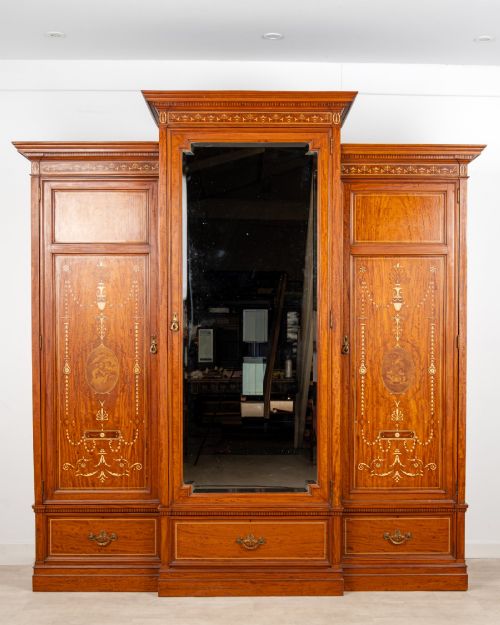
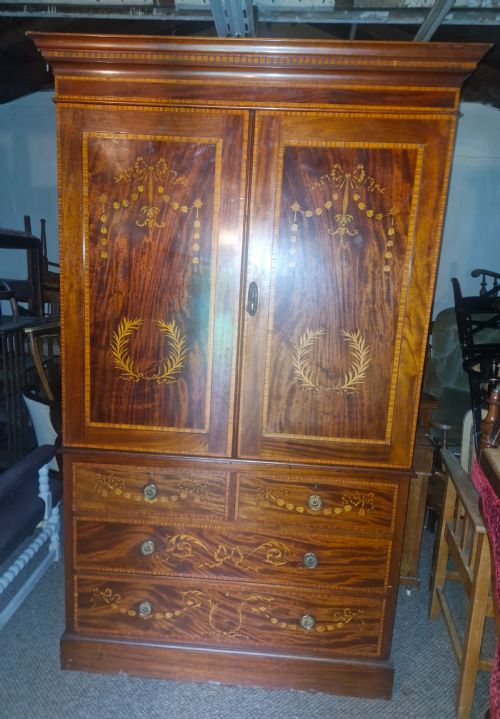
When you search for an edwardian satinwood press, you are looking at substantial case furniture designed for linen and garments, primarily originating from the Edwardian period and the late nineteenth century. These items encompass linen presses, compactum wardrobes, and large armoires that combine hanging space with linen slides or drawers. The versions you are most likely to meet on this page feature satinwood or mahogany construction, frequently enhanced with intricate stringing and marquetry.
The aesthetic leans heavily on Sheraton Revival design, drawing on eighteenth-century lightness and symmetry. Pieces range from two-door models to expansive triple wardrobes and multi-section bedroom suites. While some examples serve purely as housekeepers cupboards or linen presses, others integrate mirror glass doors and fitted internal compartments to meet domestic needs.
How they were made
Makers utilised satinwood and mahogany as primary cabinet timbers, often selecting highly figured veneers for the main panel surfaces. Boxwood and rosewood feature extensively in contrasting inlay work, creating delicate floral motifs, urns, and geometric banding. Brass hardware, including drop handles and escutcheons, provides functional detailing across doors and drawer fronts.
Glass and mirror glass are integrated into doors on larger armoires and triple wardrobes to reflect light and add depth to bedrooms. Internal construction relies on solid secondary timbers for drawer linings and carcass frames, ensuring stability for large architectural pieces. Surface finishes protect the light wood while highlighting the natural grain and contrast of the marquetry.
Listings feature Edwardian, Victorian, and nineteenth-century periods alongside Sheraton Revival styling.
What varies in quality
The distinction between standard commercial output and superior cabinetmaking lies in the selection of timbers and the precision of the inlay. Top-tier pieces exhibit carefully matched satinwood veneers with crisp boxwood and rosewood stringing that remains intact across complex curves and breakfront cornices. Lesser examples rely on simpler painted decoration or plain timber surfaces with minimal detailing.
Internal fitting and hardware also dictate the hierarchy of these items. Pieces retaining original brass fittings, fully fitted interior linen slides, and clean mirror glass represent a higher standard of craftsmanship than those altered or stripped of their internal configuration. The integration of complex forms, such as breakfront profiles and multi-section construction, separates utilitarian storage from notable workshop production.
Edwards and Roberts·Waring & Gillow·Maples & Co·Druce & Co
The Edwardian Satinwood Press Glossary
- Satinwood
- A hard, durable timber with a natural golden sheen and satin-like lustre, used extensively for high-end cabinetwork. It takes a fine polish and forms the primary visual surface on many Edwardian pieces.
- Linen press
- A large storage item featuring upper sliding trays for folded textiles and lower drawers for bulkier garments. Traditional forms evolved into multi-functional wardrobes by the late nineteenth century.
- Compactum
- A fitted wardrobe containing a combination of hanging space, drawers, shelves, and linen slides within a single unified carcass. This efficient layout maximises storage capacity in domestic interiors.
- Marquetry
- The art of applying decorative veneer pieces to a structure to form intricate pictorial or geometric patterns. Makers used contrasting woods like boxwood and rosewood to achieve tonal depth.
- Sheraton Revival
- A late nineteenth and early twentieth century design movement replicating the neoclassical elegance of Thomas Sheraton. It is characterised by symmetrical proportions, tapered legs, and delicate marquetry.
Edwardian Satinwood Press: Frequently Asked Questions
How do I clean satinwood?
Dust the surfaces regularly with a soft, dry cloth to prevent dirt accumulation. Avoid harsh chemical cleaners or excess moisture, which can damage the delicate veneer and polishes.
Apply a quality microcrystalline wax periodically to nourish the timber and maintain its natural lustre. Buff gently with a clean cloth to bring up the characteristic sheen without building up heavy residues.
Will a large wardrobe fit?
Measure your ceiling height and floor space carefully before purchasing, accounting for projecting cornices and door swings. Many pieces in this category are exceptionally tall and heavy, requiring adequate clearance for placement.
Check whether the item disassembles into sections for transport and installation. Larger triple wardrobes and compactums often separate into distinct carcases and cornices to facilitate movement through doorways and stairwells.
How do I tell Edwardian from Victorian?
Edwardian furniture generally exhibits lighter construction, paler timber tones, and a preference for delicate Sheraton Revival inlay. Proportions tend to feel airier compared to earlier nineteenth-century output.
Victorian pieces often display heavier proportions, darker mahogany or rosewood timbers, and more robust carving. However, transitional pieces from the late nineteenth century frequently blur these stylistic boundaries.
What is a compactum used for?
A compactum provides multi-functional storage designed to hold an entire wardrobe within a single footprint. It divides internal space into hanging sections, sliding linen trays, and multiple drawers.
This form served domestic needs by keeping garments, undergarments, and bed linen organised in one designated enclosure. The internal division reflects the shift towards specialised bedroom storage in the late Victorian and Edwardian eras.