




Edwardian Platinum Diamond Brooch
An edwardian platinum diamond brooch combines delicate metalwork with bright stones, offering a wearable piece of early twentieth-century design.
Edwardian Platinum Diamond Brooch
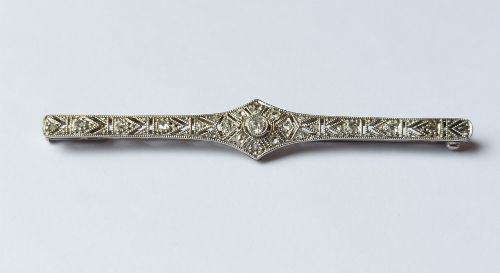
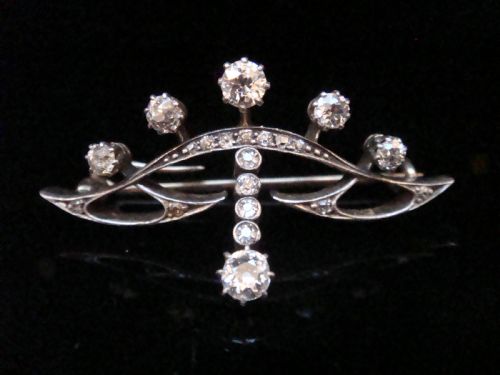
An edwardian platinum diamond brooch brings together fine pierced metal settings and old-cut stones, taking forms such as bar pins, crescents, pendants, and figural shapes like birds and butterflies.
Most examples originate from the early decades of the twentieth century, bridging late Victorian tastes, Edwardian lightness, and the geometry of Art Deco.
Many of these jewels combine platinum with gold backings or mounts, often incorporating pearls, aquamarines, sapphires, rubies, or emeralds alongside the central diamonds.
How they were made
Makers utilised the strength of platinum to fashion exceptionally thin wirework, knife-edge bars, and intricate millegrain borders that held small stones securely without heavy metal surrounds.
Gold provided a supportive backing or contrasting warmth, while gems were hand-cut into old mine cuts, rose cuts, or early brilliant facets to catch candlelight and daylight alike.
Pendant brooches often incorporated detachable fittings, allowing a single jewel to transform from a dress ornament into a neck chain pendant.
Among the creatures pinned to these historic lapels, a lone flying duck joins a gathering of butterflies and floral sprays.
What varies in quality
The refinement of the piercing and the crispness of the millegrain work distinguish finer workshops from simpler commercial production.
Stone selection creates a clear division, with uniform colour, matched proportions, and lively old-cut diamonds elevating the piece above examples with mismatched or dull gems.
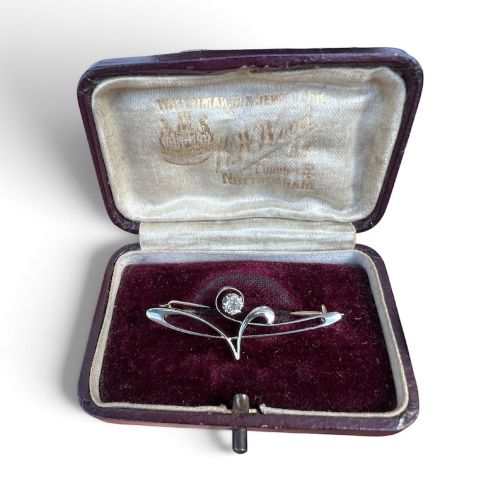
Original fitted presentation boxes and intact convertible mechanisms add significant integrity to surviving pieces.
CARTIER
The Edwardian Platinum Diamond Brooch Glossary
- Millegrain
- A decorative technique featuring a row of tiny raised metal beads along the edge of a setting. This softens the transition between metal and stone.
- Old-cut diamond
- A hand-faceted diamond shape common before modern machine cutting, characterised by a smaller table and high crown. These stones display deep, chunky light reflection.
- Bar brooch
- A slender horizontal pin design popular across the Edwardian and Art Deco eras. It frequently displays central stone clusters or symmetrical geometric patterns.
- Jabot pin
- A decorative pin originally used to secure folds of fabric on a jabot cravat. They often feature ornamental terminals at both ends.
- Plique-à-jour
- An enamelling technique resembling stained glass without a backing, allowing light to shine through translucent coloured enamel.
Edwardian Platinum Diamond Brooch: Frequently Asked Questions
How do I wear a brooch?
These pieces pin securely onto lapels, heavy scarves, or dress bodices using traditional pin and safety catches. Placing them on heavier fabrics helps prevent the stem from sagging.
Many designs also feature hidden loops behind the frame, allowing the brooch to slip onto a chain and transform into a pendant.
Are these brooches convertible?
Several period examples include detachable fittings or hinged bails. This engineering lets the wearer switch between pinning the ornament to clothing and suspending it from a necklace.
Original boxes often show fitted spaces designed to hold both the brooch frame and its matching chain or pin attachment.
How do I tell Edwardian from Art Deco?
Edwardian designs lean towards flowing garlands, bows, ribbons, and natural motifs executed in light platinum lace. They emphasise organic curves and soft floral arrangements.
Art Deco pieces shift towards strict symmetry, linear bar structures, and bold geometric shapes, often pairing diamonds with calibré-cut coloured gemstones.
What metals are used together?
Many early twentieth-century jewellers combined platinum with yellow or white gold. Platinum provided a bright, durable surface for claw and bezel settings while gold formed the structural reverse.
This dual-metal construction allowed makers to utilise the strength of platinum on the visible face while retaining traditional gold fabrication underneath.