



Edwardian Mercury Barometer
An edwardian mercury barometer brings practical science and rich timber into a room, offering a traditional way to track the weather using classic domestic instruments.
Edwardian Mercury Barometer
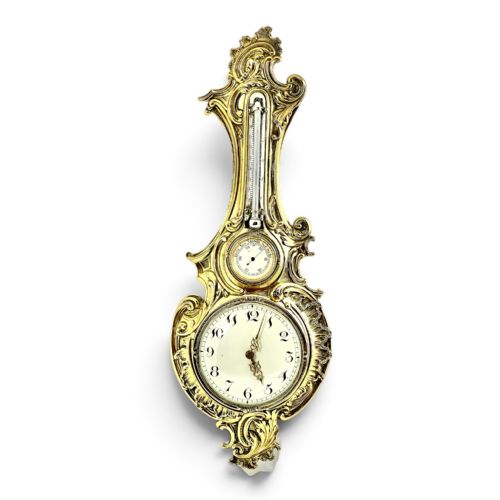
When you search for an edwardian mercury barometer, you encounter instruments designed to measure atmospheric pressure through the movement of liquid metal within a sealed tube. These pieces often combine multiple domestic instruments, frequently pairing the barometric reading with an alcohol thermometer or a clock face to serve broader household needs.
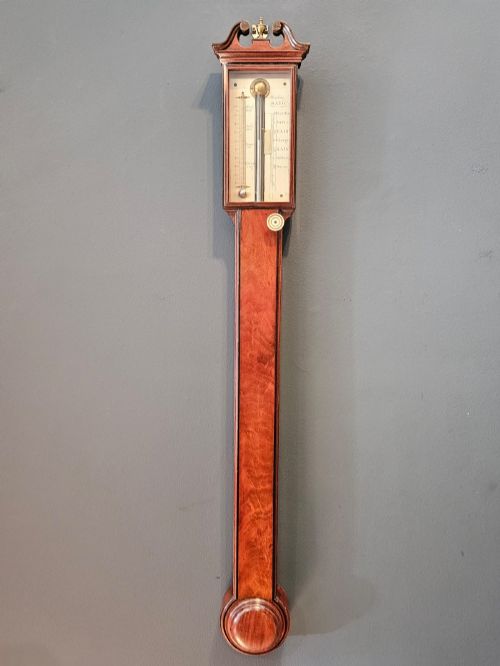
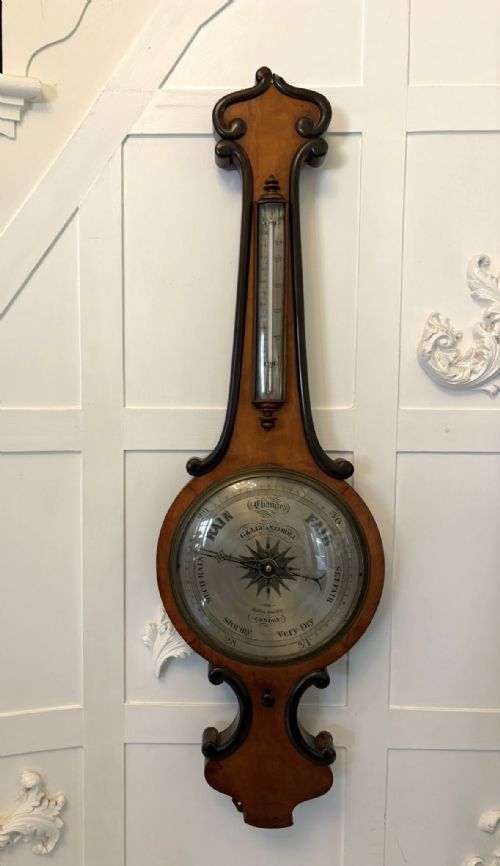
The versions most common on this page incorporate rich timber cases, spanning forms from slender stick barometers to broader banjo shapes and architectural wall mountings. Makers housed these sensitive glass tubes in sturdy surrounds of mahogany, oak, walnut, or rosewood, often enhancing the timber with carved detailing or delicate inlay.
While many examples date from the Edwardian era and surrounding decades, the styles represented across the selection also draw heavily on earlier Victorian, Georgian, and Neoclassical traditions. This stylistic overlap means a buyer encounters everything from austere scientific stick barometers to ornate domestic wheel barometers.
How They Were Made
The casing relied heavily on dense cabinet timbers like mahogany, oak, walnut, and rosewood, shaped into curved stick bodies or wide banjo frames. Cabinetmakers utilised veneers, string inlay, and carved scrollwork to finish the exterior woodwork, protecting the fragile glass mechanisms housed within.
Dial faces were typically rendered in silvered metal, brass, or bone, featuring engraved numbers and maker signatures filled with dark pigment for legibility. Glass front plates and protectivebezels shielded these delicate paper or metal scales from dust and accidental impact in busy rooms.
The selection includes stick barometers, wheel barometers, and clock stations.
What Varies in Quality
The standard of the timber casework establishes the initial impression, separating mass-produced utility items from bespoke pieces with carefully matched veneers and intricate carving. Well-figured mahogany, burr walnut, and rich rosewood reflect a higher tier of domestic furnishing.
The legibility and crispness of the engraved silvered dial plate or brass scale indicate the care taken by the instrument maker. Fine graduation marks and well-preserved maker signatures point to superior workshop standards during production.
G and L Guanziroli·Negretti and Zambra·Alexander Wright·Hayward of Ashford·J Hicks of London
The Edwardian Mercury Barometer Glossary
- Stick barometer
- A tall, narrow instrument that houses the mercury tube openly within a wooden trunk, allowing direct observation of the column height.
- Wheel barometer
- A dial-type instrument where the mercury movement drives a pulley and pointer wheel to indicate pressure on a circular face.
- Silvered metal
- A brass or copper plate treated with a silver solution to create a pale, reflective surface for engraved measurement scales.
- Fortin barometer
- A precision scientific stick barometer featuring an adjustable cistern base to set the mercury level accurately before reading.
Edwardian Mercury Barometer: Frequently Asked Questions
How do I read a mercury barometer?
You read the height of the mercury column against the graduated scale on the dial or brass plate to observe pressure changes.
A rising column generally indicates improving weather, while a falling column points towards approaching rain or wind.
Where should I hang a stick barometer?
Hang your instrument on an interior wall away from direct sunlight, radiators, and heavy draughts to ensure accurate temperature stability.
Choose a location at a comfortable eye level where the timber case and silvered dial receive gentle, indirect illumination.
Can these barometers still measure weather?
Many surviving examples remain fully functional and respond naturally to shifts in atmospheric pressure when placed in a stable environment.
Their primary appeal today, however, lies in their decorative presence and historical craftsmanship as much as daily meteorological forecasting.
How do I clean the wooden case?
Dust the timber regularly with a soft, dry cloth and apply a quality beeswax sparingly to nourish the polish without building up residue.
Avoid using liquid cleaners or chemical polishes that might damage the antique finish or seep into the delicate joints of the case.