
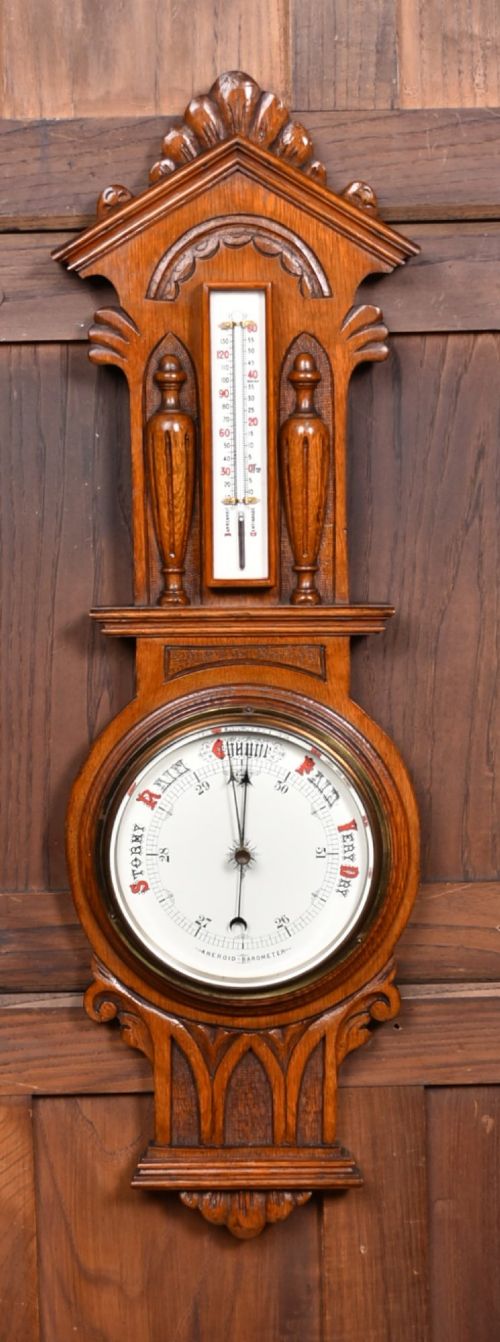


Carved Mercury Weather Station
A carved mercury weather station brings dependable barometric instrumentation into a room, housed in finely worked timber cases that suit period interiors.
Carved Mercury Weather Station
A carved mercury weather station combines atmospheric pressure tracking with timber craftsmanship, appearing in domestic spaces from the eighteenth century onwards. These instruments monitor barometric fluctuations using mercury columns or associated clockwork, fulfilling a practical function while serving as decorative wall furniture.
The versions most commonly met on this page span the Victorian and Edwardian eras, featuring banjo and stick formats carved from oak, walnut, and mahogany. Alongside barometers, related architectural desk clocks and caduceus-shaped combination pieces reflect the wider scope of nineteenth-century domestic time and weather recording.
Materials and construction
Cases are shaped from dense hardwoods like oak, walnut, and mahogany, chosen for stability and responsiveness to detailed carving. Artisans shaped these timbers into banjo profiles, stick enclosures, and architectural desk housings using traditional cabinet-making joints.
Internal instrumentation integrates delicate glass tubes for mercury columns alongside brass fittings, enamel dials, and occasional clock movements. The visible woodwork often displays relief carving, fluting, or scrollwork framing the operational gauges.
Listings feature oak, walnut, and mahogany cases spanning the eighteenth to the early twentieth century, including stick and banjo configurations.
Assessing quality and execution
The distinction between standard domestic items and finer pieces lies in the crispness of the timber carving and the sophistication of the case design. Better examples exhibit deep, deliberate relief work and well-balanced proportions that integrate the barometer tube without crowding the dial.
Signatures on enamel dials or backplates from established makers elevate an instrument, as does the retention of original glass and brass bezels. The integration of auxiliary instruments, such as thermometer scales or clock dials, marks a more ambitious piece of workshop production.
J Hughes London·Negretti & Zambra
The Carved Mercury Weather Station Glossary
- Banjo barometer
- A domestic weather instrument housed in a tall, curved wooden case resembling a banjo, typically featuring a hygrometer, thermometer, and large round dial at the base. This format became widespread during the Georgian and Victorian periods.
- Stick barometer
- A tall, narrow wall instrument where the mercury column remains exposed within a protective wooden trunk beneath a sliding vernier scale. These offer greater precision than dial models and were favoured by scientific observers.
- Mercury
- A heavy, silvery liquid metal that rises and falls within a sealed glass tube in response to atmospheric pressure changes. Its density makes it uniquely suited for accurate barometric readings.
- Aneroid barometer
- A weather instrument that measures air pressure through the expansion and contraction of a corrugated metal capsule rather than using liquid mercury. This mechanism allows for compact casing formats like desk clocks.
- Caduceus
- A decorative staff entwined by two serpents, occasionally utilised as a sculptural motif for nineteenth-century scientific instrument cases. It brings classical symbolism to domestic weather stations.
Carved Mercury Weather Station: Frequently Asked Questions
How do I read a mercury barometer?
Observe the height of the mercury column inside the glass tube against the engraved scale to track atmospheric pressure. Rising levels typically indicate fair weather, while falling columns suggest approaching precipitation or wind.
Many banjo formats include a secondary pointer set by hand over the primary needle to record daily changes. Comparing the current position to this marker shows whether pressure is moving upward or downward.
Where should I hang a wall barometer?
Mount the instrument on an interior wall away from direct sunlight, radiators, and heavy draughts to ensure accurate pressure readings. Stable indoor temperatures prevent artificial expansion of the internal components.
Choose a location at eye level where the dial or scale can be easily consulted daily. Ensure the fixing wall is sturdy enough to support the weight of the dense hardwood case.
How do I tell Victorian from Georgian pieces?
Georgian instruments often display simpler mahogany veneers, understated stringing, and restrained architectural pediments. Their proportions tend to be slender and functional.
Victorian examples frequently introduce heavier timber selection, deeper relief carving, and elaborate scrollwork, particularly in banjo formats. Oak and walnut also become much more prominent in the later nineteenth century.
Can these barometers still be calibrated?
Most traditional mercury and aneroid instruments can be adjusted using a small screw mechanism linked to the pointer or internal linkage. This allows the reading to match known local barometric pressure.
Calibration should be done gently, referencing a reliable digital source or nearby meteorological station for the current local reading. Seek professional assistance if the internal tube or linkage requires mechanical adjustment.