
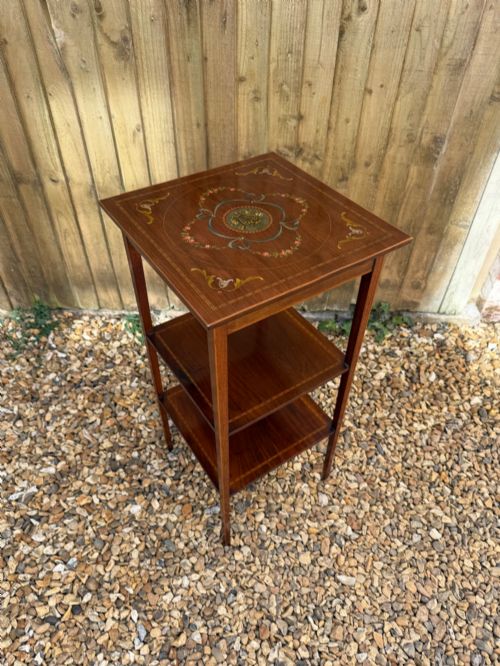
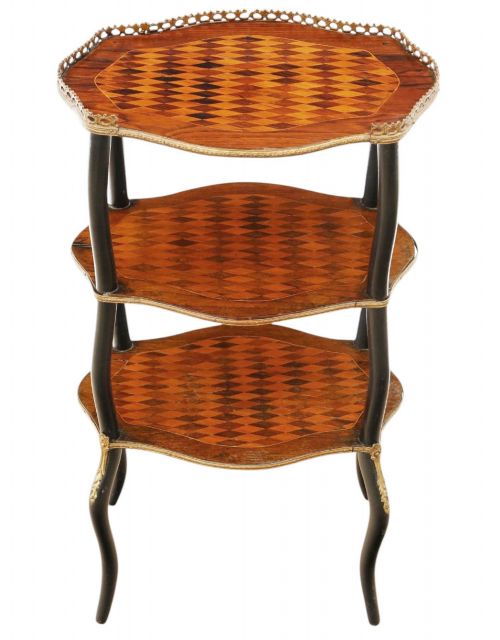


Edwardian Inlaid Whatnot
These edwardian inlaid whatnot pieces offer tiered shelving with delicate decorative work, giving collectors practical display surfaces with period charm.
Edwardian Inlaid Whatnot
An edwardian inlaid whatnot is a multi-tiered piece of freestanding furniture designed to hold books, ornaments, and display items. The examples appearing on this page span from the Victorian era into the Edwardian period, often taking the form of open etageres or corner stands.
The layout typically consists of three or four graduated shelves supported by slender uprights, occasionally incorporating drawers or music cabinet compartments below. While some pieces originate in the late nineteenth century, the Sheraton Revival and French Revival styles heavily influence the design vocabulary across the whole group.
Buyers encounter corner models alongside freestanding rectangular and circular tiers, demonstrating how cabinetmakers adapted the multi-shelf format to suit different domestic spaces. The presence of marquetry or parquetry adds a decorative layer to the functional framework.
Materials and Technique
Cabinetmakers constructed these pieces primarily using walnut, burr walnut, and mahogany, sometimes applying ebonised finishes to create striking visual contrast. The rich figuring of burr walnut provides a patterned surface texture that complements the architectural lines of the tiers.
Decoration relies on boxwood inlay, marquetry, and parquetry, set carefully into the primary timber to form floral, geometric, or classical motifs. Brass mounts and original castors appear on select examples, combining structural utility with fine detailing.
Listings feature walnut, burr walnut, mahogany, and ebonised wood across Victorian and Edwardian periods.
Standards of Execution
Quality separates the standard production piece from the exceptional workshop creation through the crispness of the inlay work and the selection of timber veneers. Finely figured burr walnut and intricate marquetry demand superior craftsmanship compared to plain mahogany surfaces.
The rigidity of the tiered supports and the precision of the joinery determine the structural integrity of the piece over time. Items retaining original castors and mounts preserve their complete historical form more effectively than altered examples.
The Edwardian Inlaid Whatnot Glossary
- Whatnot
- A set of open shelves designed for displaying ornaments or holding books, popular throughout the nineteenth century. The form allows items to be viewed from multiple angles.
- Etagere
- A French term for a piece of furniture consisting of a set of open shelves for displaying small objects. These often feature ornate ormolu mounts and marquetry.
- Marquetry
- Decorative veneer applied to furniture in patterns using wood pieces, shell, or ivory. It creates pictorial or geometric designs across the surface.
- Parquetry
- A geometric mosaic of wood pieces used for floors and furniture surfaces. It produces repeating patterns such as cubes or chequers.
- Canterbury
- A low stand with partitions for holding sheet music or loose papers, frequently incorporated into the base of a whatnot. This combines storage with display capability.
Edwardian Inlaid Whatnot: Frequently Asked Questions
What is an edwardian inlaid whatnot used for?
These pieces serve as multi-tiered display stands intended for ornaments, ceramics, and small decorative objects in a principal room. The shelves allow collectors to arrange items vertically without taking up excessive floor space.
Some variants incorporate lower cabinets or drawers for practical storage, bridging the gap between display furniture and a cabinet.
How do I tell a Victorian from an Edwardian piece?
Victorian examples often employ darker timbers such as burr walnut and heavy ebonised wood with dense carving or ornate marquetry. The proportions tend to be robust and grounded.
Edwardian interpretations generally favour lighter mahogany or satinwood influences, reflecting the Sheraton Revival aesthetic with cleaner, airier lines and delicate boxwood stringing.
Where should I place a corner whatnot?
Corner models fit neatly into unused room junctions, making them ideal for smaller reception rooms or hallways where wall space is limited. Their triangular tiers maximise display capacity without jutting into the main traffic path of the interior.
They pair well with surrounding period seating and help soften bare room angles by introducing warm timber tones.
Are these pieces structurally stable?
The multi-tiered design relies on slender upright supports, meaning that proper construction and tight joints are essential for daily stability. Most surviving examples handle standard display duties well when placed on level flooring.
Heavy loading should be avoided on the upper tiers to protect the delicate upright spindles and the joints securing them to the shelves.