
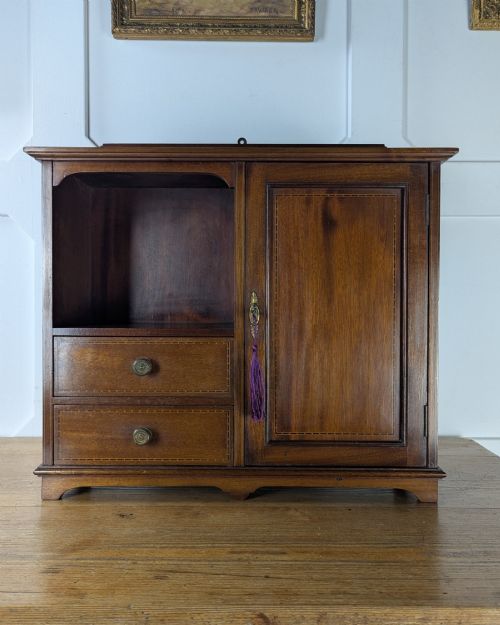


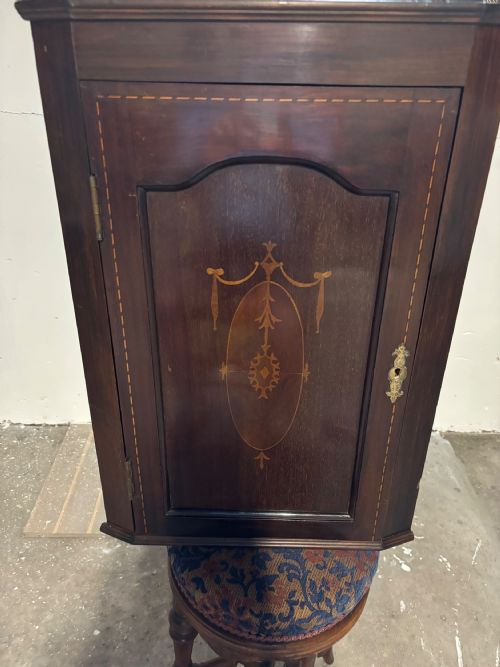


Edwardian Inlaid Wall Cabinet
These edwardian inlaid wall cabinet pieces offer compact display space, combining rich timber with delicate stringing to lift a plain room.
Edwardian Inlaid Wall Cabinet
An edwardian inlaid wall cabinet is a compact hanging piece designed to save floor space while displaying small items behind glass or keeping contents tidy behind wooden doors. You will frequently meet corner cupboards and flat wall-mounted display units bearing the light stringing characteristic of the period.
The selection ranges from dedicated hanging display cabinets with glazed doors to small smokers cupboards and corner units. Most examples on offer lean towards the Edwardian era and the turn of the twentieth century, though earlier Georgian and Victorian revivals also appear.
Makers of the period adapted traditional forms into lighter, more manageable proportions suited for smaller town rooms and parlours. These cabinets mount directly to the wall, serving both a decorative and a practical storage function within the home.
How they were made
Cabinet makers utilised solid timbers and veneers, predominantly mahogany and rosewood, often enriched with contrasting satinwood inlay and boxwood stringing. Marquetry inlay appears on finer examples, adding floral or geometric motifs into the timber surface.
Brass hinges, key escutcheons and door latches complete the construction, alongside glass panels for display variants. Joinery methods of the period ensured stability for items intended to hang securely from domestic walls.
Smokers cupboards kept private pipes and tobacco secure behind tiny locked doors.
What varies in quality
The standard of an edwardian inlaid wall cabinet rests on the crispness of its marquetry and the choice of primary timber. Richer grain in the mahogany or rosewood combined with intricate satinwood banding elevates a piece beyond standard utility furniture.
Proportion and glazing also divide ordinary production from superior examples. Cabinets featuring astragal glazed doors and well-balanced cornices show greater attention from the workshop than plain functional boxes.
The Edwardian Inlaid Wall Cabinet Glossary
- Inlay
- A technique where contrasting pieces of wood or other materials are fitted into a recess in the primary surface to form a design. This adds decorative contrast without altering the overall profile of the timber.
- Stringing
- A narrow strip of contrasting wood inlaid into channels cut into the surface of the cabinet. It creates delicate border lines around panels and drawers.
- Marquetry
- Elaborate veneer work forming pictorial or decorative patterns using various wood types. It requires high skill to cut and fit the components seamlessly.
- Astragal
- The narrow wooden moulding that divides panes of glass within a cabinet door. These can be straight or form intricate Gothic and Georgian Revival lattice patterns.
- Bowfront
- A convex curved cabinet front that projects outward from the corners. This shape softens the profile of wall-mounted and corner cupboards.
Edwardian Inlaid Wall Cabinet: Frequently Asked Questions
How do I hang a wall cabinet safely?
These cabinets mount using internal screw fixings or secure hanging brackets attached to the back frame. It is essential to anchor the piece directly into wall studs or use appropriate heavy-duty wall plugs to support the weight of the timber and its contents.
Overloading glazed display shelves can strain old joints, so distribute weight evenly inside. Professional installation ensures the cabinet remains secure against the wall without pulling on historic fixings.
What is the difference between a corner cabinet and a flat wall cabinet?
Corner cabinets feature an angled back designed to fit snugly into the ninety-degree junction of two walls, making efficient use of unused space. Flat wall cabinets have a straight back and hang on a single flat surface.
Both forms utilise similar glazing and inlay techniques, but corner units have triangular interior shelving whilst flat cabinets provide rectangular storage.
How do I clean and maintain inlaid wood?
Dust the cabinet regularly with a soft, dry cloth to prevent grit accumulation on the delicate satinwood and marquetry. Avoid modern silicone sprays or harsh chemical polishes that can degrade the historic finish.
Feed the dry timber occasionally with a traditional wax polish to preserve the lustre of the mahogany or rosewood. Keep hanging cabinets away from direct sunlight and damp walls to prevent veneer lifting.
Were these cabinets meant for corners or flat walls?
The evidence shows both configurations were produced in equal measure to suit different domestic interiors. Corner cupboards were traditionally used in dining rooms and parlours to display porcelain and glassware.
Flat wall cabinets and hanging shelves provided similar utility in tighter spaces such as hallways or above writing desks. Choosing between them depends entirely on the wall space available in your room.