





Edwardian Inlaid Table Set
An edwardian inlaid table set brings stacking convenience and refined marquetry into a room without dominating the floor space.
Edwardian Inlaid Table Set
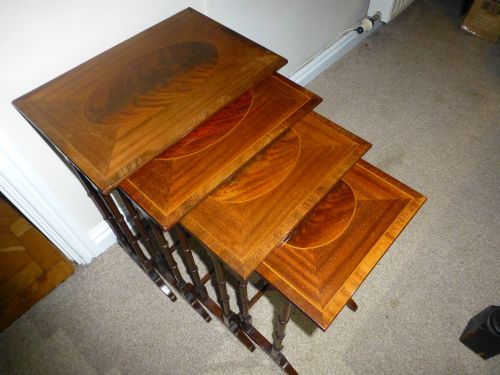
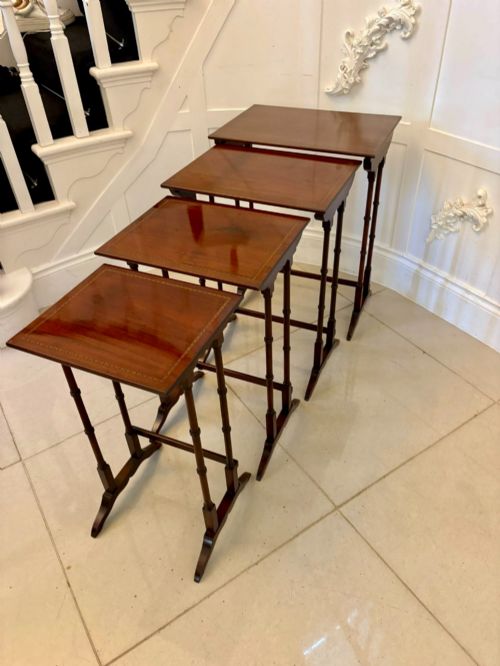
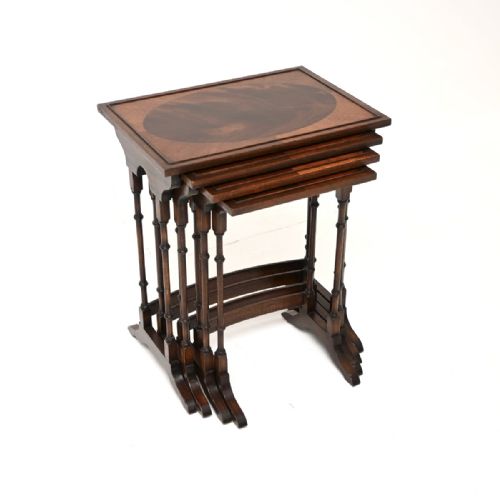
When you search for an edwardian inlaid table set, you are looking at stacking occasional furniture designed to slide neatly beneath one another when not in use. These pieces most frequently appear as quartetto sets comprising four graduating tables, though sets of three also occur within the records.
The dominant period on this page is the Edwardian era, alongside late Victorian and 1930s revivals, often following earlier Sheraton and Regency design principles. They serve various practical roles around a home, functioning as coffee, lamp, wine, or side tables depending on the needs of the room.
Materials and Construction
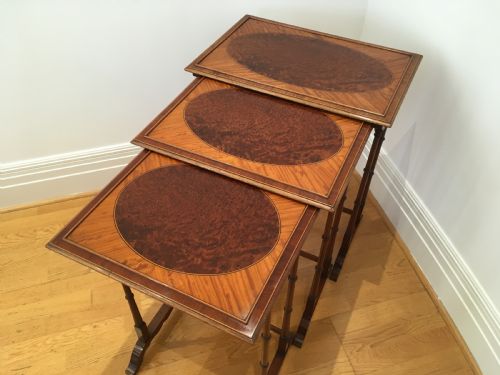
Makers built these pieces primarily from solid mahogany and mahogany veneer, chosen for stability and a rich reddish-brown surface tone. They utilised satinwood, rosewood, amboyna, and boxwood for contrasting stringing, cross-banding, and delicate marquetry details.
Structural elements include square tapered legs and serpentine forms that require precise carpentry to allow the smaller tables to nest smoothly inside the larger frames. Brass details and castors occasionally appear on specific variants like games tables.
Edwardian Inlaid Table Set Retail Price Guide 2026
Typical asking prices for edwardian inlaid table set among the pieces listed under this phrase on Sellingantiques today, from the lower quarter to the upper quarter. They describe what is for sale here now, not the wider market.
Listings on this page include mahogany, satinwood inlay, rosewood, and brass across Edwardian, Victorian, and Regency periods.
Judging Quality
Quality in these sets depends heavily on the crispness of the satinwood inlay and the precision of the mitred joints where the legs meet the top. Superior examples maintain structural rigidity across all graduated sizes without loose joints or warping in the stacking clearance.
The choice of secondary timbers and the subtlety of the cross-banding also distinguish standard production items from finer workshop pieces. Better proportioned tables feature balanced proportions and clean timber grain visible beneath the polish.
Gillows
The Edwardian Inlaid Table Set Glossary
- Quartetto
- A matched set of four graduating tables designed to stack inside one another. This term originates from musical quartets and appears frequently in Edwardian furniture descriptions.
- Satinwood
- A lustrous tropical hardwood native to India and Ceylon with a yellow sheen. Makers utilised it extensively for contrasting banding and inlay work.
- Cross-banding
- A strip of veneer applied to the edge of a table top where the grain runs at right angles to the central panel. This technique frames the primary timber surface.
- Stringing
- Thin inlaid lines of contrasting wood such as boxwood used to outline geometric shapes or tabletops. It provides a linear border for more complex marquetry motifs.
- Serpentine
- A curved edge profile shaped like a gently undulating snake line. This form softens the rectangular outline of the table top.
Edwardian Inlaid Table Set: Frequently Asked Questions
What is a quartetto nest?
A quartetto nest consists of four graduating tables designed to slide one beneath another into a single compact footprint.
This clever stacking design originated in the nineteenth century and became particularly popular during the Edwardian period for entertaining.
How were these tables used?
Owners pulled out the smaller individual tables as needed for serving tea, holding lamps, or placing drinks beside seating.
When entertaining finished, the smaller tiers slid back inside the main table to save floor space.
Are all these tables from 1900?
While the Edwardian period forms the core of these listings, the selections span from the late nineteenth century into later revival periods.
Craftsmen continued to produce these traditional stacking tables well into the twentieth century using identical construction methods.