
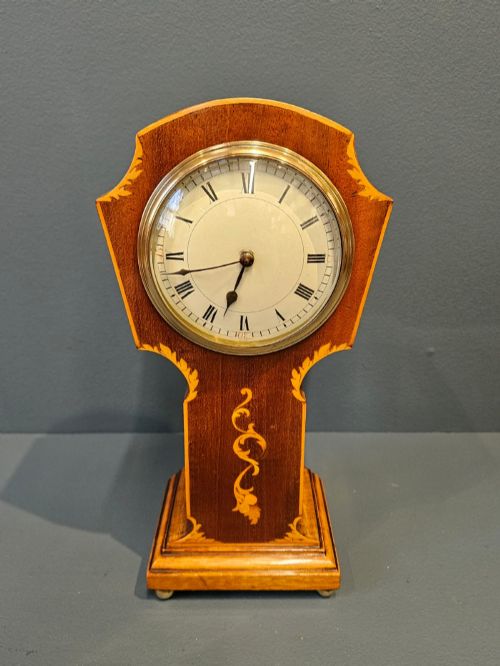
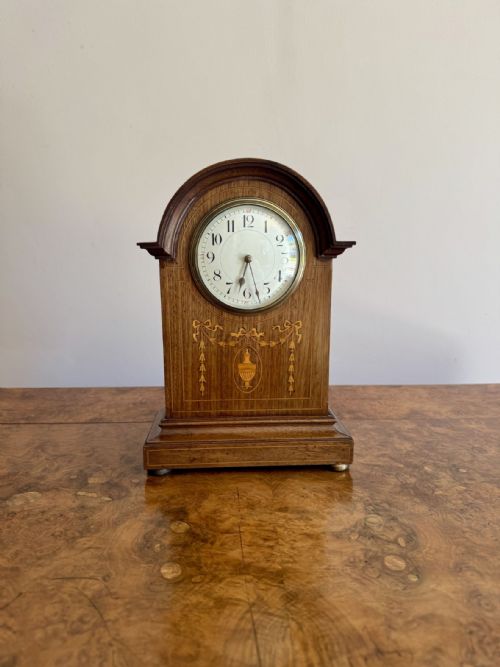
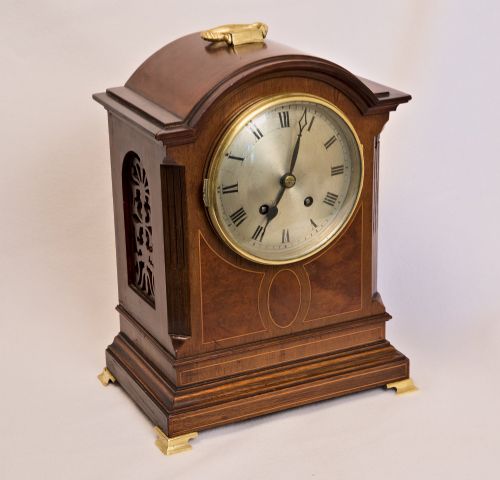


Edwardian Inlaid Shelf Clock
These Edwardian inlaid shelf clock pieces combine domestic timekeeping with delicate marquetry, bringing period character to a mantelpiece.
Edwardian Inlaid Shelf Clock
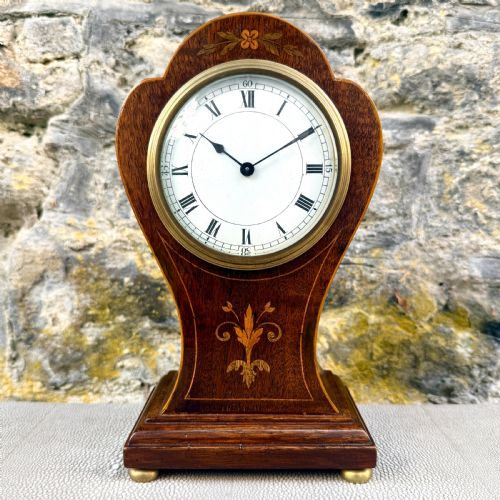
An edwardian inlaid shelf clock is typically a timber mantel clock designed to sit on a shelf, bracket or tabletop in a domestic interior. The examples gathered here span the late nineteenth century and the early twentieth century, with the Edwardian period providing the bulk of the domestic items.
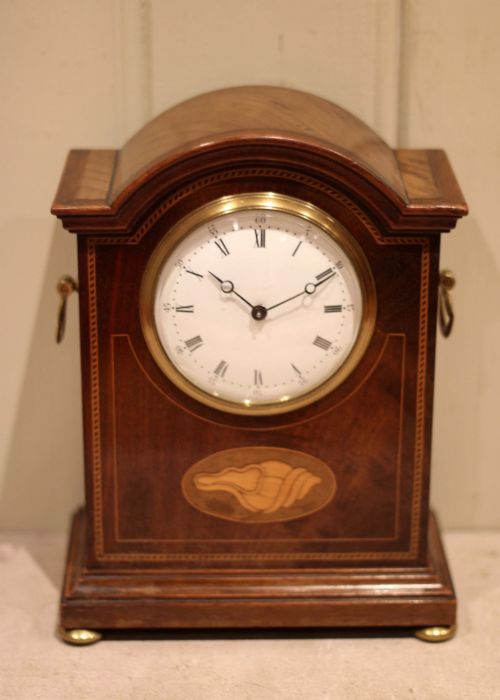
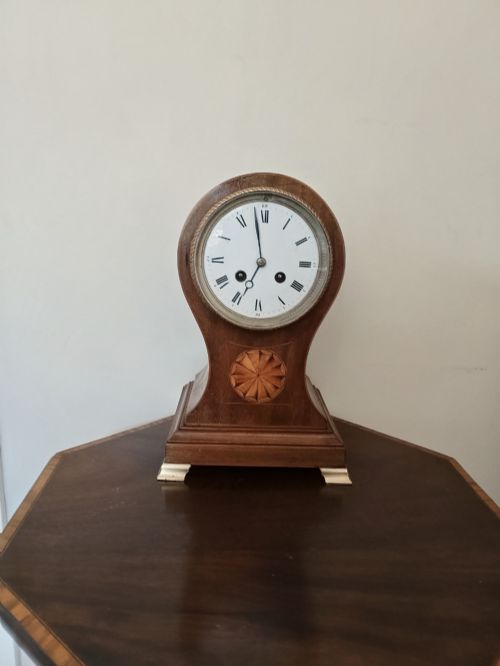
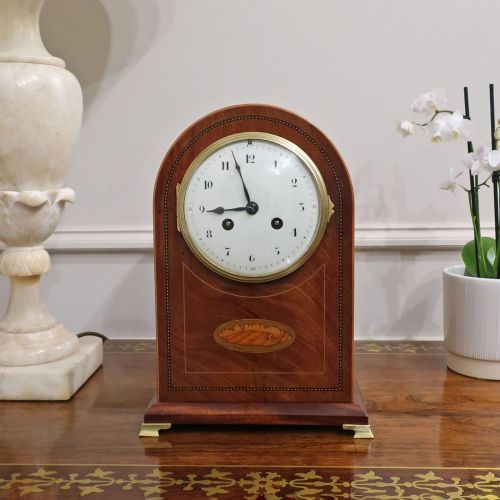
The version you are most likely to meet on this page is an upright or balloon-shaped mahogany timepiece featuring contrasting wood inlay. These range from simple lancet and break arch silhouettes to ornate French and German movements housed in compact wooden cases.
Materials and construction
Makers built these clock cases predominantly from solid or veneered mahogany, alongside occasional examples in oak, black marble and boxwood. The timber surfaces serve as a dark ground for delicate satinwood and boxwood stringing or pictorial marquetry.
Brass fittings such as bezel rings, feet and swinging handles complement the warm timber tones, while white enamel dials with dark numerals ensure legibility. Movements are integrated behind glazed doors, balancing structural joinery with intricate interior mechanics.
Standards of craftsmanship
Quality rests upon the crispness of the cabinetwork and the precision of the inlay work. Finer pieces demonstrate meticulous hand-cut marquetry and tightly mitred corners rather than printed or superficial decoration.
The distinction also lies in the sophistication of the internal movement and the heft of the brass and glass components. Superior examples maintain balance between architectural proportion and decorative restraint.
Junghans German·Seikosha Seiko
The Edwardian Inlaid Shelf Clock Glossary
- Balloon clock
- A mantel clock featuring a case shaped like a hot air balloon, curving outward from a narrow base to a rounded dome. This silhouette proved popular throughout the Edwardian period.
- Marquetry
- The art of applying small pieces of veneer to a structure to form decorative patterns or pictorial scenes. Makers utilised contrasting timbers like satinwood and boxwood for these motifs.
- Timepiece
- A clock that tells the time without incorporating a striking mechanism for hours or quarters. These simpler movements required winding just for the hands.
- Lancet top
- A pointed, arched architectural silhouette resembling a Gothic window arch. This shape defines the upper profile of several mantel clocks here.
- Bezel
- The metal ring that holds the glass protecting the dial face. In these clocks, it is commonly cast in brass and hinged to allow access for setting the hands.
Edwardian Inlaid Shelf Clock: Frequently Asked Questions
What is a shelf clock?
A shelf clock is a portable timepiece designed to stand on a mantelpiece, sideboard, or bracket rather than hang upon a wall or rest on the floor.
These domestic clocks combined practical utility with decorative cabinetmaking, allowing households to keep accurate time in principal living rooms.
How do I wind an antique clock?
Winding requires inserting a matching key into the winding holes on the enamel dial and turning it gently until resistance is felt.
Care must be taken not to overwind the mainspring, which can damage the internal mechanism of these delicate mechanical pieces.
How do I date an Edwardian clock?
Dating relies upon stylistic markers such as the presence of satinwood inlay, balloon cases, and Art Nouveau motifs alongside the period of the movement.
While many pieces date precisely from the Edwardian era, related examples span from late Victorian production into the early twentieth century.
Where should I place a mantel clock?
These clocks sit securely on level surfaces such as mantelpieces, desks, or wooden shelves away from dampness and direct sunlight.
Placing them on a stable surface ensures the pendulum or balance wheel maintains an even beat for reliable timekeeping.