
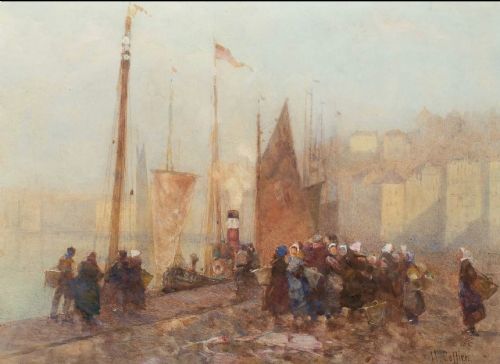
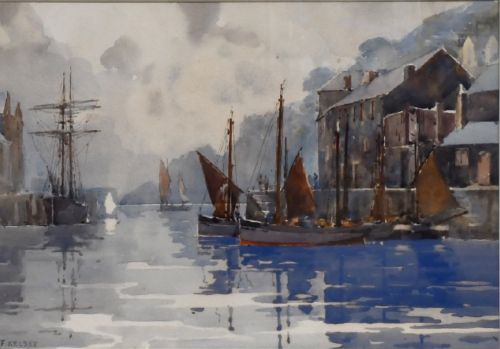


Edwardian Harbour Scene
An edwardian harbour scene captures the salty air and bustling maritime life of early twentieth-century coastal ports through delicate brushwork.
Edwardian Harbour Scene
When you search for an edwardian harbour scene, you encounter depictions of British and European coastal life spanning the early decades of the twentieth century, alongside occasional nineteenth-century antecedents. These works record busy fishing dockyards, tidal harbours, and returning fleets in Cornwall, Yorkshire, London, and beyond.
You are most likely to meet watercolour paintings on paper, often mounted behind glass in wooden frames, capturing the transient light of maritime environments. Painters associated with regional artist colonies such as Newlyn and Staithes frequently form the core of these selections.
Materials and Technique
Artists deployed watercolour pigments onto paper to achieve translucent washes of sea and sky, or applied oil paint to canvas and board for heavier textures of coastal waters and vessels. These paintings rely on the interplay of paper or canvas grounds with fluid pigment handling to suggest movement and atmosphere.
Framing typically involves wood and gilded wood mouldings under glass for watercolours, protecting the delicate pigments from atmospheric moisture and handling damage.
Several paintings capture Whitby Abbey looming quietly above the harbour while fishermen haul their daily catch ashore.
Evaluating Quality
Quality rests upon the artist's ability to command atmosphere and perspective within a restricted coastal palette, distinguishing accomplished regional observations from formulaic dockside sketches. The handling of restless water and rigging requires a sure, confident hand that elevates the entire composition.
The condition of the paper surface, the absence of excessive foxing, and the integrity of the original framing elements contribute significantly to the standing of a piece.
Hector Caffieri·Frank Kelsey·George F Pennington·Alfred George Morgan·Richard Harry Carter·John Bell·James Webb·James Thomas Watts·Ernest F Hill·Frederick Stuart Richardson·Percy Brooke·William Lambert Bell·Ralph Todd·Rowland Henry Hill·Frank W Scarborough·Harry Wanless·William Lee Hankey·Owen Bowen·Walter Sweet·Walter Henry Sweet·Edward Fletcher·John D Walker·Frank William Scarbrough
The Edwardian Harbour Scene Glossary
- Watercolour
- A painting method in which the paints are made of pigments suspended in a water-based solution. This medium allows for luminous washes that suit depictions of sea and coastal atmosphere.
- Newlyn School
- An art colony based in Cornwall during the late nineteenth and early twentieth centuries. Artists here focused on plein-air painting of local fisherfolk and harbour life.
- Staithes School
- A group of northern impressionist painters working on the Yorkshire coast. They captured the bustling activity of fishing ports with vibrant brushwork.
- Lugger
- A type of small fishing vessel with lug sails common in West Country ports. These boats frequently feature as focal points in maritime scenes from Cornwall and Devon.
Edwardian Harbour Scene: Frequently Asked Questions
What is an edwardian harbour scene?
These works are paintings and prints depicting coastal ports, fishing fleets, and tidal harbours created around the early twentieth century.
They record the daily routines of British and European maritime communities through watercolours and oil paintings.
How were these coastal scenes used?
Artists painted these scenes to capture the changing light and rugged livelihoods of working coastal towns.
Collectors and residents hung them in homes to celebrate Britain's maritime heritage and regional fishing ports.
How do I live with watercolour paintings?
Watercolours require placement away from direct sunlight to prevent the fading of delicate pigments on paper.
Keeping them behind glass in stable indoor environments protects the paper and medium from humidity.
How do I distinguish regional art schools?
Regional groups like the Newlyn and Staithes schools are identified by their focus on local fishing communities and distinct plein-air painting techniques.
Their works often reflect the specific coastal topography of Cornwall or Yorkshire.