
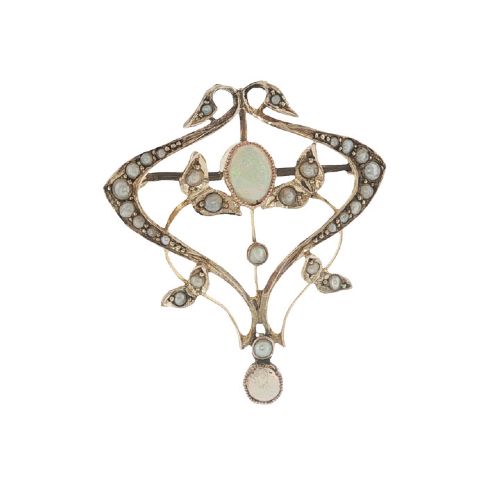


Edwardian Foliate Pendant
These delicate gold pieces, known to collectors as an edwardian foliate pendant, bring fine openwork floral motifs and soft gemstones straight from the early twentieth century to your neckline.
Edwardian Foliate Pendant
An edwardian foliate pendant captures the lightness of the early twentieth century through openwork metal scrolls and floral or leaf motifs arranged symmetrically around central gemstones. These jewels rely on delicate wreaths, tendrils, and botanically inspired drops that reflect the grace of the Belle Epoque period.
You will most frequently meet pieces fashioned from nine-carat or fifteen-carat gold, often paired with platinum settings to hold smaller diamonds securely. The composition usually incorporates pearls, seed pearls, amethysts, aquamarines, opals, or tourmalines, suspended from fine chain necklaces.
Many designs function as versatile convertible jewels, featuring integrated pin stems on the reverse that allow the pendant to double as a brooch. The forms range from simple lavaliers with cascading stone drops to intricate circular wreaths and symmetrical floral clusters.
How they were made
Goldsmiths of this era employed fine casting and piercing techniques to create airy, lace-like wirework frames from yellow gold and platinum. These open frameworks allowed maximum light to pass through the gemstones while keeping the overall weight remarkably light.
Gemstones such as amethysts, aquamarines, and opals were typically bezel-set or collet-set by hand, surrounded by borders of split pearls or seed pearls secured with tiny individual beads of metal. The addition of platinum facing on gold sections provided a bright, durable surface for diamond settings without adding excessive weight.
Edwardian Foliate Pendant Retail Price Guide 2026
Typical asking prices for edwardian foliate pendant among the pieces listed under this phrase on Sellingantiques today, from the lower quarter to the upper quarter. They describe what is for sale here now, not the wider market.
Recorded pieces combine yellow gold, fifteen-carat gold, and platinum with amethysts, aquamarines, opals, tourmalines, and pearls.
What varies in quality
The distinction between standard examples and the finest work lies in the intricacy of the pierced metalwork and the uniformity of the seed pearls. Superior pieces exhibit hand-carved leaf details and seamless integration between the gold frame and the central stone drops.
Stone selection also dictates the tier of the piece, with cleaner, deeply saturated amethysts and vibrant tourmalines or opals commanding greater presence than paler or included variants. The survival of the original convertible pin mechanism and fine gold chain further elevates a piece.
The Edwardian Foliate Pendant Glossary
- Foliate
- Decorated with leaf or plant motifs. This style draws directly from natural botanical forms translated into precious metal.
- Lavalier
- A pendant featuring a suspended drop stone hanging below the main body. These necklaces swing freely with the movement of the wearer.
- Seed pearl
- A very small, naturally occurring or early cultured pearl, often half-drilled and glued or pegged onto tiny pins. They form delicate borders around larger central gemstones in Edwardian jewellery.
- Collet setting
- A low collar of metal that surrounds the girdle of a gemstone and is rubbed over to hold it in place. This technique creates a smooth, finished border around the stone.
- Belle Epoque
- A period of fine decorative arts spanning the late nineteenth century to the First World War. It is characterised by light, garland-style designs executed in platinum and gold.
Edwardian Foliate Pendant: Frequently Asked Questions
Are these pendants fragile?
These jewels are structurally sound for careful daily wear, though their delicate wirework and seed pearls require gentle handling.
Avoid wearing them during strenuous physical activity or exposing them to harsh cleaning chemicals.
Can I wear this as a brooch?
Many examples from this era include a hidden pin stem and clasp alongside the suspension loop on the reverse.
This clever dual purpose allows you to pin the jewel securely to lapels or fabrics as well as hanging it from a chain.
What chain should I use?
Pair the pendant with a fine gold chain that matches the carat colour and weight of the frame.
Heavier modern chains will overwhelm the delicate proportions typical of Edwardian metalwork.