
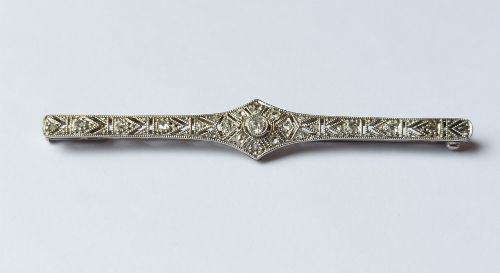

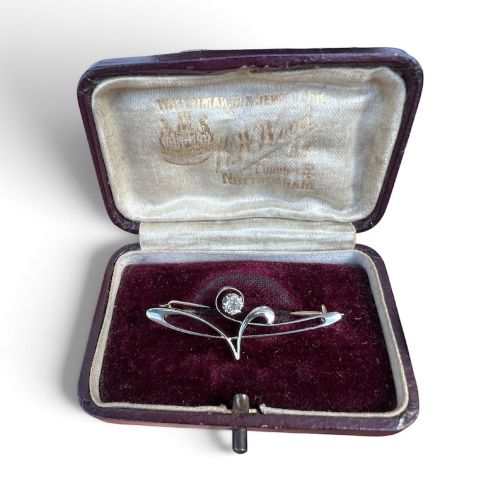

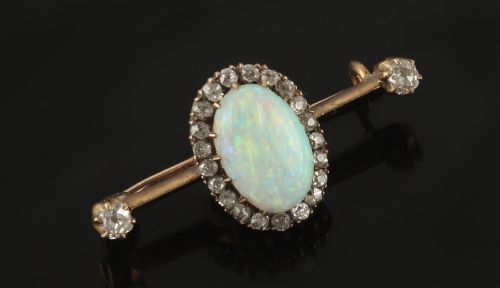


Edwardian Diamond Bar Brooch
An edwardian diamond bar brooch brings together linear elegance and period gemstone work, offering a refined piece of early twentieth-century jewellery for daily wear.

Edwardian Diamond Bar Brooch
An edwardian diamond bar brooch is a slender horizontal pin designed to fasten lapels, collars and scarves, typically measuring a few inches across.
The selections on this page span the Edwardian era, late Victorian period, and Art Deco transitions, alongside select pieces from the 1890s through to 1940.
Beyond strict bar forms, many pieces incorporate floral motifs, insects, birds, bicycles, and crescent shapes set with diamonds alongside rubies, emeralds, sapphires, opals, and pearls.
How they were made
Goldsmiths utilised a combination of yellow gold, rose gold, 15ct gold, silver, and white gold, frequently pairing these with platinum mounts to secure the stones.
Diamonds are predominantly old cut or rose-cut, handset into metal settings that often combine silver-topped gold or platinum-topped gold techniques of the period.
Coloured gemstones and pearls are integrated alongside enamel work to create dimensional subjects such as ducks, swallows, cockerels, and floral sprays.
Object forms span standard linear bar brooches, crescent shapes, and pictorial subjects including swallows, ducks, monkeys, and bicycles.
What varies in quality
The standard of an edwardian diamond bar brooch depends on the crispness of the metalwork, the symmetry of the setting, and the integration of secondary gems like rubies, emeralds, or natural pearls.
Purity of line and structural integrity separate simpler pins from masterworks that incorporate intricate motifs like insects or detailed floral clusters.
The retention of original box settings and undamaged enamel or stone work elevates the overall calibre of the piece.
The Edwardian Diamond Bar Brooch Glossary
- Bar brooch
- A horizontal pin designed with a narrow shaft, often accented with gemstones or central motifs. This form dominated jewellery design from the late Victorian period through the Edwardian era.
- Old cut diamond
- A hand-faceted diamond shape common in antique jewellery, featuring a smaller table, higher crown, and open culet. These stones display a softer candlelit sparkle compared to modern brilliant cuts.
- Rose-cut diamond
- A vintage gemstone cut with a flat base and a domed crown of triangular facets arranged in a star shape. They provide a translucent, understated shimmer.
- Platinum-topped gold
- A manufacturing method where a thin layer of platinum is fused over a gold base. This technique allowed makers to utilise a bright white metal for diamond settings while maintaining the strength of gold underneath.
- Natural pearl
- Pearls formed organically in molluscs without human intervention, frequently found in Edwardian clusters alongside diamonds. They display subtle variations in orient and lustre.
Edwardian Diamond Bar Brooch: Frequently Asked Questions
How do I wear a bar brooch?
These pieces suit heavy fabrics such as wool lapels, tailored jackets, and thick scarves where the pin can anchor securely without sagging. Using a safety catch or supplemental pin backing helps secure the horizontal shaft during daily movement.
Alternatively, many collectors pin them to the centre of a neckline or fasten them across a silk cravat. The slender profile allows the brooch to sit flat against tailored garments.
Are these pieces made of platinum?
Many Edwardian and Art Deco examples utilise platinum, often combined with gold or silver. Platinum-topped gold was a prevalent technique that allowed artisans to showcase diamonds against a white metal surface.
Yellow gold and rose gold also appear frequently, particularly in pieces originating from the late Victorian period and early 1900s. The metal choice generally reflects the exact decade of manufacture.
What gems besides diamonds are used?
Makers frequently set rubies, sapphires, emeralds, opals, tourmalines, aquamarine, and natural pearls alongside the central diamonds. These coloured stones provide vibrant focal points within floral, animal, or geometric bar designs.
Enamel work also appears in select pieces, adding coloured details to wings, leaves, and whimsical subjects like insects and bicycles.