




Edwardian Desk with Gallery
An edwardian desk with gallery brings refined writing spaces into a room, offering upright pigeonholes and shelves for stationery alongside a practical working surface.
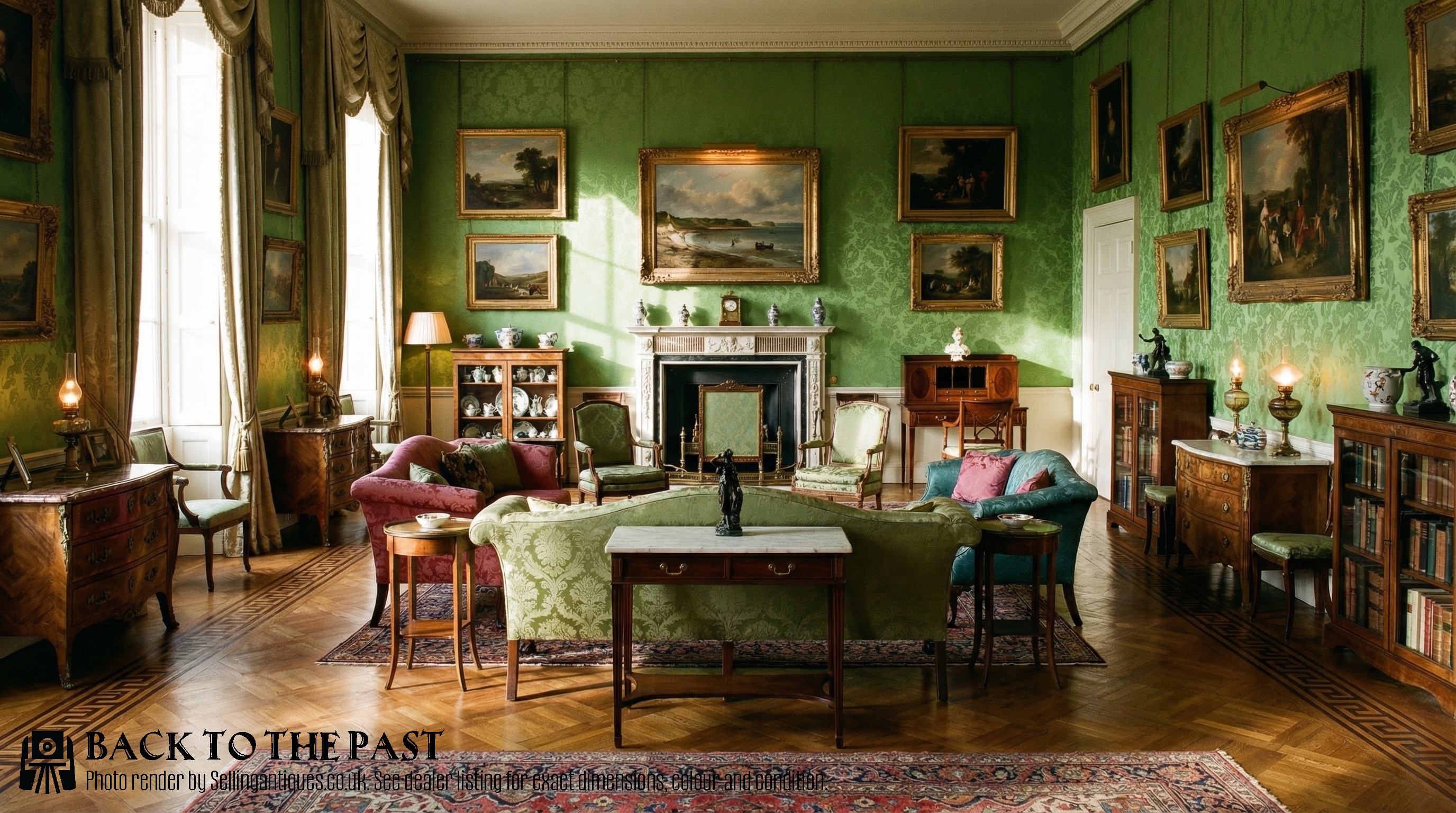
Edwardian Desk with Gallery
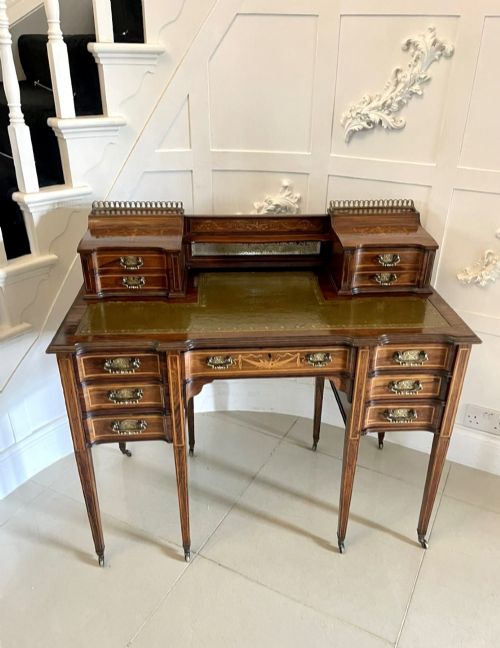
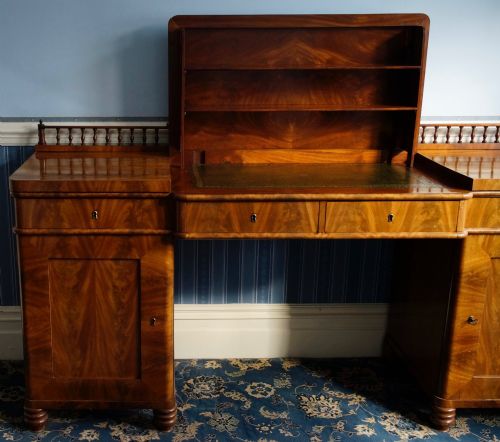
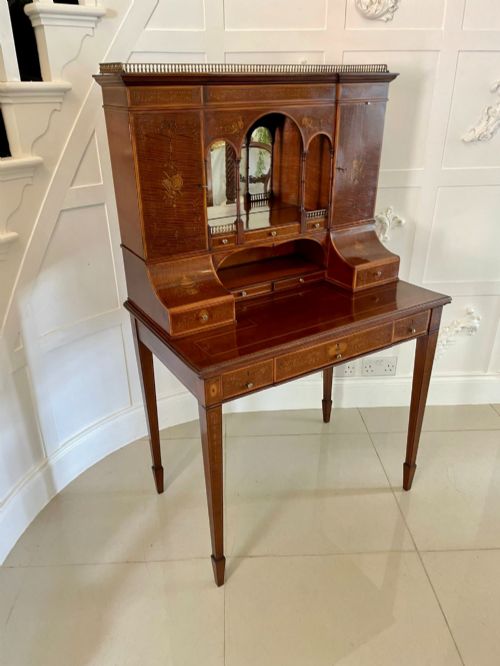
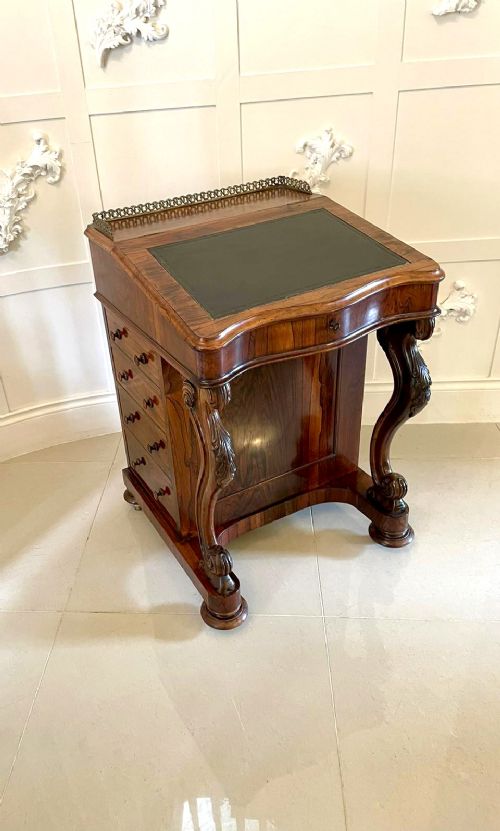
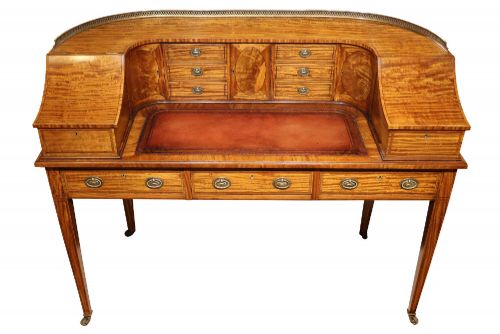
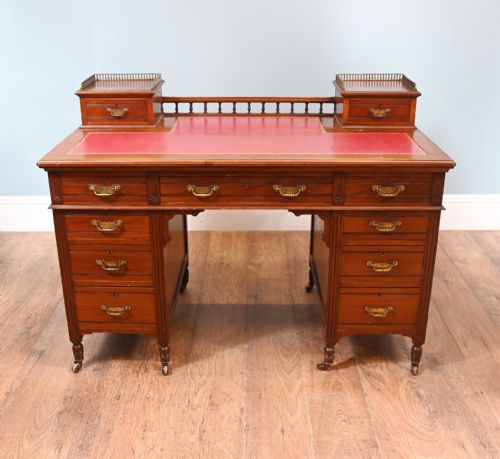
An edwardian desk with gallery unites the polished proportions of the early twentieth century with practical superstructure shelving. These writing tables frequently emerge from the Edwardian period and the broader nineteenth century, constructed in forms ranging from compact ladies writing desks to larger pedestal desks and grand Carlton House styles.
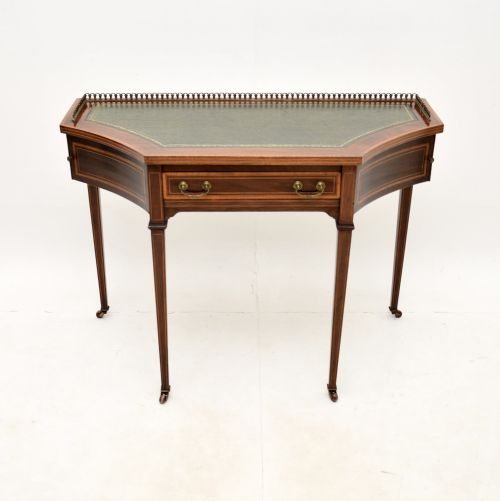
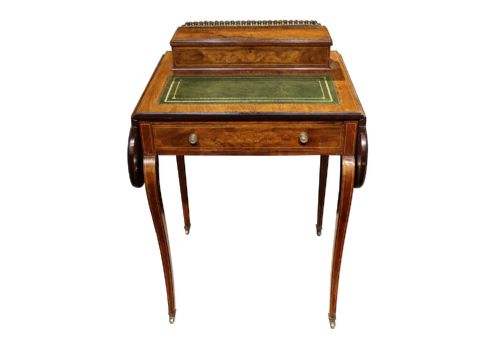
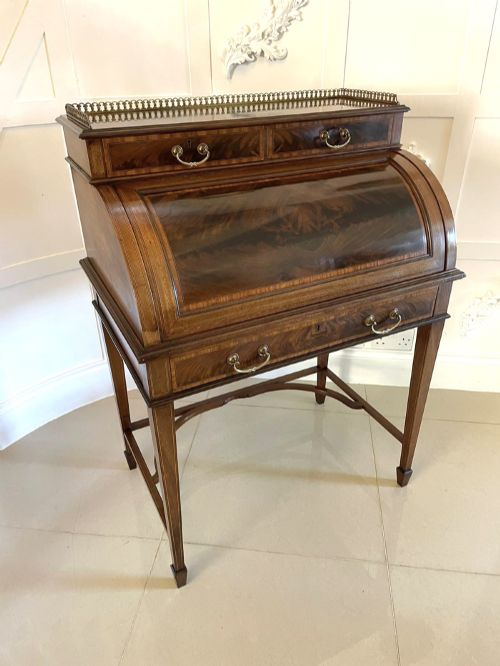
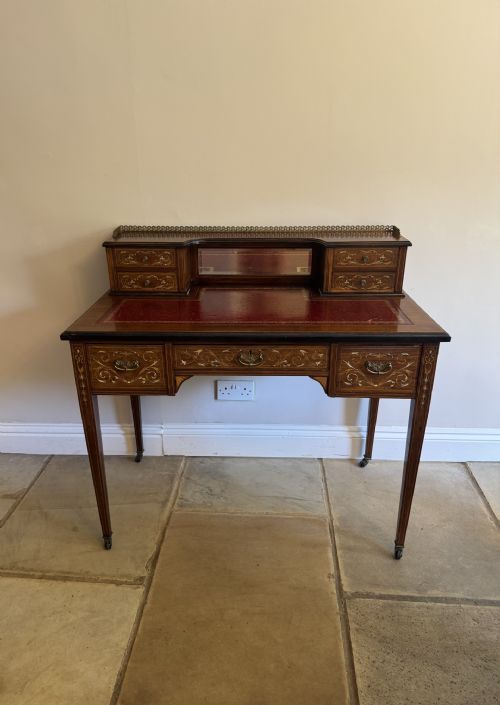
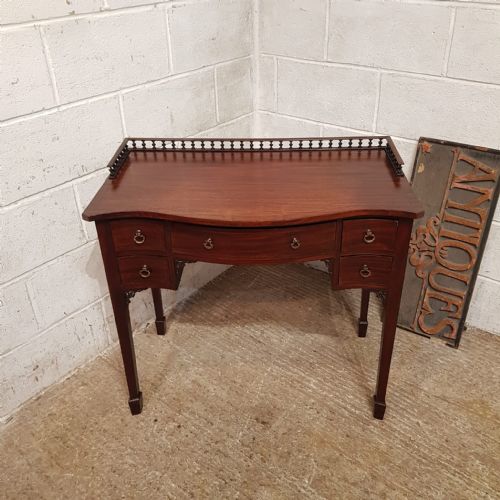
The defining gallery sits upon the rear of the writing surface, taking the form of a low pierced brass rail or a tiered wooden superstructure of small drawers and pigeonholes. Buyers seek these pieces to organise correspondence whilst retaining the warmth of traditional timber furniture in a study or drawing room.
The examples gathered here demonstrate the strong influence of Sheraton Revival design alongside straightforward Edwardian manufacturing. Mahogany forms the backbone of these pieces, accompanied by walnut, rosewood, and satinwood, frequently enriched with delicate inlay work.
Materials and Construction
Makers built these desks primarily from solid and veneered mahogany, walnut, and satinwood, often selecting dense rosewood or amboyna for finer examples. Timber frames supported working surfaces lined with tooled leather, providing a durable flat plane for daily correspondence.
Details relied upon contrasting timbers for satinwood inlay and crossbanding in kingswood, framing drawer fronts and borders with geometric precision. Brass hardware proved essential, appearing as original handles on drawers and as pierced gallery rails mounted along the upper rear edges.
Listings feature woods spanning mahogany, walnut, rosewood, satinwood, and amboyna, alongside brass and leather components.
Markers of Quality
Quality rests upon the crispness of the timber inlay and the choice of primary woods, moving from standard mahogany up to figured satinwood and amboyna. Superior pieces display thoughtful internal joinery, such as oak-lined drawers and fitted stationery interiors that integrate smoothly with the superstructure.
Hardware integrity separates standard production from the finest workshops, seen in heavy cast brass handles and robust gallery rails securely seated into the timber top. The harmony of proportion between the lower writing surface and the upper gallery dictates the visual balance of the piece.
Maple of London·Heal & Sons·Maple & Co
The Edwardian Desk with Gallery Glossary
- Gallery
- A raised superstructure of small shelves, pigeonholes, or a low metal rail positioned along the back edge of a desk top. It provides organised storage for letters and stationery.
- Crossbanding
- A narrow strip of veneer laid across the grain of the primary timber panel, frequently used around the borders of drawer fronts and tabletops to create a decorative frame.
- Carlton House Desk
- A distinct form of writing desk featuring a horseshoe-shaped superstructure of drawers and pigeonholes curving around the rear and sides of the working surface.
- Escritoire
- A traditional writing cabinet or desk equipped with a sloping or fall-front writing surface concealing internal compartments.
- Sheraton Revival
- A late nineteenth and early twentieth century design movement that reinterpreted the light, neoclassical furniture forms popularised by Thomas Sheraton in the eighteenth century.
Edwardian Desk with Gallery: Frequently Asked Questions
What is a gallery on a desk?
A gallery is an upright tier of small shelves, compartments, or a pierced metal rail fixed to the rear edge of the writing surface. It keeps writing implements and correspondence neatly ordered above the main desk.
This feature distinguishes these writing tables from plain flat desks, adding both architectural height and practical desktop organisation.
How do I distinguish Edwardian pieces from Victorian ones?
Edwardian furniture generally exhibits lighter proportions, simpler neoclassical revival details, and paler satinwood or mahogany veneers. Victorian pieces often lean towards heavier construction, darker timbers, and more robust mouldings.
The listings here show how late nineteenth-century Victorian forms evolved into the airier aesthetic characteristic of the Edwardian era.
What timber was commonly used?
Mahogany served as the primary structural timber for the vast majority of these desks, valued for its stability and rich grain. Walnut, satinwood, and rosewood also appeared frequently, often selected for decorative veneer panels and fine crossbanding.
Inlaid details in contrasting woods frequently highlighted the borders of drawers and tabletops to catch the eye.
Where should I place a gallery desk?
These desks suit studies, bedrooms, and sitting rooms where their finished backs allow them to sit away from a wall if needed. The raised gallery provides useful vertical storage without demanding a larger footprint in the room.
Pairing the desk with a low chair ensures comfortable clearance beneath the writing surface and leaves the upper compartments within easy reach.