

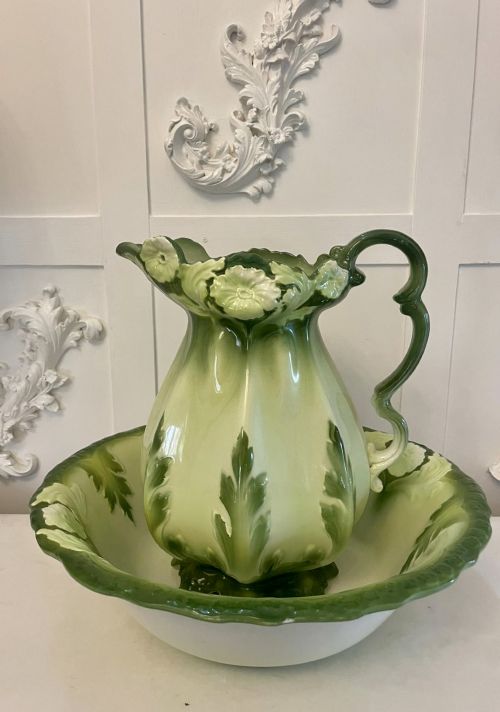



Edwardian Decorative Ewer
These edwardian decorative ewer pieces bring hand-painted artistry and classical form into your room, offering an immediate focal point.
Edwardian Decorative Ewer
When you search for an edwardian decorative ewer, you are looking at ornamental vessels shaped for display rather than functional pouring, drawing on centuries of classical forms. The pieces you meet on this page span the Edwardian period alongside late Victorian and early twentieth-century examples, taking the form of ewers, jugs, and wash sets.
Makers such as Royal Worcester, Doulton Lambeth, and Coalport dominate the selection, often produced as matched pairs or individual cabinet items. You will encounter decorative jugs and pedestal vases alongside traditional ewers, reflecting the varied output of British potteries during these decades.
The aesthetic ranges from elaborate floral hand-painting to blush ivory finishes and neoclassical contours. Art Nouveau flourishes and revival styles also appear across the listings, showing how makers adapted historical shapes to contemporary interior tastes.
How they were made
Potters shaped these ewers from ceramic bodies including porcelain and earthenware, applying glaze to create smooth or lustrous surfaces before secondary firing. Skilled artisans then added hand-painted decoration, often featuring botanical or scenic motifs signed by the studio painter.
Many examples incorporate gilt, gold leaf, and delicate gilding to highlight handles, rims, and moulded panels. Enamel work further enriched the surfaces, particularly on blush ivory pieces where subtle colour gradients meet raised gold detailing.
Edwardian Decorative Ewer Retail Price Guide 2026
Typical asking prices for edwardian decorative ewer among the pieces listed under this phrase on Sellingantiques today, from the lower quarter to the upper quarter. They describe what is for sale here now, not the wider market.
Several ewers bear the actual signatures of factory artists who clearly wished to take personal credit for their painted flora.
What varies in quality
Quality rests on the pedigree of the maker and the finesse of the hand-painted artistry, distinguishing standard production from signed studio pieces. Works bearing the names of recognised artists command greater interest through their detailed brushwork and compositional balance.
The preservation of the gilding and enamel work defines the physical condition and visual impact of each vessel. Intricate moulding and harmonious proportions further separate exceptional cabinet pieces from simpler ceramic jugs.
Royal Worcester·Doulton Lambeth·Coalport
The Edwardian Decorative Ewer Glossary
- Ewer
- A large jug with a wide spout and a curved handle, traditionally used for holding water but rendered here as a purely decorative object. These vessels often feature classical urn shapes adapted for late nineteenth and early twentieth-century display.
- Blush Ivory
- A specialised ceramic finish developed by Royal Worcester featuring a soft, matte cream ground tinted with subtle flesh tones. It typically serves as a backdrop for delicate floral painting and raised gilding.
- Gilt
- A thin layer of gold applied to the ceramic surface to accent handles, rims, and raised decorative motifs. This technique adds reflective contrast to the glazed body.
- Earthenware
- A porous pottery body fired at lower temperatures than porcelain and finished with an opaque glaze. It forms the foundation for many larger decorative jugs and wash sets.
- Art Nouveau
- A decorative style characterised by flowing, organic lines and asymmetrical plant-inspired motifs. Pieces from this movement move away from strict historical revival towards naturalistic curves.
Edwardian Decorative Ewer: Frequently Asked Questions
What is an edwardian decorative ewer used for?
These vessels were created purely for display on mantelpieces, sideboards, or pedestals rather than practical use. Their sculptural forms and painted surfaces served to showcase household taste and refinement.
Collectors today place them as standalone decorative items or arrange them in matched pairs to anchor a room's interior design.
How do I identify a Royal Worcester ewer?
Look for factory backstamps underneath the base, alongside artist signatures such as Stinton, Chivers, or Davis on the painted body. The characteristic blush ivory finish and intricate gilding also point towards this manufacturer.
Many pieces also feature registry numbers or specific date codes stamped into the ceramic body during production.
Are these ewers made of porcelain or pottery?
The listings include both fine porcelain and heavier earthenware bodies depending on the manufacturer and the intended form. Each material received specific glazes to achieve either a high gloss or a matte finish.
Finer cabinet ewers typically utilise porcelain, while larger decorative jugs and wash sets often employ earthenware.
How should I clean a hand painted ewer?
Dust the surface gently with a soft, dry brush to prevent any accumulation without risking the delicate enamel or gold leaf. Avoid using water, abrasive cloths, or chemical cleaning agents on the painted areas.
Proper care preserves the integrity of the original hand-painted details and the underlying ceramic glaze.