
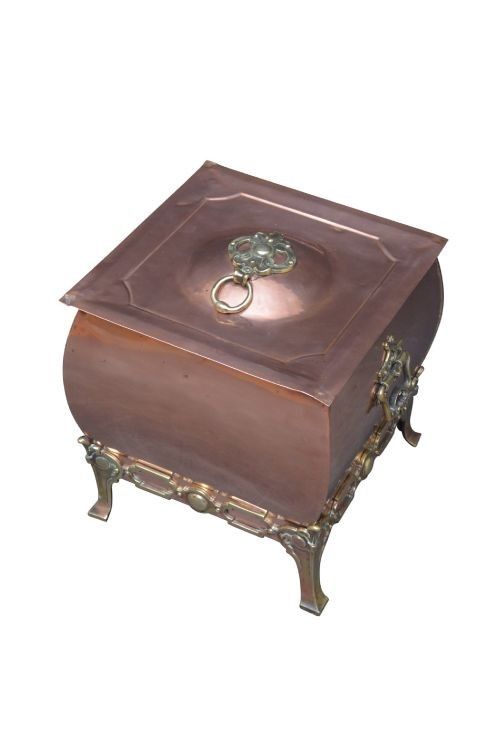


Edwardian Copper Fireside Box
An edwardian copper fireside box brings warmth and practical storage to a hearth, combining sturdy metalwork with domestic utility.
Edwardian Copper Fireside Box
When you search for an edwardian copper fireside box, you encounter pieces designed to hold fuel neatly beside a hearth. These items take forms such as coal boxes, log bins, purdoniums and coal scuttles.
The versions most commonly met on this page span the Edwardian period alongside late Victorian and Arts and Crafts examples. They serve as functional hearth accessories that double as decorative metalwork storage containers.
Makers fashioned these storage boxes to keep coal or logs contained while enhancing the sitting room interior. They bridge the gap between heavy industrial utility and domestic fireside refinement.
Materials and Construction
Artisans combined sheet copper with brass, iron and oak to build these fireside containers. Wrought iron and wood provide structural framing, while beaten copper forms the decorative outer panels.
Many examples incorporate riveted construction and repoussé decoration, featuring motifs such as galleon designs. Oak frames and wooden linings support the metal body to hold heavy loads of coal and logs safely.
Some boxes feature a galleon design hammered into the copper, letting your coal storage secretly dream of the open sea.
Evaluating Quality
Quality rests in the weight of the copper sheet and the crispness of any hammered decoration. Substantial oak framing and robust wrought iron fittings distinguish sturdier examples from lighter, purely decorative containers.
The integration of materials determines the overall standard, where thoughtful joining of wood and metal creates a cohesive fireside piece. Hand-finished details on panels elevate the workmanship above plain utility.
The Edwardian Copper Fireside Box Glossary
- Purdonium
- A specialised coal box featuring a sloping front or tipping mechanism to dispense fuel easily. This form was popular in late Victorian and Edwardian households.
- Repoussé
- A metalworking technique where the artisan hammers the metal from the reverse side to form a raised design. It defines much of the ornamentation on Arts and Crafts metalwork.
- Coal Scuttle
- A traditional bucket or container used for carrying and storing coal near the fireplace. They often include swing handles and brass or iron accents.
- Wrought Iron
- Iron that has been heated and hammered into shape by hand, providing strong structural elements. It appears frequently in the hinges and handles of fireside boxes.
Edwardian Copper Fireside Box: Frequently Asked Questions
How were these boxes used?
Households used them to hold the daily supply of coal or wood close to the fire grate. Lids and hinged doors kept dust contained and hid fuel from view.
They sat directly on the hearth or floor within easy reach of the fireplace tools. Their durable construction allowed them to withstand heavy daily handling.
How do I date a copper fireside box?
Dating relies on observing construction methods, materials, and decorative styles like Arts and Crafts or late Victorian motifs. Oak linings and specific handle types help narrow down the decade.
Makers often employed machine assistance alongside hand-beating as manufacturing methods shifted towards the twentieth century. Comparing the design to dated examples in similar styles clarifies the timeline.
How do I maintain copper fireside items?
Maintenance involves gentle cleaning to preserve the natural metal surface without stripping character. Avoid harsh chemical cleaners that remove aged patination.
Dusting regularly with a soft cloth keeps soot and ash from accumulating in the recesses of hammered panels. Keeping the wood components conditioned protects the structural integrity of the box.