

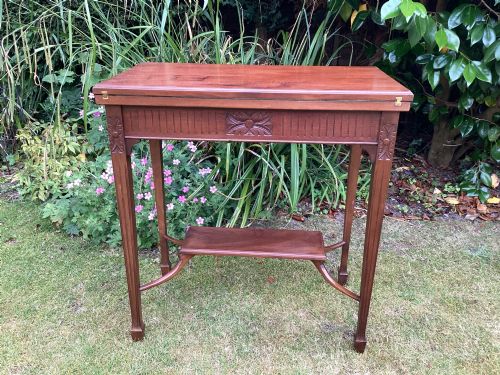

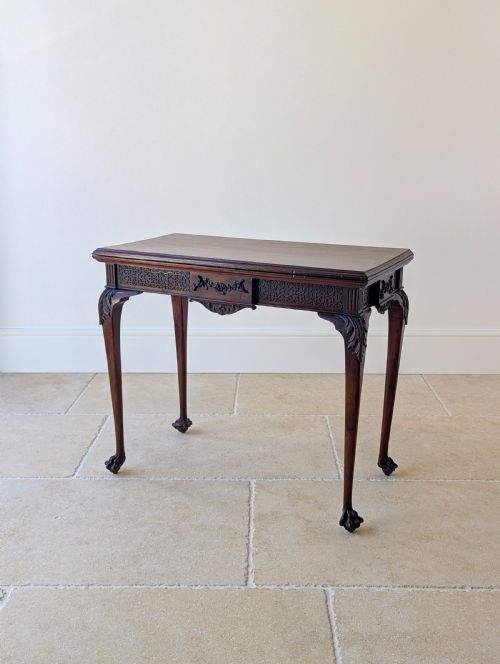


Edwardian Carved Card Table
An edwardian carved card table brings fold-over versatility and refined woodwork into a room, offering a functional surface that doubles for parlour games.
Edwardian Carved Card Table
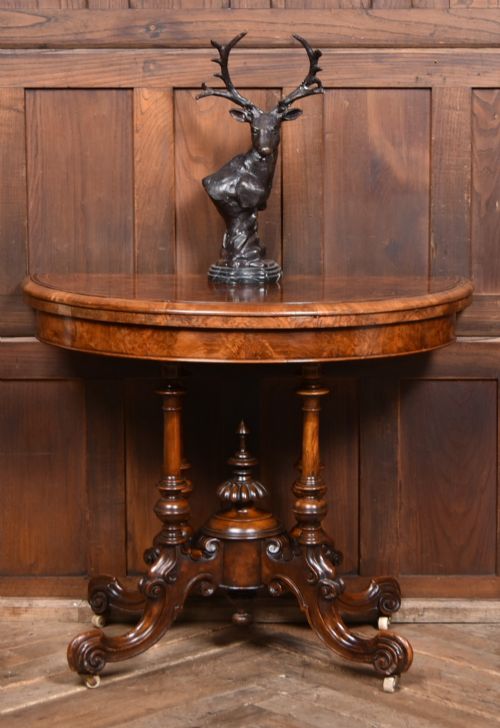
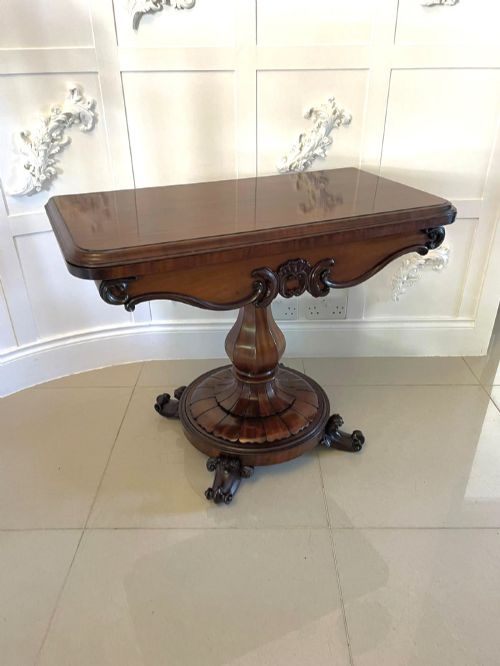
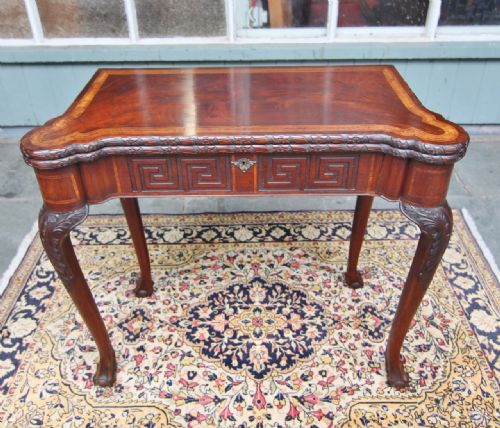
An edwardian carved card table is primarily designed for domestic entertainment, featuring a hinged top that opens to reveal a baize-lined surface for cards and board games. These pieces emerge from periods spanning the Edwardian era, Victorian era, and the early twentieth century, alongside earlier Regency and Georgian influences.
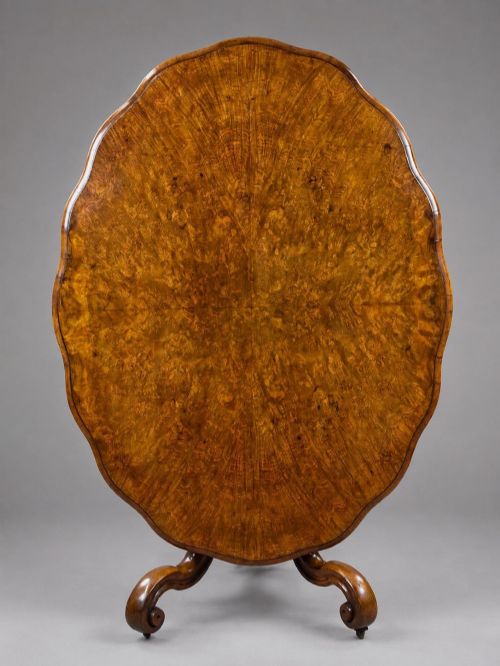
While the search term specifies Edwardian examples, buyers frequently encounter Victorian burr walnut and mahogany variations alongside Queen Anne style walnut pieces and later Edwardian revival models. The forms range from serpentine shapes and demi-lune formats to fold-over games tables and occasional tables.
Originating predominantly from British cabinet making traditions, these tables reflect the domestic social habits of the nineteenth and early twentieth centuries. They combine practical folding mechanisms with decorative woodcraft suitable for drawing rooms and parlours.
Materials and construction
Cabinet makers constructed these tables using primary timbers such as mahogany, walnut, burr walnut, rosewood, and oak, often applying burr walnut veneer to create richly figured surfaces. Wood inlay, marquetry, and Tunbridge Ware detailing provide decorative contrast on the tops and borders.
The structural design relies on hinged fold-over mechanisms supported by gate legs, pivoting tops, or demi-lune bases that swing out to bear the weight of the open playing surface. Ormolu mounts, champlevé enamel, and onyx occasionally appear as decorative accents on related centrepieces and tables from the period.
Edwardian Carved Card Table Retail Price Guide 2026
Typical asking prices for edwardian carved card table among the pieces listed under this phrase on Sellingantiques today, from the lower quarter to the upper quarter. They describe what is for sale here now, not the wider market.
Listings span multiple eras including the Victorian period, Edwardian period, Regency era, and the 1920s, constructed primarily in walnut, mahogany, and rosewood.
Judging quality in these tables
Quality rests upon the selection of timber figures, particularly the depth and symmetry of burr walnut veneers and the precision of inlaid wood details. Superior workshops demonstrate meticulous hand-carving on the frames and legs rather than relying on cast ornaments.
The integrity of the folding mechanism and the smooth operation of the pivot or gate leg dictate the functional success of the piece. Tables bearing maker stamps from established firms exhibit higher standards of internal joinery and structural framing.
Edwards & Roberts·Howard & Sons Ltd·Maple & Co
The Edwardian Carved Card Table Glossary
- Demi-lune
- Half-moon shape, describing tables with a straight back edge and a curved front that fold out into a full circle or oval.
- Burr walnut
- Timber taken from the warted growths of walnut trees, prized for its swirling, highly figured grain patterns on table tops.
- Fold-over
- A table top hinged along the centre so the leaf flips open to double the surface area for dining or playing games.
- Tunbridge Ware
- Woodworking technique involving tiny mosaic tiles of coloured wood assembled to create pictorial or geometric mosaic designs on boxes and tables.
- Ormolu
- Gilded bronze or brass applied as decorative mounts and trims on furniture frames.
Edwardian Carved Card Table: Frequently Asked Questions
What were card tables used for?
These tables served as domestic furniture for evening entertainment, specifically hosting card games, chess, and draughts in polite society.
Between uses, the top folded flat against the wall or functioned as a side table or console surface in a parlour.
How do I spot an Edwardian card table?
Edwardian examples typically display lighter mahogany framing, subtle inlay work, and stylistic revivals of Sheraton or Hepplewhite designs rather than heavy Victorian carving.
They date from the opening decades of the twentieth century and reflect a shift towards lighter domestic interiors.
Are these tables suitable for daily use?
The hinged tops and folding mechanisms are robust enough for occasional deployment as writing desks or side surfaces in a living space.
Care should be taken with antique polished surfaces, using coasters and avoiding excessive moisture on the timber.
How do I tell Victorian from Edwardian pieces?
Victorian iterations frequently utilise dark burr walnut and mahogany with serpentine shaping, heavy proportions, and elaborate marquetry.
Edwardian pieces tend to be lighter in scale, often employing mahogany with simpler string inlay and refined bracket or cabriole legs.