
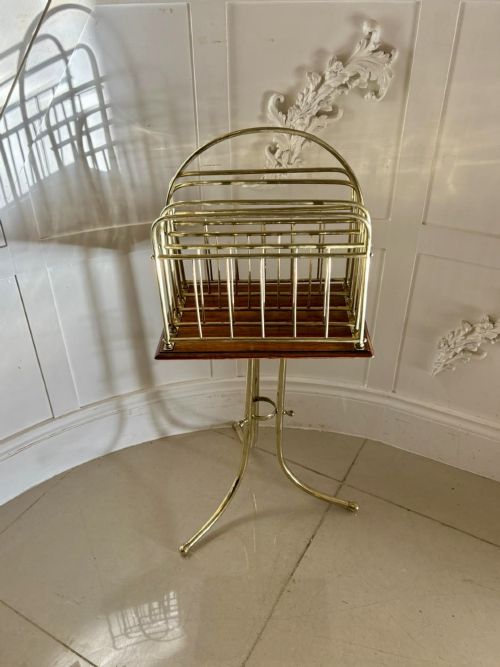
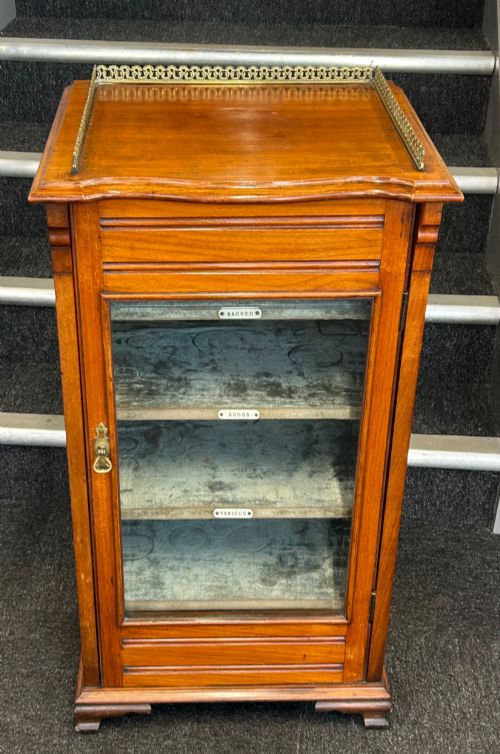
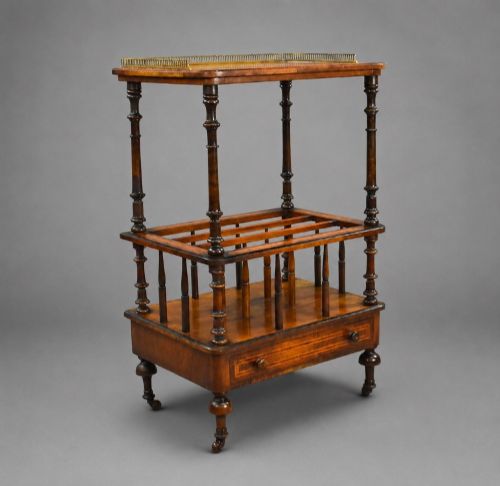


Edwardian Brass Canterbury
These pieces of edwardian brass canterbury unite utility with formal polish, offering a tidy place for periodicals and sheets.
Edwardian Brass Canterbury
An edwardian brass canterbury organises sheet music and periodicals within a domestic interior. These pieces frequently combine metal framework with timber structures like mahogany, walnut, and oak.
The selections available here range from revolving stands and traditional compartmentalised racks to standard lamps fitted with storage. Buyers encounter both compact music cabinets and larger floor models originating from the period.
Makers often integrated brass handles, rails, and casters to assist movement and protect the timber frames. The forms bridge the gap between late nineteenth-century Victorian design and twentieth-century practicality.
How They Were Made
Craftsmen shaped solid mahogany, walnut, and oak to form the main compartments, frequently applying burr walnut veneers and delicate marquetry inlays to the exterior surfaces. Brass rods and mounts provide structural support while adding metallic contrast to the dark timber.
Metal components such as brass carrying handles and revolving mechanisms required precise casting and fitting to ensure smooth operation. Glass panels and fabric linings occasionally appear in associated music cabinets and display pieces.
Some models double as lamp standards so readers could illuminate their sheet music while keeping journals within arm's reach.
What Varies in Quality
The distinction between standard examples and superior pieces rests on the choice of timber and the crispness of the brass fittings. Figured veneers and intricate inlay require greater skill than plain boards.
Rigidity in the revolving mechanisms and the weight of the cast brass base components determine the overall durability of the stand. Pieces retaining their original castors and undisturbed patination command greater attention.
The Edwardian Brass Canterbury Glossary
- Canterbury
- A low stand fitted with partitions for holding music sheets or loose publications, often mounted on castors. Originating in the eighteenth century, the form persisted well into the twentieth.
- Revolving
- Describing a rack or bookcase mounted on a central pivot mechanism allowing rotation. This design gave seated readers access to multiple compartments without moving the entire piece.
- Marquetry
- The art of forming decorative patterns on a wooden surface by fitting together thin slices of various timbers or veneers. It appears frequently on Victorian and Edwardian cabinet furniture.
- Burr Walnut
- Timber taken from a growth or burl on a walnut tree, yielding highly swirled and mottled grain patterns. Cabinetmakers sliced this wood into veneers for high-status furniture fronts.
Edwardian Brass Canterbury: Frequently Asked Questions
Where should I place a canterbury?
These stands suit sitting rooms and studies where periodicals or sheet music accumulate near seating areas. Their compact footprints allow them to sit beside armchairs or against panelled walls.
Revolving versions function well in open spaces where users can access the compartments from any angle. Care should be taken to keep them away from direct heat sources that might dry the timber.
How do I clean brass fittings?
Maintenance requires gentle dusting with a dry cloth to prevent the accumulation of grime on the metal surfaces. Strong chemical cleaners strip the aged patination that accumulates over decades.
Unlacquered brass benefits from occasional application of specialist metal polish applied carefully to avoid staining the surrounding wood. Timber elements need only a neutral wax to maintain their lustre.
Can these hold heavy books?
Most pieces were designed for lighter items such as sheet music, magazines, and weekly periodicals rather than heavy folios. Overloading the partitions can strain the vertical brass rods and timber joints.
Revolving stands handle moderate loads of publications distributed evenly across their compartments. Distributing weight symmetrically preserves the balance of the central pivot mechanism.
How do I identify the period?
Dating relies on observing timber choices, construction techniques, and decorative motifs such as inlay or brass casting styles. Edwardian pieces often display lighter woods and simpler lines than earlier Victorian iterations.
Archive records and physical evidence show that simpler forms persisted across decades with subtle shifts in hardware design. Examining the interior construction and fixing methods reveals the likely era of manufacture.