


Revolving Brass Stand
A revolving brass stand brings mechanical movement and metallic gleam to your room, serving as a practical display for books and magazines.
Revolving Brass Stand
A revolving brass stand is an adaptable piece of furniture designed to hold books, magazines, newspapers, or garments while offering a rotating mechanism. You will encounter these items spanning several distinct eras, from the Georgian period through the Victorian and Edwardian epochs up to the early twentieth century.
The forms vary widely across the inventory, encompassing revolving bookcases, library tables, magazine racks, newspaper stands, and hall stands for hats and coats. Mahogany, oak, and walnut frequently form the wooden chassis, whilst brass provides structural hardware, inlay, frames, and mountings.
Victorian examples dominate the selection alongside Edwardian interpretations, often combining polished hardwoods with gleaming metal components. Pieces range from compact tabletop book stands to substantial floor-standing furniture featuring specialised tiers for periodicals.
Materials and construction
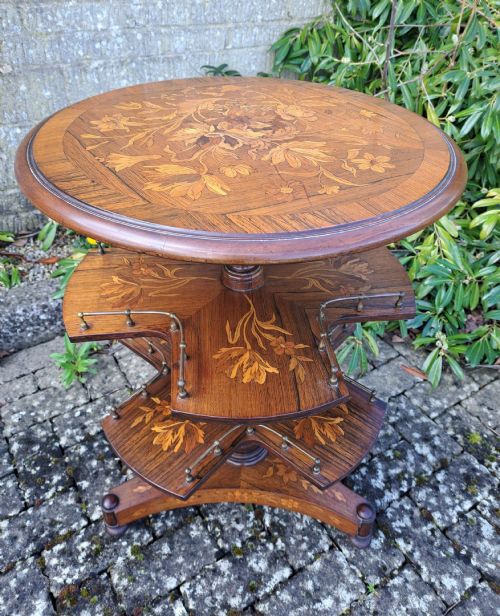
Cabinetmakers constructed the wooden frameworks using traditional timbers such as mahogany, oak, walnut, fruitwood inlay, kingwood, and occasionally marble tops or ormolu mounts. Solid brass or brass-plated components were integrated into the frames, columns, and revolving mechanisms to ensure durability during daily rotation.
Advanced joinery techniques allowed these stands to turn smoothly upon hidden pivots or ball-bearing systems housed within the base or central column. Surface decoration often included Dutch floral marquetry, intricate brass inlay, and polished wood finishes that highlighted the natural grain of the timber.
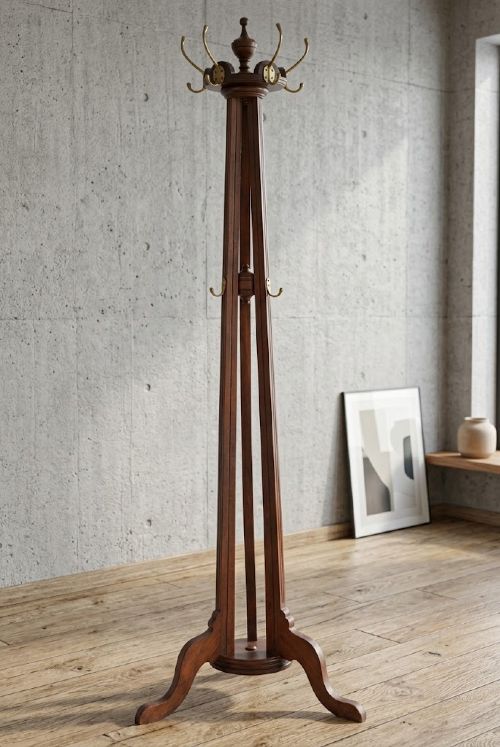
Some hall stands spin to let you grab your umbrella and hat with equal velocity.
Factors that define quality
The superiority of a revolving brass stand relies heavily on the engineering of its rotating mechanism and the weight of the materials employed. A high-grade example rotates silently and evenly without listing to one side, supported by substantial brass fittings and dense hardwoods rather than veneered softwoods.
Artisanal detail also separates finer pieces from standard production, such as precise fruitwood inlay, delicate ormolu mounts, or integrated marble tops. The crispness of the brass casting and the depth of the cabinetwork indicate the level of craftsmanship invested by the maker.
William Tonks & Sons
The Revolving Brass Stand Glossary
- Ormolu
- Gilded bronze or brass applied as a decorative mount on furniture. It adds a bright metallic accent to darker woods like mahogany and kingwood.
- Marquetry
- Inlaid wood designs creating pictorial or floral patterns on the surface. Dutch floral marquetry is a notable style seen on Georgian library tables.
- Kingwood
- A dense, richly figured exotic timber prized in fine cabinetmaking. It often appears alongside ormolu mounts on nineteenth-century pieces.
- Canterbury
- A partitioned stand originally designed for holding sheet music or books. These often feature carrying handles and slatted dividers.
- Hall stand
- A tall piece of furniture placed near an entrance to hold coats, hats, sticks, and umbrellas. Some versions incorporate revolving sections for accessibility.
Revolving Brass Stand: Frequently Asked Questions
What were revolving brass stands used for?
These stands functioned primarily as accessible storage for current reading material, sheet music, or outerwear in domestic interiors. Users could easily spin the tier to select a book or newspaper without shifting position.
In larger libraries and hallways, they kept heavy volumes or coats organised while adding an interactive element to the room's furniture layout.
How do I date a revolving stand?
Dating relies on examining the timber species, style of joinery, and the design of the brass hardware. Georgian and Regency pieces tend to feature rich mahogany and fine marquetry, whereas Victorian and Edwardian examples often utilise oak and incorporate brass framing for magazines.
Arts and Crafts pieces from the early twentieth century display simpler, sturdier lines with exposed metal construction. Maker marks or patent stamps on the revolving mechanism can also narrow down the era of manufacture.
Are these stands suitable for modern homes?
Their compact footprints and functional designs make them well suited for organising books and periodicals in contemporary living spaces. The combination of warm wood and polished brass complements both traditional and eclectic interiors.
Floor-standing magazine racks and tabletop bookcases serve as practical display units that occupy minimal floor space while offering daily utility.
How should I maintain the brass and wood?
Maintenance involves dusting the wooden surfaces regularly with a soft cloth and occasionally applying appropriate furniture wax to nourish the grain. Brass elements can be kept clean by gently wiping away dust, avoiding harsh chemical polishes that might strip the antique patina.
Keep the revolving mechanism lightly lubricated if necessary to ensure smooth, silent movement during use.