
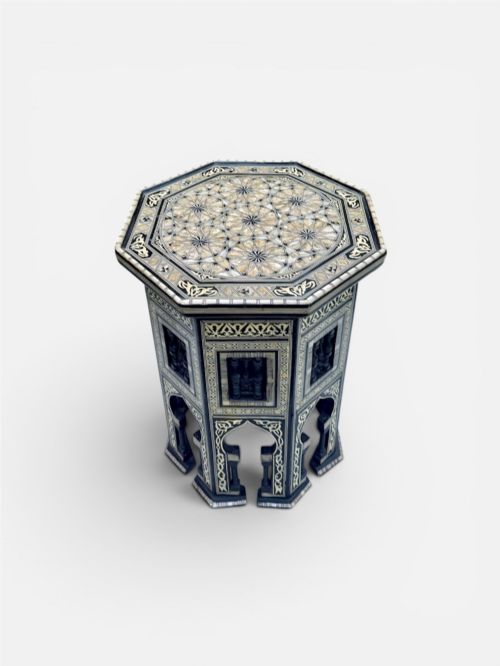
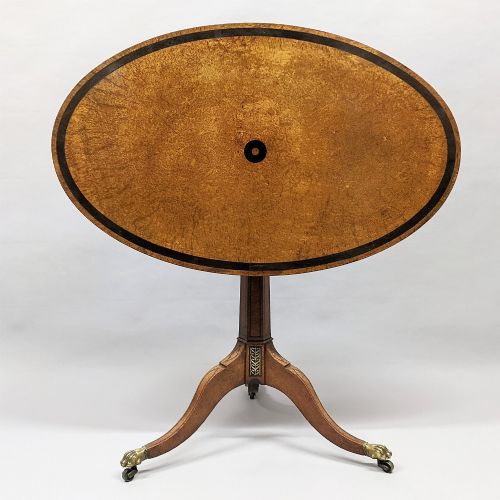


Ebony Inlaid Side Table
An ebony inlaid side table brings dark contrasting timber and crisp stringing into a room, offering a functional surface with striking geometric detail.
Ebony Inlaid Side Table
When you search for an ebony inlaid side table, you encounter a variety of forms including occasional, centre, card and writing tables spanning the nineteenth century to the early twentieth century.
The version you are most likely to meet on this page is a mahogany, satinwood or rosewood table featuring contrasting dark ebony stringing, banding or pictorial inlay.
Geographic origins vary widely across the selection, ranging from Regency workshops in Britain and French Parisian makers to Anglo-Indian colonial studios and nineteenth century Ceylonese workshops.
Distinctions in craftsmanship and design
The top of the range is distinguished by the precision of the inlay work, where every piece of ebony and bone sits flush without gaps and grain patterns in the primary timber are chosen with care.
Structural integrity and original surface patination separate fine examples from heavily restored or later pieces, particularly where delicate stringing or hinged mechanisms have survived intact over centuries.
Listings feature pieces spanning the sixteenth to the twentieth centuries, utilising materials from bone and brass to mahogany and ebony.
Gillows·George Oakley·Maison Millet
The Ebony Inlaid Side Table Glossary
- Banding
- A narrow strip of contrasting timber veneer inlaid around the border of a table top. This technique creates a distinct frame that highlights the main field of the wood.
- Stringing
- Very thin lines of inlay inserted into channels cut into the surface of furniture. It typically outlines drawers, legs and table tops with sharp linear contrast.
- Occasional table
- A small, movable table designed for specific, intermittent uses rather than a fixed central place in a room. These pieces appear frequently in various nineteenth-century styles.
- Tilt top
- A table top mounted on a mechanism allowing it to pivot vertically when not in use. This design saved space in smaller rooms during the Regency and Victorian periods.
- Etagere
- A freestanding set of open shelves supported by columns or slender legs. It functions as a tiered display surface for small decorative objects.
Ebony Inlaid Side Table: Frequently Asked Questions
Where should I place an occasional table?
An occasional table suits smaller spaces where a flexible surface is useful, such as beside a seating area or in a hallway.
Its compact footprint allows it to function as a lamp stand or a display platform without crowding the room.
How do I care for antique wood surfaces?
Maintain the timber by keeping the table away from direct heat sources and sudden humidity changes that cause wood to crack.
Apply traditional wax polish occasionally to nourish the grain and protect the delicate inlaid ebony and stringing details.
How do I identify a Regency period table?
Regency tables often display classical restraint, incorporating mahogany or satinwood paired with precise ebony stringing and brass mounts.
Proportions tend to be clean and architectural, drawing inspiration from neoclassical design motifs popular in the early nineteenth century.