
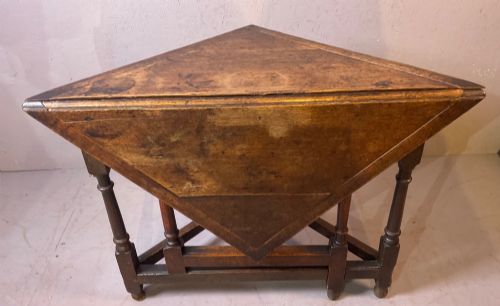
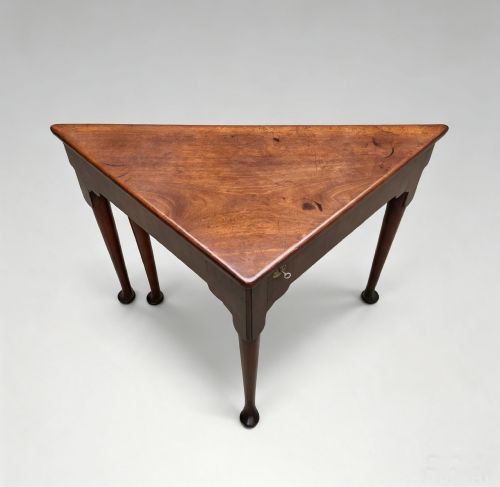


Triangular Folding Table
These triangular folding table pieces are clever space-saving designs, offering hinged leaves and polished timber surfaces that suit a corner or centre spot.
Triangular Folding Table
A triangular folding table is a versatile surface configuration that pivots, drops, or hinges to fit snugly into corners or open up for cards, tea, and supper. When you search for a triangular folding table, you encounter diverse forms ranging from seventeenth-century oak credence pieces to Georgian mahogany corner tables and Edwardian rosewood occasional designs.
The pieces appearing on this page span several centuries, highlighting forms such as card tables, side tables, console tables, and occasional tables. These clever items often utilise clever drop leaf or trifold mechanisms, transforming from compact triangular footprints into larger square or rectangular surfaces.
Originating across periods including Georgian, Victorian, and Edwardian eras, these tables demonstrate how historic cabinetmakers solved domestic space constraints. You will most frequently meet mahogany and rosewood examples finished with inlaid details or carved edges.
Materials and construction
Cabinetmakers constructed these folding tables primarily using dense hardwoods such as mahogany, oak, and rosewood, ensuring the hinged leaves and gate legs remained stable under regular use. Fruitwood, boxwood, and ebony often appear alongside satinwood inlay to create contrasting borders and geometric patterns.
The construction relies heavily on precise joinery to support the folding mechanisms, whether a trifold drop leaf, a pivoting top, or traditional gate leg supports. Brass hinges and fittings frequently secure the movable leaves, allowing the triangular tops to open smoothly.
Some clever Georgian designs masquerade as innocent corner tables until their hidden leaves swing open to reveal a full card surface.
Assessing quality and craftsmanship
The distinction between standard examples and superior pieces rests on the precision of the timber matching and the intricacy of the inlay work. Finer tables exhibit seamless grain continuity across the folding leaves and crisp, unblemished satinwood or ebony stringing.
Structural integrity in the hinge mechanisms and the smoothness of the folding action define the better pieces in this range. A superior table maintains absolute rigidity when open, without sagging at the unsupported corners.
The Triangular Folding Table Glossary
- Credence table
- A folding or pivoting table with a hinged top supported by a swinging leg, originating in earlier centuries. These pieces often feature solid oak construction.
- Drop leaf table
- A table with a fixed central section and hinged flaps that fold down at the sides. Raising the leaves and engaging swing brackets enlarges the usable surface.
- Card table
- A specialised folding table designed for gaming, frequently lined with baize or featuring coin wells and candle corners. Georgian and Victorian makers produced numerous variations of this form.
- Marquetry
- Decorative veneer work created by fitting small pieces of various woods, such as satinwood and ebony, into patterns. Dutch and English cabinetmakers utilised this technique on tabletop surfaces.
- Gate leg table
- A table with legs hinged to swing outward like a gate, providing direct support for drop leaves when raised. This sturdy framework is common in seventeenth and eighteenth-century examples.
Triangular Folding Table: Frequently Asked Questions
What is a triangular folding table used for?
These tables served multiple domestic purposes throughout history, functioning primarily as convenient surfaces for card games, tea service, or supper dining. Their clever folding mechanisms allowed households to expand a compact corner console into a larger table when guests arrived.
Today, they remain practical for modern interiors as decorative occasional pieces or functional corner desks. Their ability to fold flat against a wall or tuck into an unused corner makes them exceptionally adaptable.
How do I identify the period of a table?
Dating relies on observing the primary timber used, the style of the legs, and the complexity of any decorative inlay. Seventeenth and early eighteenth-century pieces typically feature solid oak with simple gate leg frames, while Georgian examples often showcase carved mahogany.
Victorian and Edwardian pieces frequently incorporate exotic woods like rosewood alongside intricate satinwood stringing or Aesthetic Movement details. Examining the hinges and construction methods inside the folding leaf mechanism also clarifies the manufacturing era.
Where should I place a folding table at home?
A triangular folding table fits naturally into awkward corners where standard rectangular furniture cannot go. Placing one in a hallway or landing provides a convenient surface for decorative objects or displaying flowers without obstructing movement.
Alternatively, keeping the leaves folded down against a living room wall creates a subtle console surface that opens up instantly when extra table space is needed. Their dual nature allows them to act as subtle wall fixtures or centre stage occasional pieces.
Are these tables sturdy enough for daily use?
Historic folding tables were built by skilled cabinetmakers using dense hardwoods designed to withstand frequent opening and closing. The structural stability depends on the soundness of the gate legs and the brass hinges supporting the leaves.
While antique pieces require sensible care and avoidance of excessive weight on unsupported corners, they remain fully functional for daily domestic activities such as writing or holding lamps.