




Ebonised Pendulum Wall Clock
An ebonised pendulum wall clock brings dark timber warmth and mechanical precision to a room, drawing the eye instantly to the steady swing of the brass bob.
Ebonised Pendulum Wall Clock
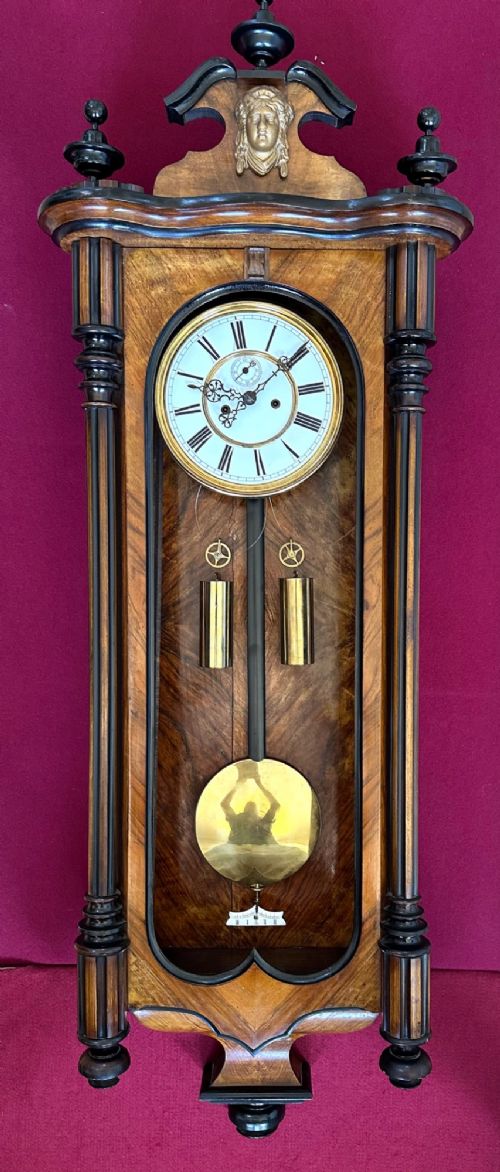
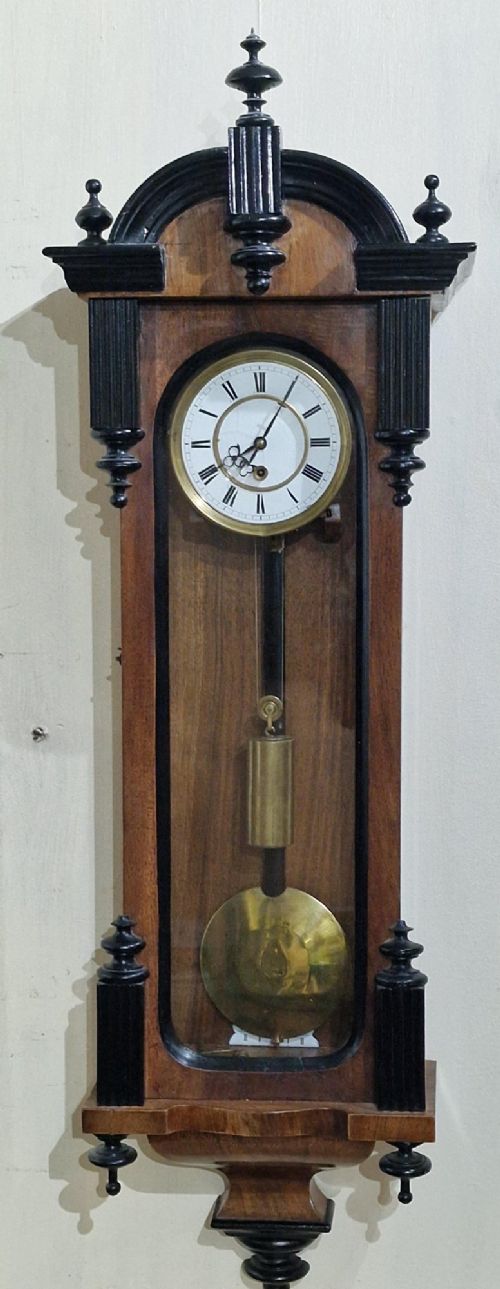
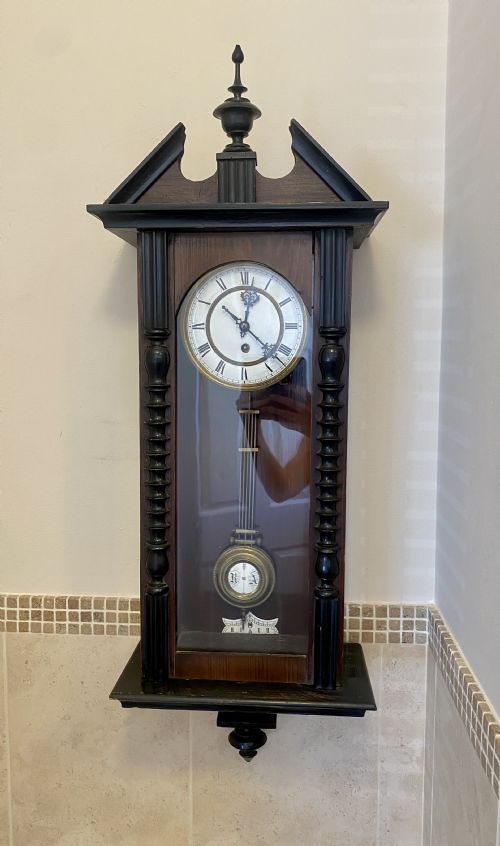
An ebonised pendulum wall clock is a timepiece designed to be hung upon a wall, featuring a case darkened to resemble ebony and a swinging pendulum that regulates the movement. These pieces primarily date from the nineteenth century, spanning Victorian Britain, Austria, and France, with forms ranging from simple timepieces to complex Vienna regulators and ornate French designs.
The buyer meets several distinct styles upon this page, most notably the Vienna regulator and the French wall clock. Vienna regulators often display tall, glazed cases in walnut and ebonised wood housing month or eight-day movements, whilst French examples introduce inlaid brass wire, mother of pearl, and papier-mache into the dark timber surrounds.
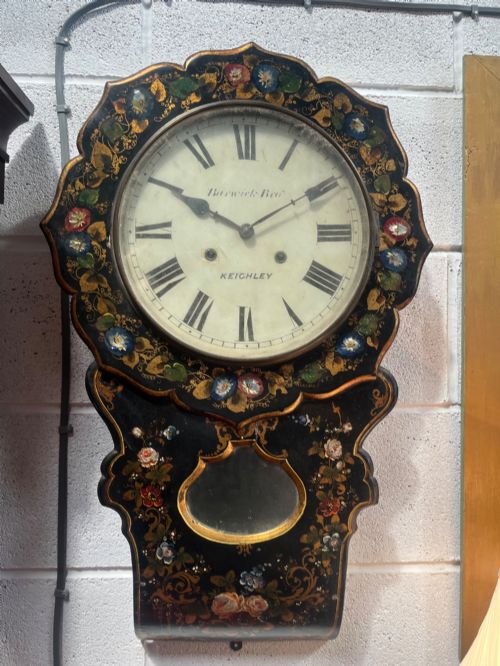
Originating largely from the mid to late nineteenth century, specifically between eighteen fifty and eighteen eighty, these wall clocks reflect the diverse aesthetic tastes of the period. One encounters simple painted dials alongside grand sonnerie striking mechanisms, demonstrating that makers adapted the ebonised case to suit both modest domestic interiors and formal reception rooms.
Materials and construction
The construction relies heavily upon timber carcasses treated with ebonising agents to achieve a deep black finish, frequently contrasted with warm walnut veneers. Makers incorporated glass panels within hinged doors to protect the dial and reveal the swinging pendulum, whilst brass and ormolu provided structural movements and decorative mounts.
Dials were commonly produced from white enamel with painted Roman or Arabic numerals, though some models featured brass chapter rings or painted metal decorations. Inlays of mother of pearl and metal wire were applied directly into the dark wooden surfaces, requiring considerable precision from the nineteenth-century artisan.
The documented examples span the Victorian period and the wider nineteenth century, encompassing both French and Austrian origins.
Distinctions in craftsmanship
Quality rests upon the sophistication of the movement and the integrity of the case construction. Higher-tier examples house month-duration or grande sonnerie movements requiring complex gearing, as opposed to standard eight-day timepieces.
The execution of surface decoration separates ordinary production from finer work. The crispness of brass wire inlay, the stability of the ebonised and walnut veneers, and the finish applied to the brass pendulum bob distinguish the workshop standards of the period.
Henri Marc of Paris·Gustof Becker
The Ebonised Pendulum Wall Clock Glossary
- Ebonised wood
- Timber treated with stain or paint to imitate true ebony. This finish was widely utilised during the nineteenth century to create a dramatic contrast with brass and enamel dials.
- Vienna Regulator
- A precision wall clock originating from Austria, characterised by a long glass door and a weight-driven movement. These clocks are known for their exceptional timekeeping accuracy and refined case design.
- Grande Sonnerie
- A striking mechanism that sounds both the hours and the quarters automatically. This complex complication indicates a higher grade of clockmaking craftsmanship.
- Two train
- A clock movement driven by two separate power sources, one for the timekeeping train and another for the striking train. This layout allows the clock to chime hours or melodies.
- Ormolu
- Gilded bronze used for decorative mounts and accents on nineteenth-century clock cases. The technique involves applying a mercury and gold amalgam to bronze.
Ebonised Pendulum Wall Clock: Frequently Asked Questions
How do I wind an ebonised pendulum wall clock?
Winding requires a matching key inserted into the winding holes on the enamel dial, turning gently until resistance is met. Care must be taken not to overwind the mainspring or damage the movement.
For weight-driven Vienna regulators, the weights must be carefully pulled back up to the top of the case using the winding chain or cord. Ensuring the pendulum is stationary during this process prevents disruption to the delicate escapement.
Where should I hang a wall clock?
An ebonised pendulum wall clock needs a sturdy internal wall capable of supporting the weight of the timber case and movement. Exterior walls subject to dampness or temperature fluctuations should be avoided.
The location must provide a completely flat surface so the case hangs plumb, allowing the pendulum to swing evenly without catching against the backboard or glass door.
How do I set the correct time?
The minute hand is moved gently clockwise to the correct hour, allowing the strike train to complete its sequence at each interval. Moving hands anti-clockwise risks damaging the internal rack and snail mechanism.
After setting the hands, the pendulum is nudged gently to one side to start its motion. Adjusting the small nut beneath the pendulum bob regulates the speed if the clock gains or loses time.